Romanticism: Artists A-Z

110 artists in our catalogue; each name opens the artist's page with all prints.

Art history: Romanticism

Romanticism was the movement that, from the 1790s to about 1850, set feeling, imagination and the power of nature against the reason of the Enlightenment and the rules of Neoclassicism. In painting it brought storms, mountains and seas, medieval legend, exotic places and the violent events of its own day, rendered with free brushwork and strong color. It grew out of the upheavals that followed the French Revolution and out of unease with the new industrial world. In the 1790s the brothers August Wilhelm and Friedrich Schlegel spoke of romantic poetry, meaning the spirit of medieval romance as opposed to classical antiquity. Only from the 1820s did the movement generally call itself by that name.

Romantic painters sought the sublime, the mixture of awe and fear felt before overwhelming nature. Landscape, long ranked low in the academic hierarchy of genres, became a vehicle for serious emotion. Figures are often small or seen from behind, light breaks through cloud and mist, and paint is laid on in visible strokes and thick impasto instead of the smooth Neoclassical finish. The change appeared first in British landscapes, where from the 1760s artists turned to wild scenery and storms.

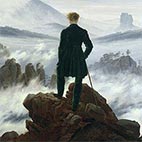
In Germany, Caspar David Friedrich (1774-1840) set lone figures, crosses or ruins in vast landscapes as signs of faith and of the brevity of life. In The Monk by the Sea (1808-1810, Alte Nationalgalerie, Berlin) a tiny figure stands on an empty shore beneath an immense sky. The Wanderer above the Sea of Fog (about 1818, Hamburger Kunsthalle) turns his back to us on a rocky summit. Friedrich held that the painter’s own feeling should be his law. Philipp Otto Runge developed a mystical symbolism of color and flowers. From 1810 the Nazarenes, German painters living as a brotherhood in a former monastery in Rome, revived the clear outlines of medieval and early Renaissance religious art.

In Britain, Henry Fuseli’s The Nightmare (1781, Detroit Institute of Arts) caused a stir at the Royal Academy in 1782, and William Blake replaced classical proportion with his own visionary figures. J. M. W. Turner (1775-1851) dissolved armies, ships and trains in light, spray and steam, as in Rain, Steam and Speed (1844, National Gallery, London). John Constable (1776-1837) gave the working countryside of his native Suffolk the large format of his six-footers, claiming for landscape the dignity of history painting. The Hay Wain (1821, National Gallery, London) won a gold medal at the Paris Salon of 1824 and impressed young French painters.

In Spain, Francisco de Goya (1746-1828) remained a man of the Enlightenment, yet he gave free rein to private nightmares more than any painter of his time. His etchings Los Caprichos (1799) attack superstition and folly with witches and monsters. The Third of May 1808 (1814, Prado, Madrid) shows French soldiers shooting Madrid civilians at night, the victim in a white shirt lit by a single lantern. Late in life he covered the walls of his house outside Madrid with the dark, thickly painted Black Paintings (1819-1823, now in the Prado).

In France the academies kept Neoclassicism strong, but under Napoleon new themes crept in. When Anne-Louis Girodet painted Ossian Receiving the Ghosts of the French Heroes (1802, Château de Malmaison), his teacher David remarked that either Girodet was mad or he himself no longer understood painting. Théodore Géricault (1791-1824) based The Raft of the Medusa (1818-1819, Louvre) on the wreck of a French frigate in 1816, a scandal for the restored monarchy. He questioned survivors, had a model of the raft built and studied corpses before showing the huge canvas at the Salon of 1819. A pyramid of dying and desperate men rises toward a tiny ship on the horizon.

Eugène Delacroix (1798-1863) became the leader of the French Romantics. The Massacre at Chios (1824, Louvre) showed an episode of the Greek War of Independence in the year Lord Byron died in that cause. The Death of Sardanapalus (1827, Louvre), taken from a play by Byron, swirls with nude women, horses and jewels in hot reds. Liberty Leading the People (1830, Louvre) turns the July Revolution in Paris into an allegory, with a bare-breasted Liberty carrying the tricolor over the barricade. After a journey to Morocco in 1832 he painted North African scenes in glowing color, and critics set his color against the line of Ingres.

Romanticism took national forms elsewhere. In Russia, Karl Bryullov painted The Last Day of Pompeii (1830-1833, Russian Museum, St. Petersburg), and Ivan Aivazovsky specialized in raging seas, as in The Ninth Wave (1850, Russian Museum). In Milan, Francesco Hayez joined history and sentiment, as in The Kiss (1859, Pinacoteca di Brera). In America, Thomas Cole and the Hudson River School celebrated untamed landscape; Cole’s four-part Voyage of Life (1842, National Gallery of Art, Washington) follows a man along a river from childhood to old age. Around 1850 Realism, led in France by Gustave Courbet, turned painters toward ordinary life, though Romantic subjects and effects lived on in academic and popular art.

Agasse, Jacques-Laurent (1767-1849) Aivazovsky, Ivan Konstantinovich (1817-1900) Allston, Washington (1779-1843) Audubon, John James (1785-1851) Bamberger, Fritz (1814-1873) Barber, Charles Burton (1845-1894) Barraband, Jacques (c.1767-1809) Bejarano, Antonio Cabral (1798-1861) Bierstadt, Albert (1830-1902) Birch, Thomas (1779-1851) Blake, William (1757-1827) Blanes, Juan Manuel (1830-1901) Bonington, Richard Parkes (1802-1828) Bradford, William (1823-1892) Bricher, Alfred Thompson (1837-1908) Carr, Samuel (1837-1908) Christy, Howard Chandler (1872-1952) Church, Frederic Edwin (1826-1900) Clairin, Georges (1843-1919) Cole, Thomas (1801-1848) Colman, Samuel (1832-1920) Constable, John (1776-1837) Copley, John Singleton (1738-1815) Corrodi, Hermann David Salomon (1844-1905) Cropsey, Jasper Francis (1823-1900) Delacroix, Eugène (1798-1863) Doré, Gustave (1832-1883) Downman, John (c.1750-1824) Duncanson, Robert Scott (1821-1872) Durand, Asher Brown (1796-1886) Durrie, George Henry (1820-1863) Elsley, Arthur John (1860-1952) Friedrich, Caspar David (1774-1840) Fuseli, Henry (1741-1825) Gifford, Sanford Robinson (1823-1880) Gignoux, Régis-François (1814-1882) Gould, John (1804-1881) Goya, Francisco de (1746-1828) Hackert, Jacob Philippe (1737-1807) Harnett, William Michael (1848-1892) Hart, James McDougal (1828-1901) Heade, Martin Johnson (1819-1904) Healy, George (1813-1894) Heard, Joseph (1799-1859) Hicks, Edward (1780-1849) Hildebrandt, Eduard (1818-1869) Hone, Nathaniel (1718-1784) Inness, George (1825-1894) Jones, George (1786-1869) Kensett, John Frederick (1816-1872) Koekkoek, Barend Cornelis (1803-1862) Koller, Rudolf (1828-1905) Krieghoff, Cornelius (1815-1872) Kruseman, Frederik Marinus (1816-1882) Lacroix, Paul (1827-1869) Lane, Fitz Henry (1804–1865) Larsson, Carl (1853-1919) Laurence, Sydney (1865-1940) Lawrence, Sir Thomas (1769-1830) Leutze, Emanuel Gottlieb (1816-1868) Linton, William (1791-187) Loutherbourg, Philip James de (1740-1812) Maignan, Albert (1845-1908) Martens, Conrad (1801-1878) Martin, Homer Dodge (1836-1897) Michel, Georges (1763-1843) Moran, Thomas (1837-1926) Morse, Samuel F.B. (1791-1872) Mount, William Sidney (1807-1868) Nerly, Friedrich von (1807-1878) O'Brien, Lucius Richard (1832-1899) Olivier, Herbert Arnould (1861-1952) Os, Georgius Jacobus Johannes van (1782-1861) Overbeck, Johann Friedrich (1789-1869) Partridge, John (1789-1872) Pickersgill, Henry William (1782-1875) Quadrone, Giovanni Battista (1844-1898) Ranney, William Tylee (1813-1857) Redouté, Pierre-Joseph (1759-1840) Reinhold, Heinrich (1788-1825) Richards, William Trost (1833-1905) Roberts, David (1796-1864) Robinson, John (1715-1745) Ronner-Knip, Henriëtte (1821-1909) Rottmann, Carl (1797-1850) Royer, Lionel (1852-1926) Salmon, Robert (c.1775-c.1845) Schendel, Petrus van (1806-1870) Schotel, Petrus Johannes (1808-1865) Schotel, Johannes Christiaan (1787-1838) Seymour, James (c.1702-1752) Sonntag, William Louis (1822-1900) Spitzweg, Carl (1808-1885) Stieler, Joseph Karl (1781-1858) Stuart, Gilbert (1755-1828) Stubbs, George (1724-1806) Sully, Thomas (1783-1872) Tayler, Albert Chevallier (1862-1925) Turner, Joseph Mallord William (1775-1851) Vernet, Claude-Joseph (1714-1789) Volaire, Pierre-Jacques (1729-c.1802) Volpe, Alessandro La (1819-1887) Weguelin, John Reinhard (1849-1927) Weitsch, Friedrich Georg (1758-1828) Whittredge, Thomas Worthington (1820-1910) Wilson, Richard (1714-1782) Wolf, Caspar (1735-1783) Wolf, Joseph (1820-1899) Wright of Derby, Joseph (1734-1797) Wyant, Alexander Helwig (1836-1892)
Back to top