
Georges de La Tour Giclée Fine Art Prints 1 of 2
1593-1652
French Baroque Painter
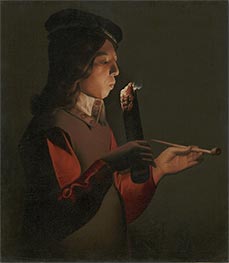
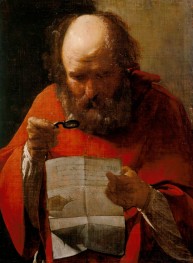
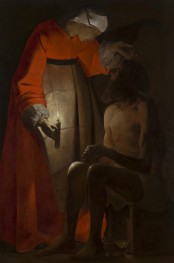
A single candle flame, often shielded by a cupped hand or a sheet of paper, holds the entire weight of the world in the paintings of Georges de La Tour. Born on 13 March 1593 in Vic-sur-Seille and dying on 30 January 1652 in Lunéville, this French Baroque painter transformed the dramatic tenebrism he inherited from the Caravaggesque tradition into something quieter, more devotional, and more mysterious than almost any of his contemporaries achieved. He was, in his time, celebrated; after his death, forgotten for nearly three centuries.
The town of his birth lay in the Diocese of Metz, technically Holy Roman Empire territory but ruled by France since 1552 - a borderland sensibility that would mark his work. His father Jean de La Tour was a baker, his mother Sybille Molian came, some scholars have suggested, from partly noble stock. Georges was the second of seven children. Nothing is recorded of his earliest artistic training, though it is thought he may have travelled to Italy or the Netherlands before 1616, absorbing there the new pictorial language radiating out of Rome in the wake of Caravaggio's death.
Some have proposed that he studied in Nancy under Jacques Bellange, the elegant Mannerist court painter of Lorraine. The stylistic evidence is thin - their sensibilities could hardly be more different - but the geographic logic is plausible. What is certain is that by 1617 he had married Diane Le Nerf, a young woman of minor noble rank, and by 1620 he had settled his household and studio in her provincial hometown of Lunéville, capital of the Duchy of Lorraine. There he would live and work for the rest of his life.
Lorraine in the early seventeenth century was not quite France and not quite Empire - an independent duchy that France would absorb, briefly, between 1641 and 1648. La Tour navigated these political tides with evident skill. In 1623 and 1624 he executed paintings for the Dukes of Lorraine. By 1638 he held the title "Painter to the King" of France, a mark of genuine status. Yet he remained rooted in Lunéville, where the town's bourgeoisie - prosperous, pious, quietly ambitious - formed his principal clientele. He grew moderately wealthy.
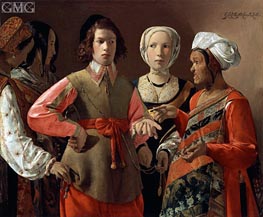
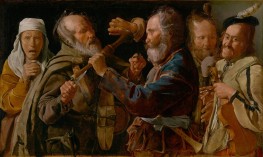
His early output owes much to the Northern Caravaggisti, those Dutch painters of Utrecht - Hendrick Terbrugghen most prominent among them - who had returned from Rome with a passion for low-life subjects rendered under a slanting, theatrical light. The Fortune Teller, with its elegantly deceived young gentleman being fleeced by a band of gypsies, belongs to this world. So too does The Musicians' Brawl, now at the Getty Museum, a rough and vital tangle of hurdy-gurdy players caught mid-scuffle, painted around 1625 to 1630. These are works of keen social observation, touched with a dry humour and a painter's delight in the textures of cloth and skin.
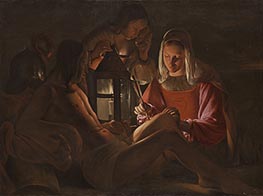
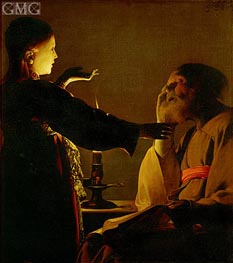
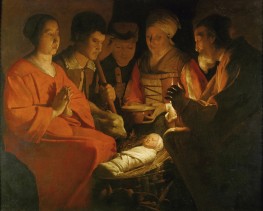
Then, perhaps in the 1640s, something changed. Whether driven by the Franciscan religious revival then sweeping Lorraine, or by an undocumented journey that scholars including Anthony Blunt have suspected (Blunt detected the influence of Gerrit van Honthorst in the later work), the art of La Tour turned inward. He disappears from the Lunéville records between 1639 and 1642. When his paintings reappear, they are transfigured. Gone are the tavern scenes and the cheats. In their place: saints in meditation, the Virgin at prayer, the Christ Child held up to the light by his mother. The candle becomes almost the subject itself.
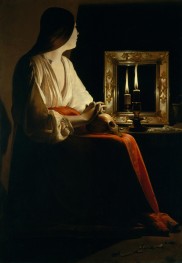
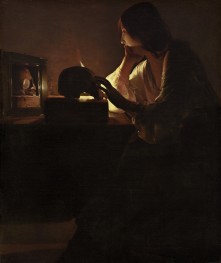
Magdalene with Two Flames, now in the Metropolitan Museum of Art and painted around 1640, shows the penitent saint seated before a mirror, her hand resting on a skull, watching the flame and its reflection. Nothing moves. Nothing needs to. The geometry is austere, the palette narrowed to ochres and deep reds, the forms simplified almost to the point of abstraction. Caravaggio had used chiaroscuro for drama; La Tour uses it for stillness. That is the distinction that matters.
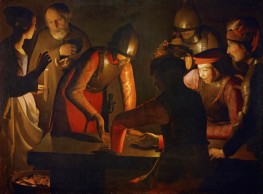
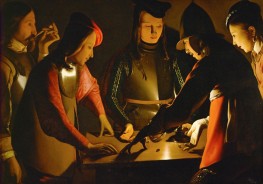
He often repeated his own compositions, sometimes with small variations, and his surviving oeuvre remains relatively compact. His son Étienne, born in 1621, worked in his studio and continued in his manner; the Education of the Virgin in the Frick Collection is one of several paintings whose attribution wavers between father and son. A further group of candlelit canvases showing solitary older figures - beggars, saints, a few women - has been gathered under the name of an unidentified Hurdy-gurdy Master. Dice-players, now at Preston Hall Museum in Stockton-on-Tees and probably painted in 1651, may be his last work. Four men bend over a gaming table in hushed concentration, lit by a single flame. It has the quality of a whispered prayer.
In 1652 an epidemic swept through Lunéville. It took Georges de La Tour, his wife, and several members of their household. Within a generation his name had all but vanished from the historical record. Some of his paintings were reattributed to Vermeer during the Dutch master's own nineteenth-century rediscovery - an eloquent confusion, given their shared reverence for light. It was not until 1915 that the German art historian Hermann Voss began the work of returning La Tour to his proper place in the canon.
His reputation now stands secure, though there remains about the work a deliberate reticence that resists easy possession. Writers as varied as René Char, André Malraux, Pascal Quignard, and Charles Juliet have been drawn to the paintings for the silence within them. Perhaps this is why La Tour matters now, in an age of incessant noise and image: he painted figures who are simply present, illuminated by something small and easily extinguished, and their attention to that small light feels - for anyone who stops long enough to look - like a kind of instruction.
The town of his birth lay in the Diocese of Metz, technically Holy Roman Empire territory but ruled by France since 1552 - a borderland sensibility that would mark his work. His father Jean de La Tour was a baker, his mother Sybille Molian came, some scholars have suggested, from partly noble stock. Georges was the second of seven children. Nothing is recorded of his earliest artistic training, though it is thought he may have travelled to Italy or the Netherlands before 1616, absorbing there the new pictorial language radiating out of Rome in the wake of Caravaggio's death.
Some have proposed that he studied in Nancy under Jacques Bellange, the elegant Mannerist court painter of Lorraine. The stylistic evidence is thin - their sensibilities could hardly be more different - but the geographic logic is plausible. What is certain is that by 1617 he had married Diane Le Nerf, a young woman of minor noble rank, and by 1620 he had settled his household and studio in her provincial hometown of Lunéville, capital of the Duchy of Lorraine. There he would live and work for the rest of his life.
Lorraine in the early seventeenth century was not quite France and not quite Empire - an independent duchy that France would absorb, briefly, between 1641 and 1648. La Tour navigated these political tides with evident skill. In 1623 and 1624 he executed paintings for the Dukes of Lorraine. By 1638 he held the title "Painter to the King" of France, a mark of genuine status. Yet he remained rooted in Lunéville, where the town's bourgeoisie - prosperous, pious, quietly ambitious - formed his principal clientele. He grew moderately wealthy.
His early output owes much to the Northern Caravaggisti, those Dutch painters of Utrecht - Hendrick Terbrugghen most prominent among them - who had returned from Rome with a passion for low-life subjects rendered under a slanting, theatrical light. The Fortune Teller, with its elegantly deceived young gentleman being fleeced by a band of gypsies, belongs to this world. So too does The Musicians' Brawl, now at the Getty Museum, a rough and vital tangle of hurdy-gurdy players caught mid-scuffle, painted around 1625 to 1630. These are works of keen social observation, touched with a dry humour and a painter's delight in the textures of cloth and skin.
Then, perhaps in the 1640s, something changed. Whether driven by the Franciscan religious revival then sweeping Lorraine, or by an undocumented journey that scholars including Anthony Blunt have suspected (Blunt detected the influence of Gerrit van Honthorst in the later work), the art of La Tour turned inward. He disappears from the Lunéville records between 1639 and 1642. When his paintings reappear, they are transfigured. Gone are the tavern scenes and the cheats. In their place: saints in meditation, the Virgin at prayer, the Christ Child held up to the light by his mother. The candle becomes almost the subject itself.
Magdalene with Two Flames, now in the Metropolitan Museum of Art and painted around 1640, shows the penitent saint seated before a mirror, her hand resting on a skull, watching the flame and its reflection. Nothing moves. Nothing needs to. The geometry is austere, the palette narrowed to ochres and deep reds, the forms simplified almost to the point of abstraction. Caravaggio had used chiaroscuro for drama; La Tour uses it for stillness. That is the distinction that matters.
He often repeated his own compositions, sometimes with small variations, and his surviving oeuvre remains relatively compact. His son Étienne, born in 1621, worked in his studio and continued in his manner; the Education of the Virgin in the Frick Collection is one of several paintings whose attribution wavers between father and son. A further group of candlelit canvases showing solitary older figures - beggars, saints, a few women - has been gathered under the name of an unidentified Hurdy-gurdy Master. Dice-players, now at Preston Hall Museum in Stockton-on-Tees and probably painted in 1651, may be his last work. Four men bend over a gaming table in hushed concentration, lit by a single flame. It has the quality of a whispered prayer.
In 1652 an epidemic swept through Lunéville. It took Georges de La Tour, his wife, and several members of their household. Within a generation his name had all but vanished from the historical record. Some of his paintings were reattributed to Vermeer during the Dutch master's own nineteenth-century rediscovery - an eloquent confusion, given their shared reverence for light. It was not until 1915 that the German art historian Hermann Voss began the work of returning La Tour to his proper place in the canon.
His reputation now stands secure, though there remains about the work a deliberate reticence that resists easy possession. Writers as varied as René Char, André Malraux, Pascal Quignard, and Charles Juliet have been drawn to the paintings for the silence within them. Perhaps this is why La Tour matters now, in an age of incessant noise and image: he painted figures who are simply present, illuminated by something small and easily extinguished, and their attention to that small light feels - for anyone who stops long enough to look - like a kind of instruction.
45 Georges de La Tour Artworks
Page 1 of 2
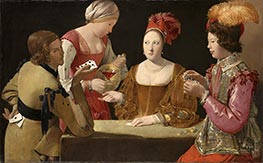
Giclée Canvas Print
$64.30
$64.30
SKU: 17591-GDT
Georges de La Tour
Original Size:97.8 x 156.2 cm
Kimbell Art Museum, Fort Worth, USA
Georges de La Tour
Original Size:97.8 x 156.2 cm
Kimbell Art Museum, Fort Worth, USA
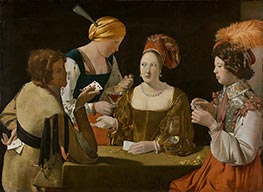
Giclée Canvas Print
$71.23
$71.23
SKU: 19163-GDT
Georges de La Tour
Original Size:106 x 146 cm
Louvre Museum, Paris, France
Georges de La Tour
Original Size:106 x 146 cm
Louvre Museum, Paris, France
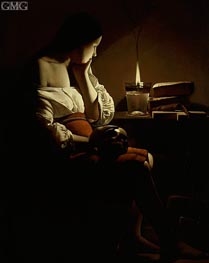
Giclée Canvas Print
$77.08
$77.08
SKU: 4600-GDT
Georges de La Tour
Original Size:117 x 91.7 cm
Los Angeles County Museum of Art, California, USA
Georges de La Tour
Original Size:117 x 91.7 cm
Los Angeles County Museum of Art, California, USA
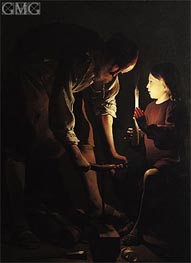
Giclée Canvas Print
$71.23
$71.23
SKU: 11460-GDT
Georges de La Tour
Original Size:137 x 102 cm
Louvre Museum, Paris, France
Georges de La Tour
Original Size:137 x 102 cm
Louvre Museum, Paris, France
Giclée Canvas Print
$72.82
$72.82
SKU: 17592-GDT
Georges de La Tour
Original Size:104.8 x 139.4 cm
Kimbell Art Museum, Fort Worth, USA
Georges de La Tour
Original Size:104.8 x 139.4 cm
Kimbell Art Museum, Fort Worth, USA
Giclée Canvas Print
$86.12
$86.12
SKU: 13566-GDT
Georges de La Tour
Original Size:93 x 81 cm
Musee des Beaux Arts, Nantes, France
Georges de La Tour
Original Size:93 x 81 cm
Musee des Beaux Arts, Nantes, France
Giclée Canvas Print
$80.26
$80.26
SKU: 4601-GDT
Georges de La Tour
Original Size:102 x 123.5 cm
Metropolitan Museum of Art, New York, USA
Georges de La Tour
Original Size:102 x 123.5 cm
Metropolitan Museum of Art, New York, USA
Giclée Canvas Print
$84.70
$84.70
SKU: 18985-GDT
Georges de La Tour
Original Size:70.8 x 61.5 cm
Fuji Art Museum, Tokyo, Japan
Georges de La Tour
Original Size:70.8 x 61.5 cm
Fuji Art Museum, Tokyo, Japan
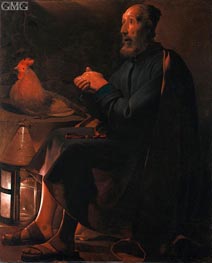
Giclée Canvas Print
$79.38
$79.38
SKU: 4602-GDT
Georges de La Tour
Original Size:114 x 95 cm
Cleveland Museum of Art, Ohio, USA
Georges de La Tour
Original Size:114 x 95 cm
Cleveland Museum of Art, Ohio, USA
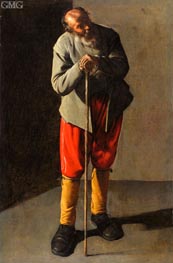
Giclée Canvas Print
$64.85
$64.85
SKU: 4604-GDT
Georges de La Tour
Original Size:91 x 60.3 cm
Fine Arts Museums of San Francisco, California, USA
Georges de La Tour
Original Size:91 x 60.3 cm
Fine Arts Museums of San Francisco, California, USA
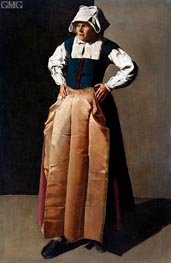
Giclée Canvas Print
$64.30
$64.30
SKU: 4603-GDT
Georges de La Tour
Original Size:91.4 x 60 cm
Fine Arts Museums of San Francisco, California, USA
Georges de La Tour
Original Size:91.4 x 60 cm
Fine Arts Museums of San Francisco, California, USA
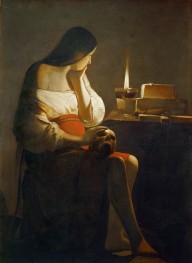
Giclée Canvas Print
$71.41
$71.41
SKU: 22335-GDT
Georges de La Tour
Original Size:128 x 94 cm
Louvre Museum, Paris, France
Georges de La Tour
Original Size:128 x 94 cm
Louvre Museum, Paris, France
Giclée Canvas Print
$71.58
$71.58
SKU: 22338-GDT
Georges de La Tour
Original Size:63.8 x 47.2 cm
The Royal Collection, London, UK
Georges de La Tour
Original Size:63.8 x 47.2 cm
The Royal Collection, London, UK
Giclée Canvas Print
$78.49
$78.49
SKU: 22310-GDT
Georges de La Tour
Original Size:107 x 131 cm
Louvre Museum, Paris, France
Georges de La Tour
Original Size:107 x 131 cm
Louvre Museum, Paris, France
Giclée Canvas Print
$71.94
$71.94
SKU: 22332-GDT
Georges de La Tour
Original Size:120 x 160 cm
Musee des Beaux Arts, Nantes, France
Georges de La Tour
Original Size:120 x 160 cm
Musee des Beaux Arts, Nantes, France
Giclée Canvas Print
$64.85
$64.85
SKU: 22331-GDT
Georges de La Tour
Original Size:145 x 97 cm
Public Collection
Georges de La Tour
Original Size:145 x 97 cm
Public Collection
Giclée Canvas Print
$64.30
$64.30
SKU: 22336-GDT
Georges de La Tour
Original Size:186 x 120 cm
Public Collection
Georges de La Tour
Original Size:186 x 120 cm
Public Collection
Giclée Canvas Print
$67.69
$67.69
SKU: 22320-GDT
Georges de La Tour
Original Size:133.4 x 102.2 cm
Metropolitan Museum of Art, New York, USA
Georges de La Tour
Original Size:133.4 x 102.2 cm
Metropolitan Museum of Art, New York, USA
Giclée Canvas Print
$64.30
$64.30
SKU: 22307-GDT
Georges de La Tour
Original Size:86.4 x 141 cm
J. Paul Getty Museum, Los Angeles, USA
Georges de La Tour
Original Size:86.4 x 141 cm
J. Paul Getty Museum, Los Angeles, USA
Giclée Canvas Print
$84.70
$84.70
SKU: 22334-GDT
Georges de La Tour
Original Size:69.5 x 61.5 cm
Louvre Museum, Paris, France
Georges de La Tour
Original Size:69.5 x 61.5 cm
Louvre Museum, Paris, France
Giclée Canvas Print
$82.21
$82.21
SKU: 22322-GDT
Georges de La Tour
Original Size:113 x 92.7 cm
National Gallery of Art, Washington, USA
Georges de La Tour
Original Size:113 x 92.7 cm
National Gallery of Art, Washington, USA
Giclée Canvas Print
$79.74
$79.74
SKU: 22306-GDT
Georges de La Tour
Original Size:61 x 52 cm
Musee des Beaux-Arts, Dijon, France
Georges de La Tour
Original Size:61 x 52 cm
Musee des Beaux-Arts, Dijon, France
Giclée Canvas Print
$68.57
$68.57
SKU: 22312-GDT
Georges de La Tour
Original Size:97 x 130 cm
Public Collection
Georges de La Tour
Original Size:97 x 130 cm
Public Collection
Giclée Canvas Print
$64.30
$64.30
SKU: 22318-GDT
Georges de La Tour
Original Size:99 x 152 cm
Public Collection
Georges de La Tour
Original Size:99 x 152 cm
Public Collection