
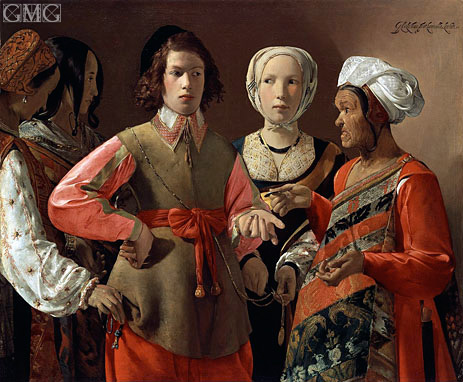
The Fortune Teller, c.1635 by Georges de La Tour
Canvas Print - 4601-GDT
Location: Metropolitan Museum of Art, New York, USAOriginal Size: 102 × 123.5 cm
Own a museum-grade giclée Canvas Print of The Fortune Teller by Georges de La Tour (c.1635). It is printed with archival pigments on 400 g/m² canvas and hand-varnished with a UV-protective layer. Set your exact proportional size—anything up to 40.5 × 49.2 in, with optional framing. Free worldwide shipping for rolled artworks. Unframed prints ship within 48 h, framed prints in 7-8 days. Guaranteed 100-year color durability.
Giclée Canvas Print | $79.15 USD
Your Selection

Customize Your Print
Sizes scale proportionally to the original. Dimensions shown are for the printed area - we always add 1.2 inches in borders beyond these dimensions for stretching.
Your Questions Answered: Fine Art Prints, Framing, Care & Delivery
Most people search for “canvas print” or “wall art” - but what they’re really looking for is a giclée print: a museum-grade reproduction of the original masterpiece, printed with archival pigment inks on fine art canvas.
Giclée (pronounced 'zhee-clay') is a French term meaning 'to spray,' referring to how ink is precisely sprayed onto canvas or paper, creating incredibly detailed fine art prints. It’s the gold standard in museum-quality printing, loved by artists, galleries, and museums worldwide.
Your artwork will be printed on premium canvas using vibrant archival inks, faithfully capturing every brushstroke and subtle nuance of Georges de La Tour's original. To ensure lasting beauty, each print is finished with a protective UV varnish. Far superior to ordinary posters, your canvas print will look and feel like a real painting, retaining its vivid colors and pristine details for more than 100 years.
For a more artistic approach: choosing a size closer to the original artwork ensures you experience the artist’s intended visual impact and authenticity. Of course, since most of us don't live in spacious baroque palaces, your available space and personal taste should ultimately guide your decision.
The Total Size includes an additional 1.2 in white border on each side, added specifically for stretching.
So yes—this white border is added on top of your selected print size. You get the full artwork at the dimensions you picked, plus extra canvas to make stretching smooth and professional.
For example, if you select a 17.8 × 21.7 in print, the full canvas you receive will measure 20.2 × 24.0 in—giving your framer plenty of room to create a clean, gallery-quality stretch.
Both options are wonderful choices! Going unframed gives you maximum flexibility—you can take your print to a local framing shop for personalized options and expert advice tailored to your décor. This is especially great if you have specific design ideas or want to match existing frames in your home.
However, keep in mind that a print truly comes to life when properly framed. Art professionals often say: 'The frame contributes 30% of the artwork’s overall impact.' A well-chosen frame elevates and completes your print.
If you choose our framing option, your print will arrive professionally framed and ready to hang right out of the box. We focus exclusively on traditional framing methods, ensuring every artwork receives the respectful presentation it deserves—this is why we don't offer gallery wrap options.
Important shipping note: Due to courier restrictions, we can ship framed prints up to 28 in on the longest side. Larger prints will arrive safely rolled in a tube, ready for you to frame locally.
What makes our canvas special? The satin-gloss finish. Think of how paintings look in museums with that beautiful varnish—that's exactly the effect we're going for. This glossy surface makes colors pop with incredible vibrancy while giving deep, rich blacks that matte canvases simply can't achieve. The result? Your print has that authentic 'real painting' look with extraordinary depth and life.
Plus, our canvas is acid-free and pH-neutral, so it'll stay beautiful for generations. We believe The Fortune Teller deserves nothing less than this museum-quality treatment.
Unframed prints are crafted in 2–4 business days.
Framed prints take 7–8 business days to build and finish.
Shipping options:
Standard Delivery (Free): Up to two unframed prints per order, provided that the short side does not exceed 59 cm (approx. 23 inches), with delivery in 10–14 working days.
Express Shipping: Delivered in 2–4 working days; costs vary by weight, volume, and destination. After adding the artwork to your cart, use the Shipping estimates tool there for exact pricing.
Note for framed prints: Because they’re bulkier and higher-value, framed artworks ship only via express tracked service and do not qualify for free standard delivery.
Packaging:
Unframed prints: Safely rolled in postal tubes.
Framed prints: Packed in reinforced boxes with corner protectors and bubble wrap.
You’ll receive a tracking number as soon as your order leaves our studio—so you can follow every step of its journey!
Just follow these simple tips:
- Hang your print away from direct sunlight and high humidity
- Dust gently with a soft, dry cloth if needed
- Avoid touching the printed surface directly
- Keep the room temperature relatively stable
We offer a 30-day return policy and accept returns for items damaged during shipping. Our return process is simple and straightforward:
Step 1 – Let us know: Send an email to info@topartprint.com with your order number and a brief explanation of the issue.
Step 2 – Send it back: We’ll reply with clear instructions for returning the print. Please return it in its original packaging and in good condition. You cover return shipping (unless we sent a damaged/incorrect item). After inspection, we'll send a replacement or refund the product price.
Please note: shipping costs are non-refundable.
For framed artworks: Since framed prints are handcrafted specifically for your order, returns are accepted only at our discretion and require a valid reason. But don’t worry—our support team is friendly, responsive, and ready to assist.
About the Painting
Georges de La Tour
Original Size:114 × 95 cm
Cleveland Museum of Art, Ohio, USA
Georges de La Tour
Original Size:91.4 × 60 cm
Fine Arts Museums of San Francisco, California, USA
Georges de La Tour
Original Size:91 × 60.3 cm
Fine Arts Museums of San Francisco, California, USA
Georges de La Tour
Original Size:137 × 102 cm
Louvre Museum, Paris, France
Georges de La Tour
Original Size:93 × 81 cm
Musee des Beaux Arts, Nantes, France