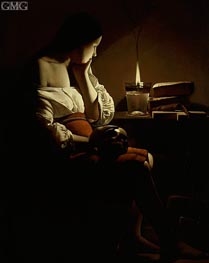
The Penitent Magdalene, c.1640 by Georges de La Tour
Canvas Print - 22335-GDT

Location: Louvre Museum, Paris, France
Original Size: 128 × 94 cm

Own a museum-grade giclée Canvas Print of The Penitent Magdalene by Georges de La Tour (c.1640). It is printed with archival pigments on 400 g/m² canvas and hand-varnished with a UV-protective layer. Set your exact proportional size—anything up to 35.4 × 26 in, with optional framing. Free worldwide shipping for rolled artworks. Unframed prints ship within 48 h, framed prints in 7-8 days. Guaranteed 100-year color durability.
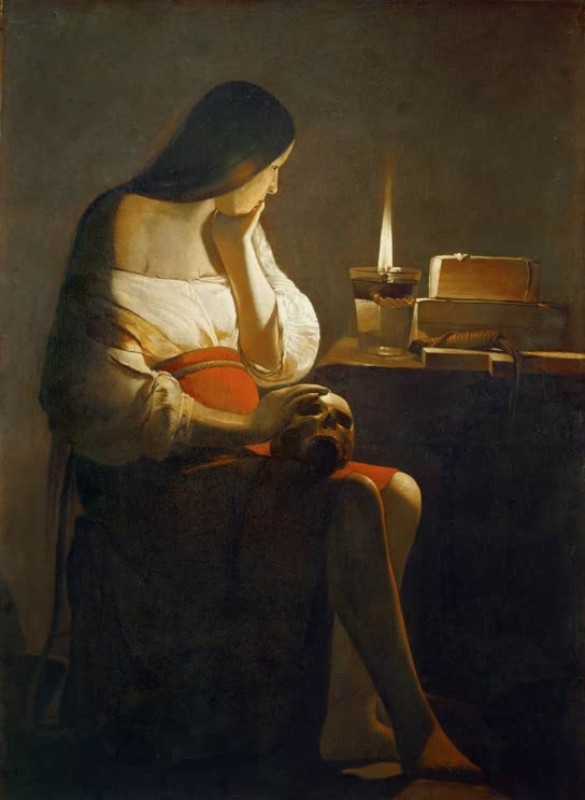
The Penitent Magdalene, c.1640 | Georges de La Tour | Giclée Canvas Print
Video

Giclée Canvas Print | $69.04 USD

Your Selection

SKU:22335-GDT
Print format
Print/Image Size
Condition:
Ships Rolled in 2-4 Business Days
Free Shipping

Customize Your Print

Largest Available
35.4″ × 26″
Framing: Long Side Up to 28"
Can be Framed

Sizes scale proportionally to the original. Dimensions shown are for the printed area - we always add 1.2 inches in borders beyond these dimensions for stretching.

Height in
Width in

If you want a painting which is not in our catalogue

Your Questions Answered: Fine Art Prints, Framing, Care & Delivery

Giclée Print Quality 400 g/m² Canvas (Satin Gloss) + 1.2 in Borders for Stretching 100+ Year Colour Guarantee Free WorldWide Shipping!

Most people search for “canvas print” or “wall art” - but what they’re really looking for is a giclée print: a museum-grade reproduction of the original masterpiece, printed with archival pigment inks on fine art canvas.

Giclée (pronounced 'zhee-clay') is a French term meaning 'to spray,' referring to how ink is precisely sprayed onto canvas or paper, creating incredibly detailed fine art prints. It’s the gold standard in museum-quality printing, loved by artists, galleries, and museums worldwide.

Your artwork will be printed on premium canvas using vibrant archival inks, faithfully capturing every brushstroke and subtle nuance of Georges de La Tour's original. To ensure lasting beauty, each print is finished with a protective UV varnish. Far superior to ordinary posters, your canvas print will look and feel like a real painting, retaining its vivid colors and pristine details for more than 100 years.

About Giclée Fine Art Printing

Here's a simple trick: use painter’s tape to mark the print size directly on your wall, and step back to see how it feels. Generally, larger sizes around 36 in wide work beautifully in living rooms or open spaces. Medium sizes around 24 in fit nicely in bedrooms, hallways, or offices. Hanging it above a sofa? Choose a print that's roughly two-thirds the width of your couch. Still unsure? Start with our popular 21.7 × 15.9 in size—it fits comfortably in most spaces!

For a more artistic approach: choosing a size closer to the original artwork ensures you experience the artist’s intended visual impact and authenticity. Of course, since most of us don't live in spacious baroque palaces, your available space and personal taste should ultimately guide your decision.

In many cases, yes! If you need a specific size to fit a particular space or frame, feel free to reach out—we're happy to see what’s possible. Because each print is made to order, we can often accommodate custom dimensions as long as they respect the proportions of the original painting.Just send us an email at info@topartprint.com with the title of the artwork and the size you're looking for. We’ll get back to you quickly with options and pricing.

Good to know: when you choose the size of your artwork, the Print Size shown in the Your Selection box refers to the actual image area—that’s the part you’ll see once the canvas is stretched or framed.

The Total Size includes an additional 1.2 in white border on each side, added specifically for stretching.
So yes—this white border is added on top of your selected print size. You get the full artwork at the dimensions you picked, plus extra canvas to make stretching smooth and professional.

For example, if you select a 21.7 × 15.9 in print, the full canvas you receive will measure 24.0 × 18.2 in—giving your framer plenty of room to create a clean, gallery-quality stretch.

Both options are wonderful choices! Going unframed gives you maximum flexibility—you can take your print to a local framing shop for personalized options and expert advice tailored to your décor. This is especially great if you have specific design ideas or want to match existing frames in your home.

However, keep in mind that a print truly comes to life when properly framed. Art professionals often say: 'The frame contributes 30% of the artwork’s overall impact.' A well-chosen frame elevates and completes your print.

If you choose our framing option, your print will arrive professionally framed and ready to hang right out of the box. We focus exclusively on traditional framing methods, ensuring every artwork receives the respectful presentation it deserves—this is why we don't offer gallery wrap options.

Important shipping note: Due to courier restrictions, we can ship framed prints up to 28 in on the longest side. Larger prints will arrive safely rolled in a tube, ready for you to frame locally.

For more detailed information, please see our complete guide to fine art framing methods.

We've carefully selected this premium canvas because it brings out the absolute best in Georges de La Tour's work. Made from natural cotton with a 400 g/m² weight, it has just the right texture to capture every brushstroke and detail of the original painting.

What makes our canvas special? The satin-gloss finish. Think of how paintings look in museums with that beautiful varnish—that's exactly the effect we're going for. This glossy surface makes colors pop with incredible vibrancy while giving deep, rich blacks that matte canvases simply can't achieve. The result? Your print has that authentic 'real painting' look with extraordinary depth and life.

Plus, our canvas is acid-free and pH-neutral, so it'll stay beautiful for generations. We believe The Penitent Magdalene deserves nothing less than this museum-quality treatment.

Every print is made just for you—no mass production here! Once you place your order, we begin creating your The Penitent Magdalene print with care and precision.

Unframed prints are crafted in 2–4 business days.
Framed prints take 7–8 business days to build and finish.

Shipping options:
Standard Delivery (Free): Up to two unframed prints per order, provided that the short side does not exceed 59 cm (approx. 23 inches), with delivery in 10–14 working days.
Express Shipping: Delivered in 2–4 working days; costs vary by weight, volume, and destination. After adding the artwork to your cart, use the Shipping estimates tool there for exact pricing.

Note for framed prints: Because they’re bulkier and higher-value, framed artworks ship only via express tracked service and do not qualify for free standard delivery.

Packaging:
Unframed prints: Safely rolled in postal tubes.
Framed prints: Packed in reinforced boxes with corner protectors and bubble wrap.

You’ll receive a tracking number as soon as your order leaves our studio—so you can follow every step of its journey!

It’s super easy! Your giclée print is designed to last over 100 years when properly displayed. We’ve already applied a UV-protective varnish, so there’s no need for any extra treatments on your part.

Just follow these simple tips:
  • Hang your print away from direct sunlight and high humidity
  • Dust gently with a soft, dry cloth if needed
  • Avoid touching the printed surface directly
  • Keep the room temperature relatively stable
That’s it! With these basic precautions, your Georges de La Tour print will retain its vibrant colors and pristine condition for generations to come.

We want you to truly love your art. Since each piece is custom-made just for you, we kindly recommend double-checking the size and details before placing your order. But if something’s not right—especially in terms of quality—we’re here to help and will make it right.

We offer a 30-day return policy and accept returns for items damaged during shipping. Our return process is simple and straightforward:
Step 1 – Let us know: Send an email to info@topartprint.com with your order number and a brief explanation of the issue.
Step 2 – Send it back: We’ll reply with clear instructions for returning the print. Please return it in its original packaging and in good condition. You cover return shipping (unless we sent a damaged/incorrect item). After inspection, we'll send a replacement or refund the product price.
Please note: shipping costs are non-refundable.

For framed artworks: Since framed prints are handcrafted specifically for your order, returns are accepted only at our discretion and require a valid reason. But don’t worry—our support team is friendly, responsive, and ready to assist.

About the Painting

A single candle does all the work in this room. Its small flame – barely a flicker on a wick set in oil – illuminates a woman's face, her bare shoulders, the skull resting in her lap, and a still life of books and crucifix on the table beside her. Everything else falls into deep, warm darkness. This is Georges de La Tour at his most concentrated, his most hushed.

The Penitent Magdalene, painted around 1642–1644 and now in the Louvre, belongs to a series of at least five versions of the subject that Tour returned to across years. Compared with the slightly earlier Los Angeles canvas, this one strips away. Drapery is simplified. Contrasts are softened. The palette narrows to umber, ivory, and a deep red-orange sash knotted at the waist – coarse cloth, not silk, tied with rope in the manner of a Franciscan penitent. Where the Los Angeles painting still carries traces of worldly regret, this version has moved past renunciation into something quieter: the rigors of solitary devotion.

Her head tilts onto her left hand in the classic pose of melancholy, a gesture whose lineage runs back through Dürer's famous engraving. But there is nothing theatrical here. Her gaze rests on the flame, which is both a practical light source and an old symbol – human life, trembling, ready to go out with the slightest breath. One can almost feel the stillness required to keep it burning. The skull on her knees anchors the composition's lower half with its weight and shadow, recalling the Ignatian spiritual exercise of meditating on death in darkness, a skull held between one's hands.

Look closely at her right forearm. A pentimento – a ghostly trace of an earlier painted form – reveals that the chemise sleeve once extended lower, matching the Los Angeles version. Tour revised it upward, baring more skin, thinning the boundary between flesh and shadow. This small change confirms the Louvre painting came later and speaks to a process of deliberate reduction, each revision paring the image toward greater austerity.

The still life on the table deserves particular attention. Two books lean together, one open or partially so, suggesting recent reading – Scripture, presumably, given the crucifix laid alongside. The arrangement is quieter and warmer than its Los Angeles counterpart, the light gentler, the objects settling into a kind of domestic gravity. It is among the finest passages of still-life painting in all of Tour's work, yet it refuses to compete with the figure. Everything orbits her silence.

Color operates within an extraordinarily narrow band. Warm ochres and siennas dominate. The red-orange of the sash and skirt provides the only real chromatic intensity, and even that is muted, absorbed into shadow at its edges. White appears only in the chemise, catching the candlelight along the shoulder and upper arm with a softness that suggests glazing rather than thick application – thin layers of pigment allowing warmth to rise from beneath.

Georges de La Tour's tenebrism owes something to Caravaggio, of course, but it works differently. Caravaggio's darkness is dramatic, often violent. Tour's darkness is inhabited. It feels like an interior you could sit in – a room where the air is still and faintly warm, where you might hear the wax crackle if you held your breath. Perhaps that is why this painting, among his many nocturnes, feels so unusually intimate. It does not stage penitence for our benefit. It simply shows a woman thinking, alone, by a single light, and trusts that we will understand the weight of what she contemplates.

Top