
Johann Liss Giclée Fine Art Prints
c.1597-c.1630/31
German Baroque Painter
A parish register in Verona records the last certain fact of a short life: on 5 December 1631, in a city sealed against plague, a painter from the far north of Germany was buried among strangers. Johann Liss, born at Oldenburg in Holstein around 1597, was dead somewhere in his mid-thirties. Yet this restless German artist, irregular in his habits and ferocious at the easel, had by then given Venetian painting a jolt of colour and freedom that the city would remember for a century.
Holstein was no nursery of painters, as Joachim von Sandrart later noted with some surprise. Early accounts suggest that both of Liss's parents painted, the father reportedly in the service of the dukes of Holstein, which would explain how a boy from such a province acquired the rudiments at all. What followed was the ordinary journeyman's road, taken with unusual appetite. Around 1615 he crossed into the Netherlands. In Haarlem and Amsterdam he worked in the manner of Hendrick Goltzius, whose engraved line taught a generation to build a figure out of pure swelling contour, and in Antwerp, probably between 1615 and 1619, he saw what Rubens had made of Italy.
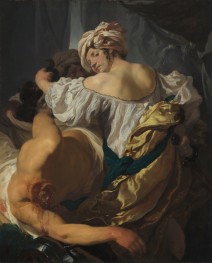
Paris came next, then Venice, around or shortly after 1620, with his presence in the city documented by 1621. From there he moved south to Rome, staying roughly from 1623 to 1626 and joining the Schildersbent, the raucous fraternity of northern artists known as the Bentvueghels, who inducted their members with wine and mock ceremony. They called him Pan. The nickname fits the work: goat-legged appetite, rustic comedy, flesh painted with evident pleasure. Rome also brought him Caravaggio, or rather Caravaggio's followers, and for a time he worked in hard raking light and deep shadow. Judith in the Tent of Holofernes, in the National Gallery, London, and dated by the museum to the close of his Roman years, shows the heroine turning towards us with the severed head still in her grip. The tenebrism is Roman; the sensuous handling of cloth and skin is already his own.
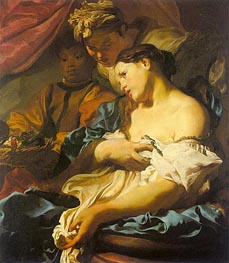
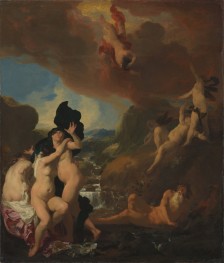
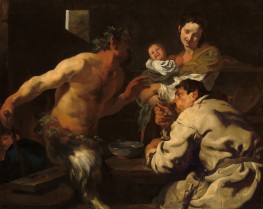
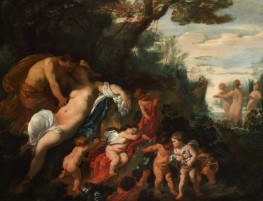
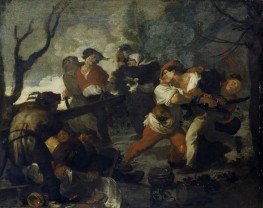
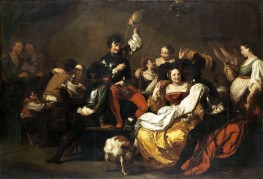
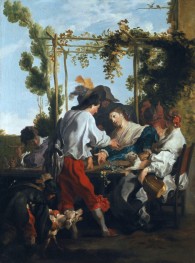
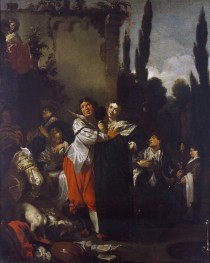
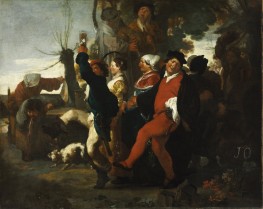
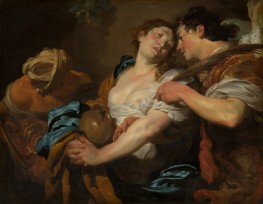
Mythology suited him. In The Fall of Phaeton, painted about 1624 and also in the National Gallery, the boy tumbles out of a scorched orange sky while nymphs clutch one another on the bank below and the old river god Eridanus reclines in the foreground, unmoved by the catastrophe above him. Munich's Alte Pinakothek holds his Death of Cleopatra of the early 1620s, an unusually intimate account of the queen's last minutes. Peasants brawl, soldiers play morra, prodigal sons squander their inheritance in gardens full of feathered hats: northern subjects at Italian temperature. Satyr and Peasant, in the National Gallery of Art, Washington, keeps a Netherlandish fable alive in warm Venetian pigment.
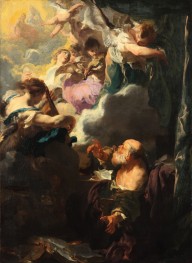
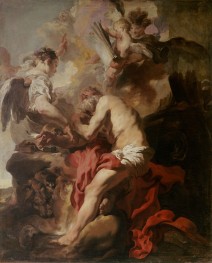
Venice reclaimed him around 1626, and there his handling loosened into something genuinely new for the city. His name appears on the roll of the painters' guild in 1629. Domenico Fetti had died in 1623 and Bernardo Strozzi would arrive from Genoa: three outsiders, between them, carried the Baroque into a Republic whose native school had fallen quiet after Tintoretto and Veronese. Liss made his largest public statement in the later 1620s, for the church of San Nicolò da Tolentino. In The Vision of Saint Jerome we see the old scholar flung backwards, pen still in hand, as an angel sounds the last trumpet above him; the paint is dragged and flicked, the pinks and lemon yellows almost weightless, the whole surface alive in a way that anticipates Guardi by a hundred years. Painters copied it for generations.
Sandrart knew him at precisely this moment. Passing through Venice in 1629 on his way to Rome, the younger German found Liss in love with Venetian painting and living by no schedule at all: long disappearances, then days and nights at the easel with little rest and less food. Worried for his health, Sandrart urged him to come south. Perhaps the vehemence of the working was the whole point, and the freedom of those late surfaces is simply what exhaustion looks like when a painter is certain of his hand.
Plague reached Venice in 1630 and carried off roughly a third of its people. Liss withdrew to Verona. He died there on 5 December 1631, a date recovered from the archives only in 1975 and published in Arte Veneta; until then, on Sandrart's authority, the literature had him perishing in the Venetian outbreak of 1629 or 1630. Small corrections of this kind are not trivial. They give an artist who died young the two extra working years that scholarship had quietly taken from him.
His surviving oeuvre is slender, a few dozen paintings and a handful of drawings, but its afterlife has been eventful. Sebastiano Ricci, Giovanni Battista Piazzetta and Giambattista Tiepolo all studied his altarpiece and his brushwork when Venetian painting revived in the eighteenth century. The first monographic exhibition came late, in 1975 at the Rathaus in Augsburg and then at the Cleveland Museum of Art, and it remains the foundation of Liss scholarship. Cleveland also holds his drawing Allegory of Christian Faith, seized by the Gestapo in 1939 from the collection of Arthur Feldmann, who was murdered in the Holocaust together with his wife; the museum reached a settlement with the family's heirs in 2013. Johann Liss lived little more than thirty years and painted professionally for fewer than twenty of them, in five countries and under four versions of his own name. What remains is a body of work that still feels improvised, sensual and quick - the painting of an artist who trusted the loaded brush more than the drawn outline, and who left Venice more colourful than he found it.
Holstein was no nursery of painters, as Joachim von Sandrart later noted with some surprise. Early accounts suggest that both of Liss's parents painted, the father reportedly in the service of the dukes of Holstein, which would explain how a boy from such a province acquired the rudiments at all. What followed was the ordinary journeyman's road, taken with unusual appetite. Around 1615 he crossed into the Netherlands. In Haarlem and Amsterdam he worked in the manner of Hendrick Goltzius, whose engraved line taught a generation to build a figure out of pure swelling contour, and in Antwerp, probably between 1615 and 1619, he saw what Rubens had made of Italy.
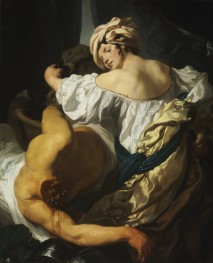
Paris came next, then Venice, around or shortly after 1620, with his presence in the city documented by 1621. From there he moved south to Rome, staying roughly from 1623 to 1626 and joining the Schildersbent, the raucous fraternity of northern artists known as the Bentvueghels, who inducted their members with wine and mock ceremony. They called him Pan. The nickname fits the work: goat-legged appetite, rustic comedy, flesh painted with evident pleasure. Rome also brought him Caravaggio, or rather Caravaggio's followers, and for a time he worked in hard raking light and deep shadow. Judith in the Tent of Holofernes, in the National Gallery, London, and dated by the museum to the close of his Roman years, shows the heroine turning towards us with the severed head still in her grip. The tenebrism is Roman; the sensuous handling of cloth and skin is already his own.
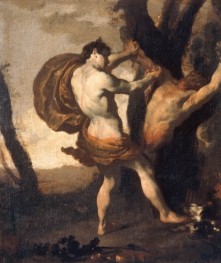
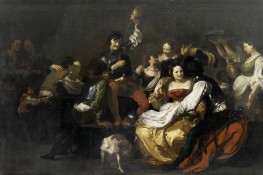
Mythology suited him. In The Fall of Phaeton, painted about 1624 and also in the National Gallery, the boy tumbles out of a scorched orange sky while nymphs clutch one another on the bank below and the old river god Eridanus reclines in the foreground, unmoved by the catastrophe above him. Munich's Alte Pinakothek holds his Death of Cleopatra of the early 1620s, an unusually intimate account of the queen's last minutes. Peasants brawl, soldiers play morra, prodigal sons squander their inheritance in gardens full of feathered hats: northern subjects at Italian temperature. Satyr and Peasant, in the National Gallery of Art, Washington, keeps a Netherlandish fable alive in warm Venetian pigment.
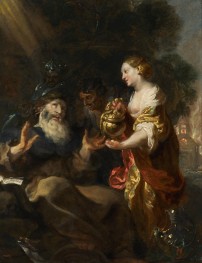
Venice reclaimed him around 1626, and there his handling loosened into something genuinely new for the city. His name appears on the roll of the painters' guild in 1629. Domenico Fetti had died in 1623 and Bernardo Strozzi would arrive from Genoa: three outsiders, between them, carried the Baroque into a Republic whose native school had fallen quiet after Tintoretto and Veronese. Liss made his largest public statement in the later 1620s, for the church of San Nicolò da Tolentino. In The Vision of Saint Jerome we see the old scholar flung backwards, pen still in hand, as an angel sounds the last trumpet above him; the paint is dragged and flicked, the pinks and lemon yellows almost weightless, the whole surface alive in a way that anticipates Guardi by a hundred years. Painters copied it for generations.
Sandrart knew him at precisely this moment. Passing through Venice in 1629 on his way to Rome, the younger German found Liss in love with Venetian painting and living by no schedule at all: long disappearances, then days and nights at the easel with little rest and less food. Worried for his health, Sandrart urged him to come south. Perhaps the vehemence of the working was the whole point, and the freedom of those late surfaces is simply what exhaustion looks like when a painter is certain of his hand.
Plague reached Venice in 1630 and carried off roughly a third of its people. Liss withdrew to Verona. He died there on 5 December 1631, a date recovered from the archives only in 1975 and published in Arte Veneta; until then, on Sandrart's authority, the literature had him perishing in the Venetian outbreak of 1629 or 1630. Small corrections of this kind are not trivial. They give an artist who died young the two extra working years that scholarship had quietly taken from him.
His surviving oeuvre is slender, a few dozen paintings and a handful of drawings, but its afterlife has been eventful. Sebastiano Ricci, Giovanni Battista Piazzetta and Giambattista Tiepolo all studied his altarpiece and his brushwork when Venetian painting revived in the eighteenth century. The first monographic exhibition came late, in 1975 at the Rathaus in Augsburg and then at the Cleveland Museum of Art, and it remains the foundation of Liss scholarship. Cleveland also holds his drawing Allegory of Christian Faith, seized by the Gestapo in 1939 from the collection of Arthur Feldmann, who was murdered in the Holocaust together with his wife; the museum reached a settlement with the family's heirs in 2013. Johann Liss lived little more than thirty years and painted professionally for fewer than twenty of them, in five countries and under four versions of his own name. What remains is a body of work that still feels improvised, sensual and quick - the painting of an artist who trusted the loaded brush more than the drawn outline, and who left Venice more colourful than he found it.
23 Johann Liss Artworks
Giclée Canvas Print
$84.74
$84.74
SKU: 2533-LIJ
Johann Liss
Original Size:97.5 x 85.5 cm
Alte Pinakothek, Munich, Germany
Johann Liss
Original Size:97.5 x 85.5 cm
Alte Pinakothek, Munich, Germany
Giclée Canvas Print
$81.94
$81.94
SKU: 23233-LIJ
Johann Liss
Original Size:126.5 x 110.3 cm
National Gallery, London, UK
Johann Liss
Original Size:126.5 x 110.3 cm
National Gallery, London, UK
Giclée Canvas Print
$74.43
$74.43
SKU: 23245-LIJ
Johann Liss
Original Size:83 x 69 cm
Galleria degli Uffizi, Florence, Italy
Johann Liss
Original Size:83 x 69 cm
Galleria degli Uffizi, Florence, Italy
Giclée Canvas Print
$86.84
$86.84
SKU: 23236-LIJ
Johann Liss
Original Size:104.5 x 94.9 cm
Metropolitan Museum of Art, New York, USA
Johann Liss
Original Size:104.5 x 94.9 cm
Metropolitan Museum of Art, New York, USA
Giclée Canvas Print
$71.98
$71.98
SKU: 23235-LIJ
Johann Liss
Original Size:87.7 x 65.7 cm
Cleveland Museum of Art, Ohio, USA
Johann Liss
Original Size:87.7 x 65.7 cm
Cleveland Museum of Art, Ohio, USA
Giclée Canvas Print
$76.70
$76.70
SKU: 23234-LIJ
Johann Liss
Original Size:133.3 x 167.4 cm
National Gallery of Art, Washington, USA
Johann Liss
Original Size:133.3 x 167.4 cm
National Gallery of Art, Washington, USA
Giclée Canvas Print
$70.41
$70.41
SKU: 23246-LIJ
Johann Liss
Original Size:81.8 x 60.5 cm
Old Masters Gallery, Berlin, Germany
Johann Liss
Original Size:81.8 x 60.5 cm
Old Masters Gallery, Berlin, Germany
Giclée Canvas Print
$75.48
$75.48
SKU: 23241-LIJ
Johann Liss
Original Size:88 x 69 cm
Galleria degli Uffizi, Florence, Italy
Johann Liss
Original Size:88 x 69 cm
Galleria degli Uffizi, Florence, Italy
Giclée Canvas Print
$73.56
$73.56
SKU: 23228-LIJ
Johann Liss
Original Size:53.5 x 69 cm
Staatliche Kunsthalle, Karlsruhe, Germany
Johann Liss
Original Size:53.5 x 69 cm
Staatliche Kunsthalle, Karlsruhe, Germany
Giclée Canvas Print
$76.18
$76.18
SKU: 23238-LIJ
Johann Liss
Original Size:68 x 83 cm
Germanisches Nationalmuseum, Nuremberg, Germany
Johann Liss
Original Size:68 x 83 cm
Germanisches Nationalmuseum, Nuremberg, Germany
Giclée Canvas Print
$65.52
$65.52
SKU: 23240-LIJ
Johann Liss
Original Size:164.5 x 242 cm
Gemaldegalerie Alte Meister, Kassel, Germany
Johann Liss
Original Size:164.5 x 242 cm
Gemaldegalerie Alte Meister, Kassel, Germany
Giclée Canvas Print
$71.46
$71.46
SKU: 23239-LIJ
Johann Liss
Original Size:75.5 x 56 cm
Gemaldegalerie Alte Meister, Kassel, Germany
Johann Liss
Original Size:75.5 x 56 cm
Gemaldegalerie Alte Meister, Kassel, Germany
Giclée Canvas Print
$81.07
$81.07
SKU: 23243-LIJ
Johann Liss
Original Size:58 x 48 cm
Gallerie dell'Accademia, Venice, Italy
Johann Liss
Original Size:58 x 48 cm
Gallerie dell'Accademia, Venice, Italy
Giclée Canvas Print
$63.41
$63.41
SKU: 23229-LIJ
Johann Liss
Original Size:22 x 16.8 cm
Alte Pinakothek, Munich, Germany
Johann Liss
Original Size:22 x 16.8 cm
Alte Pinakothek, Munich, Germany
Giclée Canvas Print
$78.10
$78.10
SKU: 23227-LIJ
Johann Liss
Original Size:129 x 104 cm
Museum of Fine Arts, Budapest, Hungary
Johann Liss
Original Size:129 x 104 cm
Museum of Fine Arts, Budapest, Hungary
Giclée Canvas Print
$64.12
$64.12
SKU: 23237-LIJ
Johann Liss
Original Size:160.5 x 240 cm
Germanisches Nationalmuseum, Nuremberg, Germany
Johann Liss
Original Size:160.5 x 240 cm
Germanisches Nationalmuseum, Nuremberg, Germany
Giclée Canvas Print
$76.88
$76.88
SKU: 23244-LIJ
Johann Liss
Original Size:68 x 58 cm
Gallerie dell'Accademia, Venice, Italy
Johann Liss
Original Size:68 x 58 cm
Gallerie dell'Accademia, Venice, Italy
Giclée Canvas Print
$76.70
$76.70
SKU: 23226-LIJ
Johann Liss
Original Size:65.5 x 81.5 cm
Museum of Fine Arts, Budapest, Hungary
Johann Liss
Original Size:65.5 x 81.5 cm
Museum of Fine Arts, Budapest, Hungary
Giclée Canvas Print
$77.58
$77.58
SKU: 23232-LIJ
Johann Liss
Original Size:128.5 x 99 cm
National Gallery, London, UK
Johann Liss
Original Size:128.5 x 99 cm
National Gallery, London, UK
Giclée Canvas Print
$75.48
$75.48
SKU: 23242-LIJ
Johann Liss
Original Size:66 x 85 cm
Gallerie dell'Accademia, Venice, Italy
Johann Liss
Original Size:66 x 85 cm
Gallerie dell'Accademia, Venice, Italy
Giclée Canvas Print
$74.78
$74.78
SKU: 23231-LIJ
Johann Liss
Original Size:98.8 x 125.8 cm
Metropolitan Museum of Art, New York, USA
Johann Liss
Original Size:98.8 x 125.8 cm
Metropolitan Museum of Art, New York, USA
Giclée Canvas Print
$63.41
$63.41
SKU: 23230-LIJ
Johann Liss
Original Size:34.2 x 27.3 cm
Fitzwilliam Museum, Cambridge, UK
Johann Liss
Original Size:34.2 x 27.3 cm
Fitzwilliam Museum, Cambridge, UK
Giclée Canvas Print
$77.75
$77.75
SKU: 3134-LIJ
Johann Liss
Original Size:225 x 175 cm
San Nicolo dei Tolentini, Venice, Italy
Johann Liss
Original Size:225 x 175 cm
San Nicolo dei Tolentini, Venice, Italy