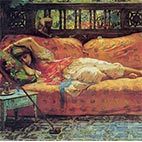
Orientalism was a 19th-century current in Western painting, strongest in France and Britain, that showed North Africa and the Middle East as a world of harems, bazaars, deserts and biblical sites. Most of it was painted in a polished academic manner, with minute detail, glowing color and a strong appetite for the exotic. Art historians distinguish painters who recorded what they saw on their travels from those who invented their scenes in the studio. The French critic Jules-Antoine Castagnary made Orientalist a term of disdain, yet Jean-Léon Gérôme became honorary president of the Society of French Orientalist Painters, founded in 1893.
Eastern figures had entered Western art long before. In Renaissance Venice, Gentile Bellini traveled to Constantinople and portrayed the Sultan, and Vittore Carpaccio filled his scenes with turbaned figures dressed in white. In the 18th century Jean-Étienne Liotard worked in Istanbul, made pastels of Turkish domestic life and went on wearing Turkish costume back in Europe. Travelers liked to be portrayed in Eastern dress, and so did Madame de Pompadour, who never left Europe. Lord Byron’s poems then spread a Romantic taste for exotic Eastern settings that shaped much 19th-century painting.
The movement proper began with Napoleon’s campaign in Egypt and Syria (1798-1801), which failed militarily but awakened a passion for Egypt. Antoine-Jean Gros, who had not joined the expedition, glorified it in Bonaparte Visiting the Plague Victims of Jaffa (1804, Louvre). The government published the richly illustrated Description de l’Égypte between 1809 and 1828. Eugène Delacroix (1798-1863) painted the Greek war against the Ottomans in The Massacre at Chios (1824, Louvre) before he had seen the East. His Death of Sardanapalus (1827, Louvre), inspired by Byron, is often seen as the start of the blend of eroticism, violence, languor and exoticism that pervades much later French Orientalism.
In 1832 Delacroix joined a French diplomatic mission to the Sultan of Morocco and on the way back stopped in Algiers, which the French had taken in 1830. He likened the people he met to ancient Romans and painted subjects from the journey for the rest of his life. Women were hard to sketch, but he apparently gained entry to a harem in Algiers, the source of Women of Algiers in Their Apartment (1834, Louvre). Jean-Auguste-Dominique Ingres never went east, yet his Grande Odalisque (1814, Louvre) and the circular Turkish Bath (1862, Louvre) fixed the image of the languid nude in an imagined harem. His pupil Théodore Chassériau painted The Toilette of Esther (1841, Louvre) years before he first saw Algeria in 1846.
Steamships made travel easier, and later painters went east in growing numbers. Jean-Léon Gérôme (1824-1904) became the leading figure, painting mosques, markets and street life in smooth, almost photographic detail and brilliant light. His harem, bath and slave-market scenes, taken up by many followers, tied Orientalism to the eroticized nude. His For Sale; Slaves at Cairo caused widespread offense when London’s Royal Academy showed it in 1871. The Snake Charmer (about 1879, Clark Art Institute, Williamstown), in which a naked boy performs before armed men against a wall of blue tiles, became one of the movement’s best-known images.
British Orientalism grew more from religion than from conquest. Sir David Wilkie traveled to Istanbul and Jerusalem in 1840 to find authentic settings for biblical subjects and died off Gibraltar on the way home. The Pre-Raphaelite William Holman Hunt worked in Egypt and Palestine and painted The Finding of the Saviour in the Temple (1860, Birmingham Museum and Art Gallery) with archaeological care. David Roberts (1796-1864) published lithographs of temples and ruins in The Holy Land, Syria, Idumea, Arabia, Egypt and Nubia. John Frederick Lewis lived for years in a Cairo mansion and painted luminous interiors full of lattice screens and silks; he painted no nudes, and his wife posed for his harem scenes.
Other nations painted their own Orients. Russian artists turned to Central Asia, which the empire was then conquering, and Vasily Vereshchagin exposed the cruelty of those wars in The Apotheosis of War (1871, Tretyakov Gallery, Moscow), a pyramid of skulls in the desert. In Central Europe and the Balkans, history painters dwelt on battles against the Ottomans. Edwin Lord Weeks, who reached British India in 1883, is the earliest American painter known to have worked there; he painted maharajas and palaces. Trained in Paris, the Ottoman painter Osman Hamdi Bey offered an insider’s view in The Tortoise Trainer (1906, Pera Museum, Istanbul). Henri Matisse revived the odalisque in his Nice paintings of the 1920s.
Edward Said’s book Orientalism (1978) gave the word a new meaning: a Western habit of picturing the East as static and backward, bound up with imperial power. A detail of Gérôme’s Snake Charmer appeared on its cover. Said wrote about literature, and in 1983 the art historian Linda Nochlin applied his approach to painting in her essay The Imaginary Orient. Others, such as the critic Jonathan Jones, held that most Orientalist art sprang from sincere curiosity and admiration rather than prejudice. Since the 1970s collecting has revived strongly, led largely by buyers from the Middle East.