
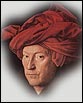
Jan van Eyck Giclée Fine Art Prints
b.1395-1441
Netherlandish Painter - Northern Renaissance
Jan van Eyck canvas prints: 42 works in museum quality, each made to order in the size you choose, with optional framing.
Few signatures in art history carry the weight of quiet confidence quite like the words ALS ICH KAN - "As I Can" - a punning motto that Jan van Eyck inscribed on his panels in Greek lettering. Born around 1380 to 1390 in Maaseik, a small town in the Limburg region of present-day Belgium, van Eyck died on 9 July 1441 in Bruges. He stands as one of the defining figures of Early Netherlandish painting and the Northern Renaissance, a painter whose technical command of oil transformed how artists across Europe conceived of light, texture, and the visible world.
Records of his earliest years remain sparse. Scholars have placed his birth as early as 1380 or as late as 1395, and the town of Maaseik - from which his surname derives - was identified as his birthplace only in the late sixteenth century. His daughter Lievine later entered a nunnery there, and preparatory notes for his Portrait of Cardinal Niccolo Albergati are written in the Maasland dialect. Jan van Eyck had at least two brothers who were also painters: Hubert, likely the elder, who died in 1426, and Lambert, who would later manage the workshop after Jan's death. Evidence suggests Jan received a classical education unusual among painters of his era; he wrote inscriptions in Latin, Greek, and Hebrew, a level of learning that would have elevated his standing among cultivated patrons.
By 1422, van Eyck appears in the records of The Hague as Meyster Jan den malre - Master Jan the painter - serving John of Bavaria, ruler of Holland, Hainaut, and Zeeland. Already he commanded a workshop with assistants, and his duties extended to redecorating the Binnenhof palace. After John's death in 1425, he entered the service of Philip the Good, Duke of Burgundy, a relationship that would define the rest of his career. Philip valued him highly. A court salary freed van Eyck from dependence on commissions alone, granting him what contemporaries described as the freedom to paint "whenever he pleased."
Diplomatic missions soon followed. Between 1426 and 1429, Philip dispatched him on journeys described only as "secret" commissions, for which he received payments far exceeding his annual salary. In 1426, he departed for "certain distant lands" - possibly the Holy Land, a theory supported by the topographical precision of Jerusalem in The Three Marys at the Tomb, completed by his workshop around 1440. Better documented is his 1428 journey to Portugal, where he spent nine months painting Isabella of Portugal so that the Duke might see his prospective bride before committing to marriage. Plague forced the Portuguese court to relocate constantly, and van Eyck met them at the remote castle of Avis. He returned to the Netherlands with Isabella; she and Philip married on Christmas Day, 1429.
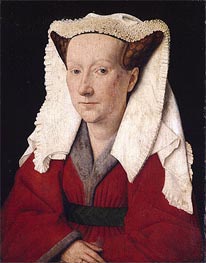
Around 1432, van Eyck married a woman named Margaret, some fifteen years his junior. Her maiden name is lost to history; contemporary documents refer to her simply as Damoiselle Marguerite. He purchased a house in Bruges, and their first child was born in 1434. Margaret outlived her husband and received a pension from the city - some of which, records show, she invested in lottery tickets. In 1439, van Eyck painted her portrait, now in the Groeningemuseum in Bruges. The frame inscription, written as if in her voice, reads: "My husband Johannes completed me in the year 1439 on 17 June, at the age of 33. As I can."
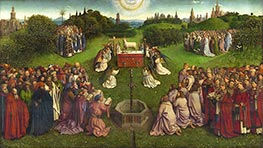
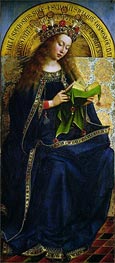
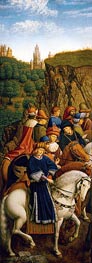
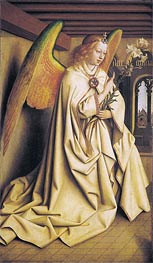
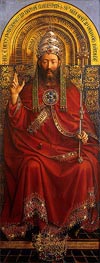
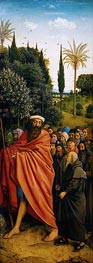
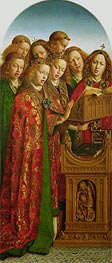
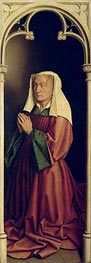
On 6 May 1432, the Ghent Altarpiece was consecrated at Saint Bavo Cathedral during an official ceremony attended by Philip the Good. This monumental polyptych, commissioned by the merchant and financier Jodocus Vijdts and his wife Elisabeth Borluut, had been begun by Hubert van Eyck before his death in 1426 and completed by Jan. In its faithful observation of nature - every jewel, every blade of grass rendered with startling clarity - it represented what scholars have called the final conquest of reality in the North. Unlike Italian contemporaries pursuing classical idealization, van Eyck offered something different: a world seen with unflinching attention, where the material and the spiritual coexist in every surface.
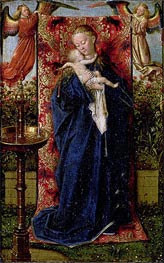
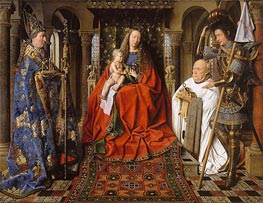
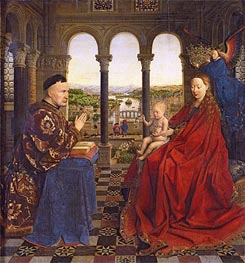
Between 1434 and 1436, he produced the works now considered his highest achievements: the Madonna of Chancellor Rolin, the Lucca Madonna, and the Virgin and Child with Canon van der Paele. In these paintings, the Virgin appears as an apparition before kneeling donors, her monumental scale separating the heavenly from the earthly even as she inhabits recognizable architectural spaces. Van Eyck built these interiors not from actual buildings but from idealized elements, Gothic and contemporary details mingled in impossible yet visually coherent arrangements. Light enters from multiple sources - porticoes, side windows - and falls across surfaces with a precision that reveals his understanding of optics as much as theology.
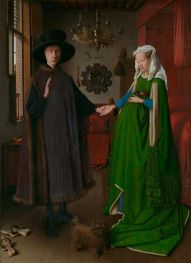
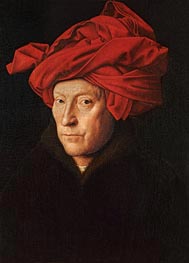
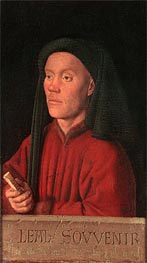
His secular portraits transformed the genre. Growing affluence across northern Europe had expanded the market for portraiture beyond royalty and high aristocracy; merchants and professionals now sought their likenesses preserved. Van Eyck responded with innovations that spread across the continent: the three-quarters view revived from antiquity, directional lighting that sculpted features, and layers of translucent glazes that achieved unprecedented depth of colour. The Arnolfini Portrait of 1434, with its convex mirror reflecting the room and its famous inscription - "Johannes de eyck fuit hic" - remains among the most analyzed paintings in Western art. In Leal Souvenir from 1432, the stone parapet appears chiseled with inscriptions so illusionistic that text and image seem to occupy the same reality.
Perhaps what distinguished van Eyck most was his handling of oil paint. Though he did not invent the medium - a claim propagated by Vasari and long repeated - he achieved a virtuosity in its manipulation that revolutionized northern painting. His glazes allowed light to penetrate and reflect from multiple layers, producing effects of luminosity that tempera could not match. Successors including Rogier van der Weyden, Petrus Christus, and Hans Memling adopted his techniques, and the myth of his invention persisted precisely because his results seemed miraculous.
Van Eyck died in Bruges on 9 July 1441. Philip the Good made a payment to his widow Margaret equal to a full year's salary. Lambert van Eyck assumed control of the workshop and, early in 1442, had his brother's body exhumed from the churchyard of St Donatian and reinterred inside the cathedral. Some twenty paintings are confidently attributed to Jan van Eyck today, all dated between 1432 and 1439. Ten bear his signature and motto. In 1454, the Italian humanist Bartolomeo Facio named him "the leading painter" of his age, placing him alongside Rogier van der Weyden, Gentile da Fabriano, and Pisanello. That a Genoese scholar praised Netherlandish and Italian painters with equal enthusiasm speaks to van Eyck's reach beyond regional boundaries. His innovations made visible a world where every object - a brass chandelier, a dog's fur, the weave of cloth - could carry meaning, where meticulous observation became a form of devotion. In Bruges, the square named Jan van Eyckplein still honours his memory. His works endure in collections from Berlin to Washington, their surfaces still catching light as they did nearly six centuries ago.
Records of his earliest years remain sparse. Scholars have placed his birth as early as 1380 or as late as 1395, and the town of Maaseik - from which his surname derives - was identified as his birthplace only in the late sixteenth century. His daughter Lievine later entered a nunnery there, and preparatory notes for his Portrait of Cardinal Niccolo Albergati are written in the Maasland dialect. Jan van Eyck had at least two brothers who were also painters: Hubert, likely the elder, who died in 1426, and Lambert, who would later manage the workshop after Jan's death. Evidence suggests Jan received a classical education unusual among painters of his era; he wrote inscriptions in Latin, Greek, and Hebrew, a level of learning that would have elevated his standing among cultivated patrons.
By 1422, van Eyck appears in the records of The Hague as Meyster Jan den malre - Master Jan the painter - serving John of Bavaria, ruler of Holland, Hainaut, and Zeeland. Already he commanded a workshop with assistants, and his duties extended to redecorating the Binnenhof palace. After John's death in 1425, he entered the service of Philip the Good, Duke of Burgundy, a relationship that would define the rest of his career. Philip valued him highly. A court salary freed van Eyck from dependence on commissions alone, granting him what contemporaries described as the freedom to paint "whenever he pleased."
Diplomatic missions soon followed. Between 1426 and 1429, Philip dispatched him on journeys described only as "secret" commissions, for which he received payments far exceeding his annual salary. In 1426, he departed for "certain distant lands" - possibly the Holy Land, a theory supported by the topographical precision of Jerusalem in The Three Marys at the Tomb, completed by his workshop around 1440. Better documented is his 1428 journey to Portugal, where he spent nine months painting Isabella of Portugal so that the Duke might see his prospective bride before committing to marriage. Plague forced the Portuguese court to relocate constantly, and van Eyck met them at the remote castle of Avis. He returned to the Netherlands with Isabella; she and Philip married on Christmas Day, 1429.
Around 1432, van Eyck married a woman named Margaret, some fifteen years his junior. Her maiden name is lost to history; contemporary documents refer to her simply as Damoiselle Marguerite. He purchased a house in Bruges, and their first child was born in 1434. Margaret outlived her husband and received a pension from the city - some of which, records show, she invested in lottery tickets. In 1439, van Eyck painted her portrait, now in the Groeningemuseum in Bruges. The frame inscription, written as if in her voice, reads: "My husband Johannes completed me in the year 1439 on 17 June, at the age of 33. As I can."
On 6 May 1432, the Ghent Altarpiece was consecrated at Saint Bavo Cathedral during an official ceremony attended by Philip the Good. This monumental polyptych, commissioned by the merchant and financier Jodocus Vijdts and his wife Elisabeth Borluut, had been begun by Hubert van Eyck before his death in 1426 and completed by Jan. In its faithful observation of nature - every jewel, every blade of grass rendered with startling clarity - it represented what scholars have called the final conquest of reality in the North. Unlike Italian contemporaries pursuing classical idealization, van Eyck offered something different: a world seen with unflinching attention, where the material and the spiritual coexist in every surface.
Between 1434 and 1436, he produced the works now considered his highest achievements: the Madonna of Chancellor Rolin, the Lucca Madonna, and the Virgin and Child with Canon van der Paele. In these paintings, the Virgin appears as an apparition before kneeling donors, her monumental scale separating the heavenly from the earthly even as she inhabits recognizable architectural spaces. Van Eyck built these interiors not from actual buildings but from idealized elements, Gothic and contemporary details mingled in impossible yet visually coherent arrangements. Light enters from multiple sources - porticoes, side windows - and falls across surfaces with a precision that reveals his understanding of optics as much as theology.
His secular portraits transformed the genre. Growing affluence across northern Europe had expanded the market for portraiture beyond royalty and high aristocracy; merchants and professionals now sought their likenesses preserved. Van Eyck responded with innovations that spread across the continent: the three-quarters view revived from antiquity, directional lighting that sculpted features, and layers of translucent glazes that achieved unprecedented depth of colour. The Arnolfini Portrait of 1434, with its convex mirror reflecting the room and its famous inscription - "Johannes de eyck fuit hic" - remains among the most analyzed paintings in Western art. In Leal Souvenir from 1432, the stone parapet appears chiseled with inscriptions so illusionistic that text and image seem to occupy the same reality.
Perhaps what distinguished van Eyck most was his handling of oil paint. Though he did not invent the medium - a claim propagated by Vasari and long repeated - he achieved a virtuosity in its manipulation that revolutionized northern painting. His glazes allowed light to penetrate and reflect from multiple layers, producing effects of luminosity that tempera could not match. Successors including Rogier van der Weyden, Petrus Christus, and Hans Memling adopted his techniques, and the myth of his invention persisted precisely because his results seemed miraculous.
Van Eyck died in Bruges on 9 July 1441. Philip the Good made a payment to his widow Margaret equal to a full year's salary. Lambert van Eyck assumed control of the workshop and, early in 1442, had his brother's body exhumed from the churchyard of St Donatian and reinterred inside the cathedral. Some twenty paintings are confidently attributed to Jan van Eyck today, all dated between 1432 and 1439. Ten bear his signature and motto. In 1454, the Italian humanist Bartolomeo Facio named him "the leading painter" of his age, placing him alongside Rogier van der Weyden, Gentile da Fabriano, and Pisanello. That a Genoese scholar praised Netherlandish and Italian painters with equal enthusiasm speaks to van Eyck's reach beyond regional boundaries. His innovations made visible a world where every object - a brass chandelier, a dog's fur, the weave of cloth - could carry meaning, where meticulous observation became a form of devotion. In Bruges, the square named Jan van Eyckplein still honours his memory. His works endure in collections from Berlin to Washington, their surfaces still catching light as they did nearly six centuries ago.
Page 1 of 2
Canvas Print
$62.05
$62.05
SKU: 7864-EJV
Jan van Eyck
Original Size:137.7 x 242.3 cm
Saint Bavo Cathedral, Ghent, Belgium
Jan van Eyck
Original Size:137.7 x 242.3 cm
Saint Bavo Cathedral, Ghent, Belgium
Canvas Print
$68.56
$68.56
SKU: 890-EJV
Jan van Eyck
Original Size:82.2 x 60 cm
National Gallery, London, UK
Jan van Eyck
Original Size:82.2 x 60 cm
National Gallery, London, UK
Canvas Print
$62.05
$62.05
SKU: 7846-EJV
Jan van Eyck
Original Size:32.6 x 25.8 cm
Groeninge Museum, Bruges, Belgium
Jan van Eyck
Original Size:32.6 x 25.8 cm
Groeninge Museum, Bruges, Belgium
Canvas Print
$62.05
$62.05
SKU: 7857-EJV
Jan van Eyck
Original Size:unknown
Saint Bavo Cathedral, Ghent, Belgium
Jan van Eyck
Original Size:unknown
Saint Bavo Cathedral, Ghent, Belgium
Canvas Print
$62.05
$62.05
SKU: 7860-EJV
Jan van Eyck
Original Size:unknown
Saint Bavo Cathedral, Ghent, Belgium
Jan van Eyck
Original Size:unknown
Saint Bavo Cathedral, Ghent, Belgium
Canvas Print
$62.05
$62.05
SKU: 891-EJV
Jan van Eyck
Original Size:26 x 19 cm
National Gallery, London, UK
Jan van Eyck
Original Size:26 x 19 cm
National Gallery, London, UK
Canvas Print
$62.05
$62.05
SKU: 7840-EJV
Jan van Eyck
Original Size:19 x 12 cm
Royal Museum of Fine Arts Antwerp, Belgium
Jan van Eyck
Original Size:19 x 12 cm
Royal Museum of Fine Arts Antwerp, Belgium
Canvas Print
$62.05
$62.05
SKU: 7865-EJV
Jan van Eyck
Original Size:unknown
Saint Bavo Cathedral, Ghent, Belgium
Jan van Eyck
Original Size:unknown
Saint Bavo Cathedral, Ghent, Belgium
Canvas Print
$62.05
$62.05
SKU: 7843-EJV
Jan van Eyck
Original Size:31 x 18 cm
Royal Museum of Fine Arts Antwerp, Belgium
Jan van Eyck
Original Size:31 x 18 cm
Royal Museum of Fine Arts Antwerp, Belgium
Canvas Print
$72.16
$72.16
SKU: 7845-EJV
Jan van Eyck
Original Size:122.1 x 157.8 cm
Groeninge Museum, Bruges, Belgium
Jan van Eyck
Original Size:122.1 x 157.8 cm
Groeninge Museum, Bruges, Belgium
Canvas Print
$62.05
$62.05
SKU: 7847-EJV
Jan van Eyck
Original Size:unknown
Saint Bavo Cathedral, Ghent, Belgium
Jan van Eyck
Original Size:unknown
Saint Bavo Cathedral, Ghent, Belgium
Canvas Print
$62.05
$62.05
SKU: 7863-EJV
Jan van Eyck
Original Size:unknown
Saint Bavo Cathedral, Ghent, Belgium
Jan van Eyck
Original Size:unknown
Saint Bavo Cathedral, Ghent, Belgium
Canvas Print
$62.05
$62.05
SKU: 7856-EJV
Jan van Eyck
Original Size:unknown
Saint Bavo Cathedral, Ghent, Belgium
Jan van Eyck
Original Size:unknown
Saint Bavo Cathedral, Ghent, Belgium
Canvas Print
$62.05
$62.05
SKU: 3174-EJV
Jan van Eyck
Original Size:33.3 x 18.9 cm
National Gallery, London, UK
Jan van Eyck
Original Size:33.3 x 18.9 cm
National Gallery, London, UK
Canvas Print
$62.05
$62.05
SKU: 7854-EJV
Jan van Eyck
Original Size:12.7 x 14.6 cm
Philadelphia Museum of Art, USA
Jan van Eyck
Original Size:12.7 x 14.6 cm
Philadelphia Museum of Art, USA

Canvas Print
$62.05
$62.05
SKU: 15727-EJV
Jan van Eyck
Original Size:unknown
Saint Bavo Cathedral, Ghent, Belgium
Jan van Eyck
Original Size:unknown
Saint Bavo Cathedral, Ghent, Belgium

Canvas Print
$62.05
$62.05
SKU: 15726-EJV
Jan van Eyck
Original Size:unknown
Saint Bavo Cathedral, Ghent, Belgium
Jan van Eyck
Original Size:unknown
Saint Bavo Cathedral, Ghent, Belgium
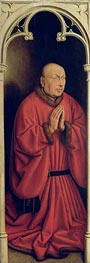
Canvas Print
$62.05
$62.05
SKU: 7869-EJV
Jan van Eyck
Original Size:unknown
Saint Bavo Cathedral, Ghent, Belgium
Jan van Eyck
Original Size:unknown
Saint Bavo Cathedral, Ghent, Belgium
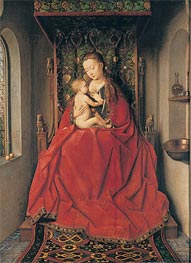
Canvas Print
$69.42
$69.42
SKU: 7844-EJV
Jan van Eyck
Original Size:65.5 x 49.5 cm
Städel Museum, Frankfurt, Germany
Jan van Eyck
Original Size:65.5 x 49.5 cm
Städel Museum, Frankfurt, Germany
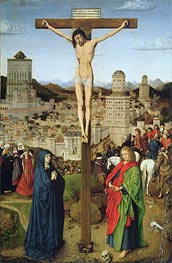
Canvas Print
$62.05
$62.05
SKU: 7871-EJV
Jan van Eyck
Original Size:46 x 31 cm
Galleria G. Franchetti alla Ca' d'Oro, Venice, Italy
Jan van Eyck
Original Size:46 x 31 cm
Galleria G. Franchetti alla Ca' d'Oro, Venice, Italy
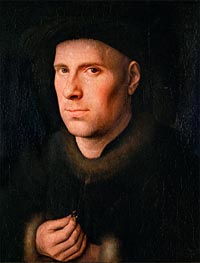
Canvas Print
$62.05
$62.05
SKU: 15728-EJV
Jan van Eyck
Original Size:24.6 x 19.2 cm
Kunsthistorisches Museum, Vienna, Austria
Jan van Eyck
Original Size:24.6 x 19.2 cm
Kunsthistorisches Museum, Vienna, Austria
Canvas Print
$62.05
$62.05
SKU: 7870-EJV
Jan van Eyck
Original Size:unknown
Saint Bavo Cathedral, Ghent, Belgium
Jan van Eyck
Original Size:unknown
Saint Bavo Cathedral, Ghent, Belgium
Canvas Print
$62.05
$62.05
SKU: 15729-EJV
Jan van Eyck
Original Size:36 x 24 cm
Kunsthistorisches Museum, Vienna, Austria
Jan van Eyck
Original Size:36 x 24 cm
Kunsthistorisches Museum, Vienna, Austria
Canvas Print
$88.91
$88.91
SKU: 3172-EJV
Jan van Eyck
Original Size:66 x 62 cm
Louvre Museum, Paris, France
Jan van Eyck
Original Size:66 x 62 cm
Louvre Museum, Paris, France