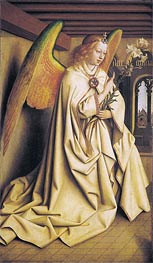
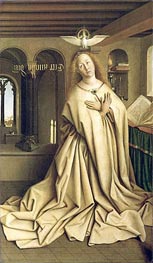
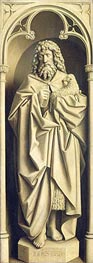
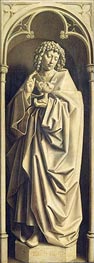
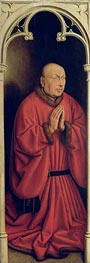
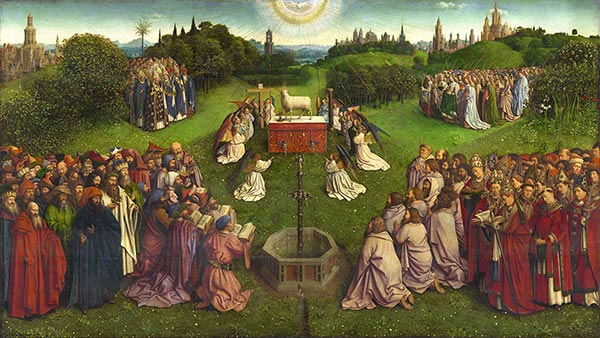
The Adoration of the Mystic Lamb (The Ghent Altarpiece), 1432 by Jan van Eyck
Canvas Print - 7864-EJV

Location: Saint Bavo Cathedral, Ghent, Belgium
Original Size: 137.7 × 242.3 cm

Own a museum-grade giclée Canvas Print of The Adoration of the Mystic Lamb (The Ghent Altarpiece) by Jan van Eyck (1432). It is printed with archival pigments on 400 g/m² canvas and hand-varnished with a UV-protective layer. Set your exact proportional size—anything up to 41.2 × 71.7 in, with optional framing. Free worldwide shipping for rolled artworks. Unframed prints ship within 48 h, framed prints in 7-8 days. Guaranteed 100-year color durability.
The Adoration of the Mystic Lamb (The Ghent Altarpiece), 1432 | Jan van Eyck | Giclée Canvas Print

Giclée Canvas Print | $56.11 USD

1 Review

Your Selection

SKU:7864-EJV
Print Size

Customize Your Print

By using the red up or down arrows, you have the option to proportionally increase or decrease the printed area in inches as per your preference.

*Max printing size: 41.2 × 71.7 in
*Max framing size: Long side up to 28"

If you want a painting which is not in our catalogue

Your Questions Answered: Fine Art Prints, Framing, Care & Delivery

Giclée Print Quality 400 g/m² Canvas (Satin Gloss) + 1.2 in Borders for Stretching 100+ Year Colour Guarantee Free WorldWide Shipping!

Most people search for “canvas print” or “wall art” - but what they’re really looking for is a giclée print: a museum-grade reproduction of the original masterpiece, printed with archival pigment inks on fine art canvas.

Giclée (pronounced 'zhee-clay') is a French term meaning 'to spray,' referring to how ink is precisely sprayed onto canvas or paper, creating incredibly detailed fine art prints. It’s the gold standard in museum-quality printing, loved by artists, galleries, and museums worldwide.

Your artwork will be printed on premium canvas using vibrant archival inks, faithfully capturing every brushstroke and subtle nuance of Jan van Eyck's original. To ensure lasting beauty, each print is finished with a protective UV varnish. Far superior to ordinary posters, your canvas print will look and feel like a real painting, retaining its vivid colors and pristine details for more than 100 years.

About Giclée Fine Art Printing

Here's a simple trick: use painter’s tape to mark the print size directly on your wall, and step back to see how it feels. Generally, larger sizes around 36 in wide work beautifully in living rooms or open spaces. Medium sizes around 24 in fit nicely in bedrooms, hallways, or offices. Hanging it above a sofa? Choose a print that's roughly two-thirds the width of your couch. Still unsure? Start with our popular 12.4 × 21.7 in size—it fits comfortably in most spaces!

For a more artistic approach: choosing a size closer to the original artwork ensures you experience the artist’s intended visual impact and authenticity. Of course, since most of us don't live in spacious baroque palaces, your available space and personal taste should ultimately guide your decision.

In many cases, yes! If you need a specific size to fit a particular space or frame, feel free to reach out—we're happy to see what’s possible. Because each print is made to order, we can often accommodate custom dimensions as long as they respect the proportions of the original painting.Just send us an email at info@topartprint.com with the title of the artwork and the size you're looking for. We’ll get back to you quickly with options and pricing.

Good to know: when you choose the size of your artwork, the Print Size shown in the Your Selection box refers to the actual image area—that’s the part you’ll see once the canvas is stretched or framed.

The Total Size includes an additional 1.2 in white border on each side, added specifically for stretching.
So yes—this white border is added on top of your selected print size. You get the full artwork at the dimensions you picked, plus extra canvas to make stretching smooth and professional.

For example, if you select a 12.4 × 21.7 in print, the full canvas you receive will measure 14.8 × 24.0 in—giving your framer plenty of room to create a clean, gallery-quality stretch.

Both options are wonderful choices! Going unframed gives you maximum flexibility—you can take your print to a local framing shop for personalized options and expert advice tailored to your décor. This is especially great if you have specific design ideas or want to match existing frames in your home.

However, keep in mind that a print truly comes to life when properly framed. Art professionals often say: 'The frame contributes 30% of the artwork’s overall impact.' A well-chosen frame elevates and completes your print.

If you choose our framing option, your print will arrive professionally framed and ready to hang right out of the box. We focus exclusively on traditional framing methods, ensuring every artwork receives the respectful presentation it deserves—this is why we don't offer gallery wrap options.

Important shipping note: Due to courier restrictions, we can ship framed prints up to 28 in on the longest side. Larger prints will arrive safely rolled in a tube, ready for you to frame locally.

For more detailed information, please see our complete guide to fine art framing methods.

We've carefully selected this premium canvas because it brings out the absolute best in Jan van Eyck's work. Made from natural cotton with a 400 g/m² weight, it has just the right texture to capture every brushstroke and detail of the original painting.

What makes our canvas special? The satin-gloss finish. Think of how paintings look in museums with that beautiful varnish—that's exactly the effect we're going for. This glossy surface makes colors pop with incredible vibrancy while giving deep, rich blacks that matte canvases simply can't achieve. The result? Your print has that authentic 'real painting' look with extraordinary depth and life.

Plus, our canvas is acid-free and pH-neutral, so it'll stay beautiful for generations. We believe The Adoration of the Mystic Lamb (The Ghent Altarpiece) deserves nothing less than this museum-quality treatment.

Every print is made just for you—no mass production here! Once you place your order, we begin creating your The Adoration of the Mystic Lamb (The Ghent Altarpiece) print with care and precision.

Unframed prints are crafted in 1–3 business days.
Framed prints take 7–8 business days to build and finish.

Shipping options:
Standard Delivery (Free): Up to two unframed prints per order, provided that the short side does not exceed 59 cm (approx. 23 inches), with delivery in 10–14 working days.
Express Shipping: Delivered in 2–4 working days; costs vary by weight, volume, and destination. After adding the artwork to your cart, use the Shipping estimates tool there for exact pricing.

Note for framed prints: Because they’re bulkier and higher-value, framed artworks ship only via express tracked service and do not qualify for free standard delivery.

Packaging:
Unframed prints: Safely rolled in postal tubes.
Framed prints: Packed in reinforced boxes with corner protectors and bubble wrap.

You’ll receive a tracking number as soon as your order leaves our studio—so you can follow every step of its journey!

It’s super easy! Your giclée print is designed to last over 100 years when properly displayed. We’ve already applied a UV-protective varnish, so there’s no need for any extra treatments on your part.

Just follow these simple tips:
  • Hang your print away from direct sunlight and high humidity
  • Dust gently with a soft, dry cloth if needed
  • Avoid touching the printed surface directly
  • Keep the room temperature relatively stable
That’s it! With these basic precautions, your Jan van Eyck print will retain its vibrant colors and pristine condition for generations to come.

We want you to truly love your art. Since each piece is custom-made just for you, we kindly recommend double-checking the size and details before placing your order. But if something’s not right—especially in terms of quality—we’re here to help and will make it right.

We offer a 30-day return policy and accept returns for items damaged during shipping. Our return process is simple and straightforward:
Step 1 – Let us know: Send an email to info@topartprint.com with your order number and a brief explanation of the issue.
Step 2 – Send it back: We’ll reply with clear instructions for returning the print. Please return it in its original packaging and in good condition. You cover return shipping (unless we sent a damaged/incorrect item). After inspection, we'll send a replacement or refund the product price.
Please note: shipping costs are non-refundable.

For framed artworks: Since framed prints are handcrafted specifically for your order, returns are accepted only at our discretion and require a valid reason. But don’t worry—our support team is friendly, responsive, and ready to assist.

About the Painting

The city spires in the distance might be Jerusalem, yet they remain curiously reminiscent of the late medieval world. This interplay between biblical symbolism and quotidian reality is precisely what stands out in the Adoration of the Mystic Lamb. Here, the senses are intrigued by a landscape so lush and detailed that each bush, tree, and flower seems singled out for praise. In that background, one detects a softly receding horizon, the buildings bristling with steeples and turrets, as if the entire earthly realm is ready to converge on a single point. That point is the altar, placed at the very heart of this painting, where the Lamb of God looks out with a startlingly direct gaze.

What first captures the eye is the overall structure. The composition directs our attention via a broad, horizontal gathering of figures - carefully orchestrated clusters of martyrs, prophets, and ecclesiastics - toward the altar and the Lamb. At the same time, a vertical axis descends from a hovering dove, representing the Holy Spirit, through the Lamb, then down to the exquisitely rendered fountain in the foreground. With this subtle geometry, the painter asks us to consider dual realms: a spiritual one above and a worldly one below. The effect is a clever fusion of heaven and earth, reinforced by the lines of saints that approach from both sides, guiding the viewer’s sight along a ceremonious route to the center. The crowd is neither chaotic nor overly regimented; there is movement, yet everyone’s focus converges on the Lamb.

The color palette is arresting in its range and intensity. Softer, mossy greens fade into stronger, emerald tones, painting the meadow with a lifelike variation of hues. Robes worn by saints sway between pastel pink and cardinal red, so luminous that they almost shimmer in the open air. Meanwhile, a pristine sky graduates from a gentle blue near the horizon to a richer tone at the top, leading the viewer’s eye skyward. Each hue is laid out with the sort of painstaking clarity that would later become a hallmark of the Northern Renaissance. One can almost feel the moisture in the air as rays of light, depicted as thin golden beams emanating from the dove, fall across the saints in the foreground. Such radiance contrasts sharply with the denser glow of the altar’s red cloth, elevating its prominence.

This use of oil-based painting, still a relatively fresh method in 15th-century Northern Europe, allowed the artist to articulate textures and reflections with exceptional clarity. Unlike the matte, quicker-drying qualities of tempera, the slow build-up of oil glazes results in a near-magical sense of depth. The angels around the altar, each with vividly tinted wings, display an array of color transitions so carefully modulated that their plumage appears to pulse. The Lamb’s wool, expertly modeled with subtle tonal shifts, further conveys the tactile promise of the medium. Each fold in the robes, every gem in the fountain’s basin, glistens as if catching the morning light. This balance between microscopic detail and broader compositional harmony has been widely noted as a crowning achievement of early Netherlandish art.

The painting’s historical resonance is equally compelling. Conceived in an epoch when theology held tremendous sway, it encapsulates a culture that saw the sacred in every corner of earthly life. The painter brings to bear a litany of references - from the precise renditions of Old Testament prophets on one side to the neatly lined ranks of apostles on the other - that would have felt both familiar and urgent to a 15th-century audience. The Lamb’s injury, blood flowing steadily into a chalice without conveying physical distress, underscores the doctrine of Christ’s redemptive sacrifice. Meanwhile, the gathering of popes, an antipope, and various church figures can be read as an allusion to the Western Schism - the painting nods at political rifts without sacrificing its overarching message of unity and devotion.

In the lower foreground, the fountain of life glitters with ornate detail, reflecting a belief in the redemptive waters that proceed from the throne of God. Significantly, it aligns along that same vertical axis shared by Lamb and dove, implying that the blood, spirit, and water all unite to sanctify the scene. Nearby, the male and female martyrs progress through the foliage in separate paths, subtly reminding us of the many roads that lead toward the divine. Carefully depicted plants appear in such variety that entire scholarly tracts have focused on identifying them - from pomegranate and date palm to woodruff and daisies. These plants, some with medicinal properties, hint at symbolic overtones of healing, fertility, and renewal.

Yet no less fascinating is the brisk realism that informs the painting’s every inch. This realism does not, however, preclude the presence of the miraculous. If one looks closely, the light that beams from the dove in the sky casts no shadow - an indication that we have entered a sacred realm unbounded by ordinary rules of illumination. The overall effect is neither rapturous nor austere, but quietly wondrous. It's a demonstration of how a sophisticated devotion can coexist with a close, nearly scientific study of the natural world.

As one stands before this majestic work, the mind is inevitably drawn into dialogue with the multitude of characters assembled. Their presence feels intimate, as if they have emerged from the pages of scripture or the corners of history to populate this garden. This conscious merging of exacting detail, theological symbolism, and human presence is what lends the altarpiece such potency. Though centuries have passed, the painting's internal radiance remains both tangible and elusive, a testament to an artist deeply invested in rendering visible the boundary where the material and spiritual worlds overlap. The Lamb, unmoved amid the throng, stands as a serene pivot, quietly insisting that the truly sacred can be found in the most precise and hard-earned details of the painted surface.

For all its religious themes, this scene is not purely mystical. It is also an invitation to observe with fresh eyes - to witness the shimmering brocades, the refined embroidery, the reflective shimmer of water - and to reflect on how an intense gaze can uncover layers of meaning beyond everyday perception. In that confluence of close-looking and theological meditation lies the secret of this altarpiece. It demonstrates how art can expand the boundaries of vision and still nod toward the mysteries of faith, seamlessly blending a world that is minutely real with one that is unashamedly divine.

1 Reviews

1 Review

5.00 Overall rating

5
1
4
0
3
0
2
0
1
0

User Avatar
Patrick  Verified Icon Verified Buyer
3rd March 2025 7:18pm
Excellent product and service
1. Received print within the expected arrival time stated.
2. Print quality is excellent.
3. Seller was very helpful to include my country as a shipping destination. Extremely satisfied with the quality of service and the product
User Avatar
TopArtPrint
Thank you, Patrick, for this review. I'm glad that you're happy with the print!
Top