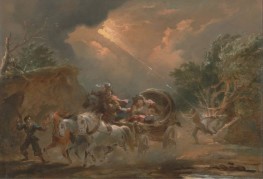
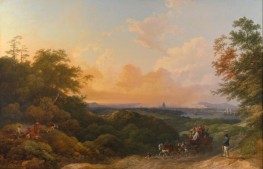
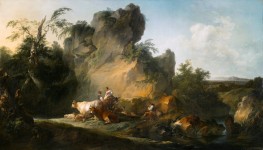
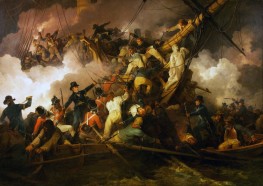
Philip James de Loutherbourg Giclée Fine Art Prints 1 of 2
1740-1812
French Romanticism Painter
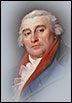
In a London room in the spring of 1781, some hundred and thirty people sat in near darkness and watched the sun set over a stage six feet wide and eight feet deep. Clouds gathered, light drained from painted water, and a storm arrived exactly on cue. The man behind that small miracle was Philip James de Loutherbourg (31 October 1740 - 11 March 1812), born Philippe Jacques de Loutherbourg in Strasbourg and later a fixture of British art - landscapist, marine painter, designer for the London stage, and a technician of illusion whose ambitions ran well past the picture frame.
Destined by his family for the Lutheran ministry, he was educated at the University of Strasbourg and expected to preach. His father, a Swiss miniature painter, had given him a different kind of grounding: the discipline of small surfaces and exact detail. The pulpit lost. In 1755 Loutherbourg went to Paris and entered the studio of Charles-André van Loo, working afterwards under Francesco Giuseppe Casanova, a specialist in battle pieces and animated landscape.
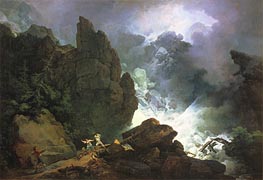
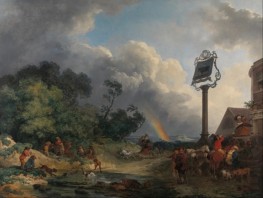
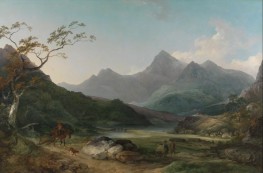
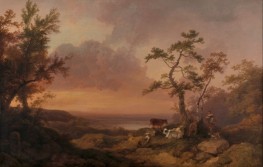
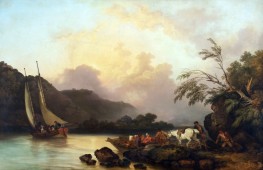
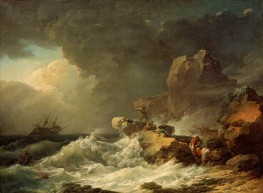
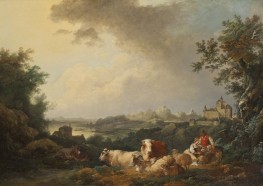
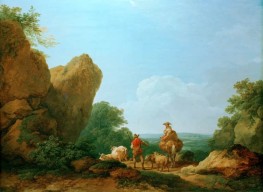
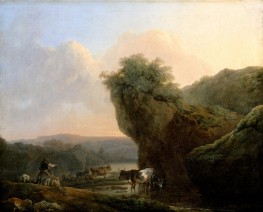
Paris took to him quickly. At the Salon of 1763 his Landscape with Figures and Animals drew praise from Denis Diderot, whose approval was not casually given. Two years later the Salon of 1765 brought further success, Morning After the Rain among the works shown. His debut group ran to twelve canvases, including Storm at Sunset and Night, and it staked out a range - weather, catastrophe, cattle, coastline - that he never really abandoned. Election to the French Academy followed in 1767, granted although he was younger than the institution's own rules allowed.
Then came the wandering years. Travelling through Switzerland, Germany and Italy, Loutherbourg attracted as much attention for his mechanical contrivances as for his canvases. One model theatre in particular became a talking point: lamps set behind stretched canvas to serve as moon and stars, water suggested by sheets of clear blue metal and gauze threaded with loose silver. Nobody had quite seen landscape handled this way - as something to be lit, timed and moved.
London settled the matter. Arriving in 1771, he was engaged by David Garrick at £500 a year to design scenery and costumes for the Theatre Royal, Drury Lane, and to take charge of its stage machinery. It was an extraordinary salary for such work, and Garrick got his money's worth. Loutherbourg made green foliage turn russet as a scene progressed; he raised a moon that caught the edges of passing cloud. Coloured lantern slides and carefully lit transparencies did the work, and painters came to look - Joshua Reynolds among them. He remained at the theatre until 1785.
The Eidophusikon, opened at his own house in March 1781, pushed the experiment further. Its name meant image of nature, and its billing promised imitations of natural phenomena set in motion. Argand lamps lit the miniature stage, stained glass shifted the colour of that light, and an auditorium of roughly a hundred and thirty seats faced a proscenium no larger than a generous window. At Christmas that year Loutherbourg staged a spectacle in the Egyptian Hall at Fonthill for William Beckford, who was told to expect something no eye had yet seen. Later programmes turned to Milton, with Satan mustering his legions beside the fiery lake and Pandemonium rising out of it. Audiences wanted new scenes faster than one man could invent them, and receipts never covered costs. The venture closed. He is sometimes credited with inventing the panorama, but that honour belongs to the Scottish painter Robert Barker, whose version appeared at much the same moment.
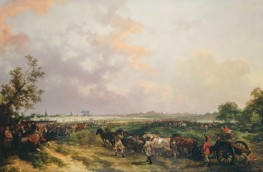
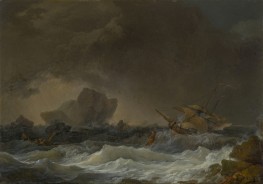
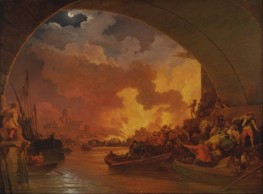
Painting continued regardless. Elected to the Royal Academy in 1781, Loutherbourg found a second career commemorating British naval victories, a genre the wars with France made both urgent and lucrative. Lord Howe's Action, or the Glorious First of June, exhibited in 1795, belongs to a category of picture demanding smoke, rigging and mass action on a scale few painters could organise. The Defeat of the Spanish Armada of 1796 is the finer thing: a reconstruction of 1588 painted with a marine specialist's grasp of how canvas behaves in a gale. Both hung in the Greenwich Hospital Gallery and remain today in the National Maritime Museum. He also produced The Great Fire of London, The Grand Attack on Valenciennes of 1793, and a painting of the Battle of Maida that reached a wider public through engraving.
One picture stands apart from all of it. Coalbrookdale by Night, painted in 1801, shows the Shropshire iron foundries burning through the dark, a landscape in which the sublime has changed hands: no longer alpine, no longer divine, but industrial. Loutherbourg had watched the Industrial Revolution arrive and understood what it looked like. It looked like fire. Seven of his works, among them Lodore Waterfall and Skating in Hyde Park, are held in the Government Art Collection.
His printed work deserves more notice than it receives. Two sets of drawings appeared in aquatint as Picturesque English Scenery, in 1801 and 1805, and he supplied illustrations to the Bible published by Thomas Macklin in 1800. Cadell and Davies issued a volume of the Apocrypha after his death. All 110 of his vignette drawings are pasted into the Bowyer Bible, now in Bolton Museum in Greater Manchester - an object more often described than examined.
In 1789 he put down his brushes altogether. Alchemy and the supernatural claimed him; he met Alessandro Cagliostro, took instruction from him in the occult, and travelled in his company, prudently parting before the adventurer's condemnation to death. With his wife he then took up faith-healing at Hammersmith Terrace, and a follower named Mary Pratt published a pamphlet in 1789 claiming the couple had cured two thousand people in barely seven months. It is easy to read this as an aberration. Perhaps it was not. A man who had spent ten years persuading paying audiences that gauze and lamplight were weather may have found the frontier between illusion and revelation less firmly drawn than his contemporaries did.
Philip James de Loutherbourg died at Chiswick in west London in 1812 and lies in the old cemetery beside St Nicholas Church, close to William Hogarth and, in time, to Whistler - a plot of ground carrying a remarkable weight of English painting. His pictures hang in Tate Britain, the Victoria and Albert Museum, the National Portrait Gallery, the Royal Academy, and the galleries of Leicester, Farnham and Derby. Reputation has treated him unevenly. The naval pieces brought money and a certain official standing; the Eidophusikon brought a footnote in the prehistory of cinema, which is arguably the larger claim. Every darkened room in which an audience agrees to accept moving light as landscape descends, however distantly, from that six-by-eight-foot stage. Loutherbourg understood something we have since built industries upon: that the appetite for looking is also an appetite for being deceived, willingly, and in comfort.