
Pietro Longhi Giclée Fine Art Prints 1 of 2
c.1702-1785
Italian Rococo Painter
A rhinoceros came to Venice in 1751, and half the city queued to see it. Pietro Longhi (5 November 1701 - 8 May 1785) went along, then painted the onlookers rather than the animal. Venetian by birth and by instinct, he made the small canvas his stage and the ordinary hour his subject, and no other Italian painter of the eighteenth century watched his own society quite so closely.
He arrived in the parish of Santa Maria, eldest child of the silversmith Alessandro Falca and his wife Antonia. Falca was the name on the baptismal register; Longhi was the one he adopted once he took up the brush, and the one Venice remembered. Antonio Balestra, a Veronese working in the city, gave him his first training and then sent him to Bologna, into the studio of Giuseppe Maria Crespi. Crespi was admired in those years for altarpieces and for scenes of humble labour alike, and he had looked hard at Dutch painting. That lesson - that a kitchen or a laundry could carry the full weight of art - stayed with the younger man. Longhi was back in Venice before 1732. In that same year he married Caterina Maria Rizzi, who bore him eleven children; only three reached adulthood.
Ambition, at first, pointed upward. His earliest securely documented commission was an altarpiece for the church of San Pellegrino, delivered in 1732. Two years later he stood on the scaffolding at Ca' Sagredo, covering the walls and ceiling of the hall with the Death of the Giants - bodies foreshortened against open sky, quadratura illusion, decorative thunder in the accepted Venetian manner. The work is accomplished. It is also curiously unfelt, and he never pursued that direction far.
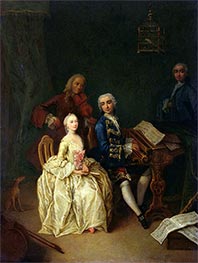
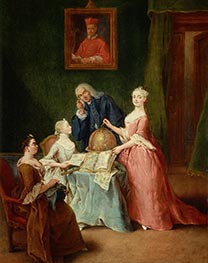
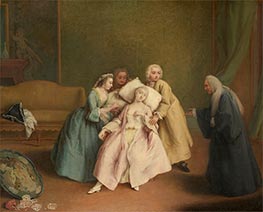
By the late 1730s he had shrunk his formats and widened his subject. Cabinet-sized pictures began leaving the studio in quantity: drawing rooms, dressmakers, dancing lessons, the barber at his trade, and the gaming halls known as ridotti that multiplied across the city in those decades. Venetian collectors bought them as fast as he could supply them. Here was a republic in its long, elegant decline, less interested in mythology than in itself, and Longhi held up a mirror scaled to the private room.
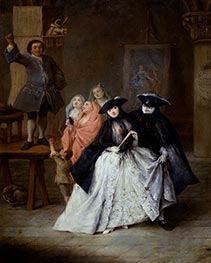
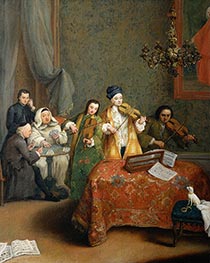
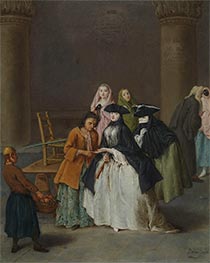
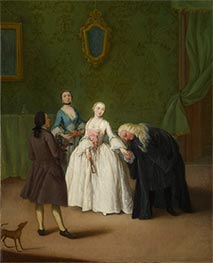
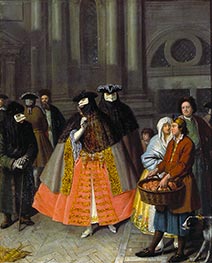
Behind nearly half of his figures there is no face at all, only the white or black oval of a carnival mask. In The Meeting of 1746, a wife is greeted by her husband, both unmasked, while at the left a seated woman lowers her moretta to address the masked man leaning over her shoulder. The moretta had no opening for the mouth; silence was its price, and setting it aside meant declaring oneself. The Charlatan of 1757 pushes its mountebank to the back, up on a table among admiring women and a boy, while in the foreground a masked man lifts the hem of a lady's dress and she busies herself with a fan. The Ridotto in Venice repeats that pairing inside a crowd. Masks conceal identity and licence appetite at once, and Longhi understood the bargain exactly.
Critics have called his figures puppet-like: delicate, stiff-jointed, faintly absurd in their poise. The charge holds, yet it describes a choice rather than a limit. His earlier history paintings and his drawings of every period show a hand entirely capable of solid anatomy. Working in black chalk or pencil heightened with white on tinted paper, he drew constantly, and many sheets were made for no painting at all - independent works, done for their own sake. In the 1750s, following Crespi's precedent, he produced seven canvases on the seven sacraments of the Catholic church; these hang today in the Pinacoteca Querini Stampalia, alongside his hunting scenes, the Caccia.
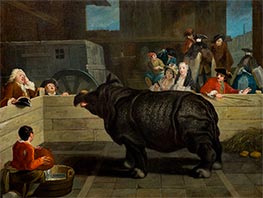
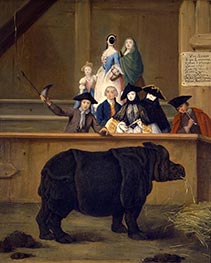
Clara the rhinoceros had reached Europe in 1741 in the care of a Dutch sea captain and impresario from Leyden, Douvemont van der Meer, and was exhibited in Venice ten years later. Longhi painted her twice, in versions so alike that the differences repay attention: the Ca' Rezzonico canvas carries the unmasked portraits of two men, where the version now in the National Gallery in London does not. On the left, a young man displays the animal's sawn-off horn. Venetians would have caught the joke at once - a horn, in the idiom of the day, belonged to the cuckold - and the unchaperoned women sharpen it.
From 1763 Longhi served as Director of the Academy of Drawing and Carving, and portraiture claimed a growing share of his time. His son Alessandro, an accomplished portraitist in his own right, worked actively at his side. Perhaps, after decades of crowded rooms, a single sitter came as a kind of rest. He died on 8 May 1785 after a short illness, in the city that had furnished him with nearly every subject he ever painted.
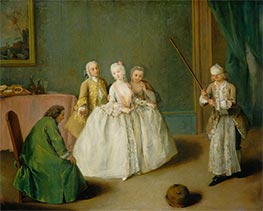
Italy produced other capable painters of modern life - Gaspare Traversi in the south, Crespi in Bologna - but the achievement here is local and singular. Pietro Longhi abandoned the grand mythologies that flattered the Venetian nobility and took up residence in their present tense instead. If Canaletto and Guardi show us the republic out of doors, in regatta and procession, Longhi shows us what happened behind the shutters. Bernard Berenson heard sound in these pictures: the barber's gossip, the maid's chatter, a violin in the dancing school, and no tragic note anywhere. That absence is the substance of him. Hogarth, the Englishman to whom he is perpetually compared, moralises and warns; Longhi simply notices, with courtesy and a faint smile. La lezione di danza, painted around 1741 and now in the Gallerie dell'Accademia in Venice, holds his whole temperament: a girl, a fiddle, a lesson, an afternoon. Two and a half centuries later, in an age that photographs its own dinners, the impulse he served looks entirely familiar - and his small rooms have kept their charge.
He arrived in the parish of Santa Maria, eldest child of the silversmith Alessandro Falca and his wife Antonia. Falca was the name on the baptismal register; Longhi was the one he adopted once he took up the brush, and the one Venice remembered. Antonio Balestra, a Veronese working in the city, gave him his first training and then sent him to Bologna, into the studio of Giuseppe Maria Crespi. Crespi was admired in those years for altarpieces and for scenes of humble labour alike, and he had looked hard at Dutch painting. That lesson - that a kitchen or a laundry could carry the full weight of art - stayed with the younger man. Longhi was back in Venice before 1732. In that same year he married Caterina Maria Rizzi, who bore him eleven children; only three reached adulthood.
Ambition, at first, pointed upward. His earliest securely documented commission was an altarpiece for the church of San Pellegrino, delivered in 1732. Two years later he stood on the scaffolding at Ca' Sagredo, covering the walls and ceiling of the hall with the Death of the Giants - bodies foreshortened against open sky, quadratura illusion, decorative thunder in the accepted Venetian manner. The work is accomplished. It is also curiously unfelt, and he never pursued that direction far.
By the late 1730s he had shrunk his formats and widened his subject. Cabinet-sized pictures began leaving the studio in quantity: drawing rooms, dressmakers, dancing lessons, the barber at his trade, and the gaming halls known as ridotti that multiplied across the city in those decades. Venetian collectors bought them as fast as he could supply them. Here was a republic in its long, elegant decline, less interested in mythology than in itself, and Longhi held up a mirror scaled to the private room.
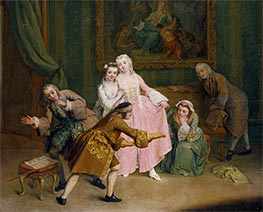
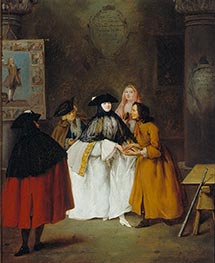
Behind nearly half of his figures there is no face at all, only the white or black oval of a carnival mask. In The Meeting of 1746, a wife is greeted by her husband, both unmasked, while at the left a seated woman lowers her moretta to address the masked man leaning over her shoulder. The moretta had no opening for the mouth; silence was its price, and setting it aside meant declaring oneself. The Charlatan of 1757 pushes its mountebank to the back, up on a table among admiring women and a boy, while in the foreground a masked man lifts the hem of a lady's dress and she busies herself with a fan. The Ridotto in Venice repeats that pairing inside a crowd. Masks conceal identity and licence appetite at once, and Longhi understood the bargain exactly.
Critics have called his figures puppet-like: delicate, stiff-jointed, faintly absurd in their poise. The charge holds, yet it describes a choice rather than a limit. His earlier history paintings and his drawings of every period show a hand entirely capable of solid anatomy. Working in black chalk or pencil heightened with white on tinted paper, he drew constantly, and many sheets were made for no painting at all - independent works, done for their own sake. In the 1750s, following Crespi's precedent, he produced seven canvases on the seven sacraments of the Catholic church; these hang today in the Pinacoteca Querini Stampalia, alongside his hunting scenes, the Caccia.
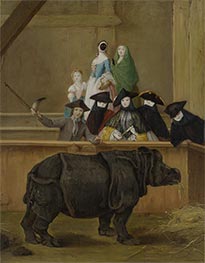
Clara the rhinoceros had reached Europe in 1741 in the care of a Dutch sea captain and impresario from Leyden, Douvemont van der Meer, and was exhibited in Venice ten years later. Longhi painted her twice, in versions so alike that the differences repay attention: the Ca' Rezzonico canvas carries the unmasked portraits of two men, where the version now in the National Gallery in London does not. On the left, a young man displays the animal's sawn-off horn. Venetians would have caught the joke at once - a horn, in the idiom of the day, belonged to the cuckold - and the unchaperoned women sharpen it.
From 1763 Longhi served as Director of the Academy of Drawing and Carving, and portraiture claimed a growing share of his time. His son Alessandro, an accomplished portraitist in his own right, worked actively at his side. Perhaps, after decades of crowded rooms, a single sitter came as a kind of rest. He died on 8 May 1785 after a short illness, in the city that had furnished him with nearly every subject he ever painted.
Italy produced other capable painters of modern life - Gaspare Traversi in the south, Crespi in Bologna - but the achievement here is local and singular. Pietro Longhi abandoned the grand mythologies that flattered the Venetian nobility and took up residence in their present tense instead. If Canaletto and Guardi show us the republic out of doors, in regatta and procession, Longhi shows us what happened behind the shutters. Bernard Berenson heard sound in these pictures: the barber's gossip, the maid's chatter, a violin in the dancing school, and no tragic note anywhere. That absence is the substance of him. Hogarth, the Englishman to whom he is perpetually compared, moralises and warns; Longhi simply notices, with courtesy and a faint smile. La lezione di danza, painted around 1741 and now in the Gallerie dell'Accademia in Venice, holds his whole temperament: a girl, a fiddle, a lesson, an afternoon. Two and a half centuries later, in an age that photographs its own dinners, the impulse he served looks entirely familiar - and his small rooms have kept their charge.
44 Pietro Longhi Artworks
Page 1 of 2
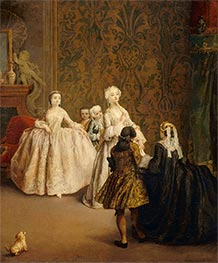
Giclée Canvas Print
$80.21
$80.21
SKU: 19155-LOP
Pietro Longhi
Original Size:66 x 55 cm
Louvre Museum, Paris, France
Pietro Longhi
Original Size:66 x 55 cm
Louvre Museum, Paris, France
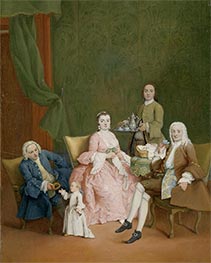
Giclée Canvas Print
$77.39
$77.39
SKU: 19171-LOP
Pietro Longhi
Original Size:60.2 x 48.2 cm
Rijksmuseum, Amsterdam, Netherlands
Pietro Longhi
Original Size:60.2 x 48.2 cm
Rijksmuseum, Amsterdam, Netherlands
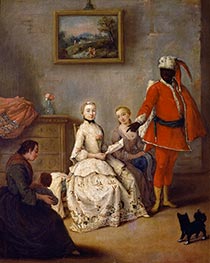
Giclée Canvas Print
$77.39
$77.39
SKU: 19178-LOP
Pietro Longhi
Original Size:62 x 50 cm
Palazzo Ca' Rezzonico, Venice, Italy
Pietro Longhi
Original Size:62 x 50 cm
Palazzo Ca' Rezzonico, Venice, Italy
Giclée Canvas Print
$78.10
$78.10
SKU: 19173-LOP
Pietro Longhi
Original Size:48.7 x 60.5 cm
The Royal Collection, London, UK
Pietro Longhi
Original Size:48.7 x 60.5 cm
The Royal Collection, London, UK
Giclée Canvas Print
$79.33
$79.33
SKU: 19179-LOP
Pietro Longhi
Original Size:62 x 50 cm
Palazzo Ca' Rezzonico, Venice, Italy
Pietro Longhi
Original Size:62 x 50 cm
Palazzo Ca' Rezzonico, Venice, Italy
Giclée Canvas Print
$75.11
$75.11
SKU: 19160-LOP
Pietro Longhi
Original Size:60.4 x 47 cm
National Gallery, London, UK
Pietro Longhi
Original Size:60.4 x 47 cm
National Gallery, London, UK
Giclée Canvas Print
$79.15
$79.15
SKU: 19180-LOP
Pietro Longhi
Original Size:60 x 51 cm
Palazzo Ca' Rezzonico, Venice, Italy
Pietro Longhi
Original Size:60 x 51 cm
Palazzo Ca' Rezzonico, Venice, Italy
Giclée Canvas Print
$72.82
$72.82
SKU: 19152-LOP
Pietro Longhi
Original Size:56.5 x 43.8 cm
Fine Arts Museums of San Francisco, California, USA
Pietro Longhi
Original Size:56.5 x 43.8 cm
Fine Arts Museums of San Francisco, California, USA
Giclée Canvas Print
$77.57
$77.57
SKU: 19177-LOP
Pietro Longhi
Original Size:62 x 50 cm
Palazzo Ca' Rezzonico, Venice, Italy
Pietro Longhi
Original Size:62 x 50 cm
Palazzo Ca' Rezzonico, Venice, Italy
Giclée Canvas Print
$76.51
$76.51
SKU: 17305-LOP
Pietro Longhi
Original Size:63 x 50 cm
Musei Civici, Padua, Italy
Pietro Longhi
Original Size:63 x 50 cm
Musei Civici, Padua, Italy
Giclée Canvas Print
$77.92
$77.92
SKU: 19168-LOP
Pietro Longhi
Original Size:50 x 61.7 cm
National Gallery of Art, Washington, USA
Pietro Longhi
Original Size:50 x 61.7 cm
National Gallery of Art, Washington, USA
Giclée Canvas Print
$77.39
$77.39
SKU: 17306-LOP
Pietro Longhi
Original Size:60 x 48 cm
Gallerie dell'Accademia, Venice, Italy
Pietro Longhi
Original Size:60 x 48 cm
Gallerie dell'Accademia, Venice, Italy
Giclée Canvas Print
$78.45
$78.45
SKU: 19164-LOP
Pietro Longhi
Original Size:61.3 x 49.5 cm
National Gallery, London, UK
Pietro Longhi
Original Size:61.3 x 49.5 cm
National Gallery, London, UK
Giclée Canvas Print
$77.39
$77.39
SKU: 19167-LOP
Pietro Longhi
Original Size:59 x 48.6 cm
National Gallery, London, UK
Pietro Longhi
Original Size:59 x 48.6 cm
National Gallery, London, UK
Giclée Canvas Print
$77.74
$77.74
SKU: 19169-LOP
Pietro Longhi
Original Size:50 x 61.7 cm
National Gallery of Art, Washington, USA
Pietro Longhi
Original Size:50 x 61.7 cm
National Gallery of Art, Washington, USA
Giclée Canvas Print
$72.82
$72.82
SKU: 19191-LOP
Pietro Longhi
Original Size:55.5 x 72 cm
Public Collection
Pietro Longhi
Original Size:55.5 x 72 cm
Public Collection
Giclée Canvas Print
$69.89
$69.89
SKU: 19154-LOP
Pietro Longhi
Original Size:41 x 53.3 cm
J. Paul Getty Museum, Los Angeles, USA
Pietro Longhi
Original Size:41 x 53.3 cm
J. Paul Getty Museum, Los Angeles, USA
Giclée Canvas Print
$76.87
$76.87
SKU: 19148-LOP
Pietro Longhi
Original Size:62 x 51 cm
Public Collection
Pietro Longhi
Original Size:62 x 51 cm
Public Collection
Giclée Canvas Print
$78.27
$78.27
SKU: 19165-LOP
Pietro Longhi
Original Size:61.3 x 49.5 cm
National Gallery, London, UK
Pietro Longhi
Original Size:61.3 x 49.5 cm
National Gallery, London, UK
Giclée Canvas Print
$87.77
$87.77
SKU: 19184-LOP
Pietro Longhi
Original Size:61 x 50 cm
Palazzo Ca' Rezzonico, Venice, Italy
Pietro Longhi
Original Size:61 x 50 cm
Palazzo Ca' Rezzonico, Venice, Italy
Giclée Canvas Print
$77.22
$77.22
SKU: 19182-LOP
Pietro Longhi
Original Size:61 x 50 cm
Palazzo Ca' Rezzonico, Venice, Italy
Pietro Longhi
Original Size:61 x 50 cm
Palazzo Ca' Rezzonico, Venice, Italy
Giclée Canvas Print
$74.58
$74.58
SKU: 19150-LOP
Pietro Longhi
Original Size:73.7 x 64 cm
Art Institute of Chicago, Illinois, USA
Pietro Longhi
Original Size:73.7 x 64 cm
Art Institute of Chicago, Illinois, USA
Giclée Canvas Print
$78.10
$78.10
SKU: 19175-LOP
Pietro Longhi
Original Size:62 x 50 cm
Palazzo Ca' Rezzonico, Venice, Italy
Pietro Longhi
Original Size:62 x 50 cm
Palazzo Ca' Rezzonico, Venice, Italy
Giclée Canvas Print
$77.74
$77.74
SKU: 19174-LOP
Pietro Longhi
Original Size:62 x 51 cm
Palazzo Ca' Rezzonico, Venice, Italy
Pietro Longhi
Original Size:62 x 51 cm
Palazzo Ca' Rezzonico, Venice, Italy