
Gustave Caillebotte Giclée Fine Art Prints 1 of 6
1848-1894
French Impressionist Painter
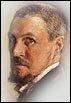
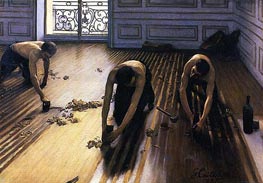
Stripped to the waist, three workmen plane the boards of a Parisian apartment. The light catches their bent backs, the shavings curl in ribbons at their knees, and the whole scene - executed with an almost photographic exactitude - announces a new eye among the Impressionists. That eye belonged to Gustave Caillebotte (1848 - 1894), a French painter whose wealth, independence, and stubborn fidelity to the real would both obscure and secure his place in the history of modern art.
Caillebotte was born on 19 August 1848 to a prosperous Parisian household on the rue du Faubourg-Saint-Denis. His father Martial had inherited a military textile firm and sat as a judge at the Tribunal de commerce de la Seine; his mother Céleste Daufresne bore three sons, of whom Gustave was the eldest to survive. A law degree came in 1868, followed by his practising licence in 1870, and he trained as an engineer besides. War interrupted that trajectory. Drafted into the Garde Nationale Mobile de la Seine, he served between July 1870 and March 1871 during the Franco-Prussian conflict, and it was in those months, by his own account, that he first began to paint.
On returning to Paris he entered the atelier of Léon Bonnat, the society portraitist. In 1873 he enrolled at the École des Beaux-Arts but evidently found little use for its strictures, and his father built him a private studio at the family home. Around this time he made the acquaintance of Edgar Degas and the Italian émigré Giuseppe de Nittis, and he attended - though did not yet show in - the first Impressionist exhibition of 1874. His father's death that same year brought him a considerable inheritance; his mother's, four years later, divided the remainder of the fortune among her surviving sons.
The second Impressionist exhibition of 1876 marked his public debut, and he hung eight canvases there. Among them was Les raboteurs de parquet (The Floor Scrapers, 1875), already refused by the Salon of the previous year. Critics found its subject - urban labourers, stripped down, at work on the artist's own studio floor - unacceptably vulgar. Peasants in a field were admissible to the academic imagination; craftsmen in a bourgeois apartment were not. By 1877 Caillebotte had taken on the organisational spine of the Impressionist project, renting the premises, selecting the hang, negotiating the temperaments of his colleagues. He exhibited in five of the eight Impressionist shows before stepping back from the fray.
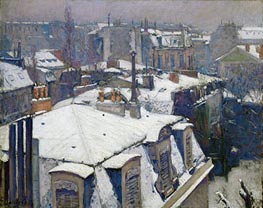
His manner resists tidy summary. At times he worked in the dense, tonal realism of Degas; at others he loosened his brush toward the optical shimmer of Renoir and Pissarro, though always with a cooler chromatic register. What remained constant was his fascination with perspective. Cropped foregrounds, plunging pavements, vertiginous rooftops - View of Rooftops (Snow) of 1878, Boulevard Seen from Above and A Traffic Island of 1880 - betray an eye trained by Japanese prints and quickened, perhaps, by the new camera. Whether he actually photographed his subjects remains uncertain. Either way, the tilted ground he favoured is unmistakable.
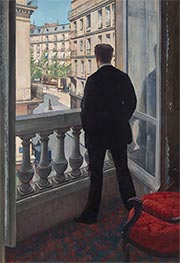
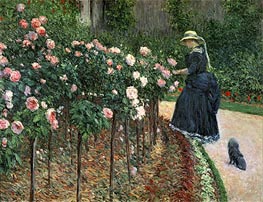
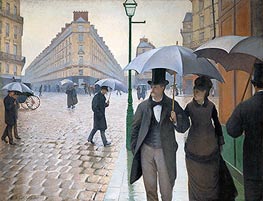
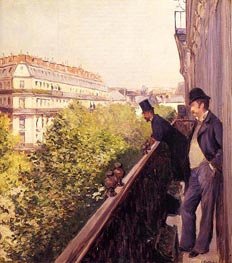
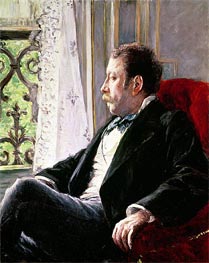
The most celebrated of his urban scenes, Paris Street; Rainy Day (1877), holds a strange, almost cinematic stillness. Its figures approach the viewer under their umbrellas, the wet cobbles of the Place de l'Europe reflecting a silver sky; the flat, saturated colour and hard edges prefigure, by half a century, the mood of an Edward Hopper. The Europe Bridge of 1876 looks down an iron span crossed by a top-hatted stroller and his dog. Man on a Balcony (1880) thrusts the viewer onto the balustrade beside its protagonist. Beside these metropolitan canvases, Caillebotte painted quieter interiors - Young Man at His Window (1876) shows his brother René gazing down on the rue de Miromesnil; Portraits in the Country (1875) gathers his mother, aunt, and cousin in the garden at Yerres.
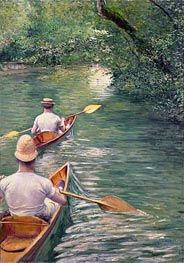
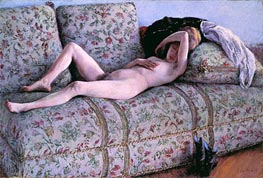
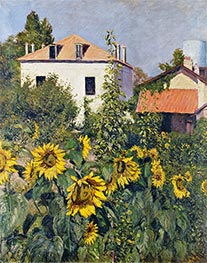
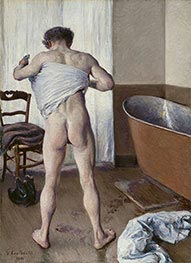
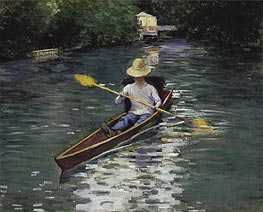
Boating, bathing, and riverside leisure occupied him as well, notably in Oarsman in a Top Hat, also known as Boating Party (1877), which he submitted to the fourth Impressionist exhibition of 1879. There are still lifes of fruit and butcher's meat, a late sequence of flowers, and a handful of male nudes - Homme au bain (1884) among them - unsettling in their frank, domestic intimacy. In 1881 he bought a property at Petit-Gennevilliers on the Seine, and by 1888 he had settled there for good. He built yachts at his own shipyard, raced them, and won. Renoir came often, and the two discussed art and politics late into the evenings. He never married, though a long attachment to Charlotte Berthier, eleven years younger and of modest background, would be remembered in his will.
On 21 February 1894 he collapsed in his garden and died of pulmonary congestion. He was forty-five. He was buried at Père Lachaise, and for decades his reputation lay quiet beneath that of the friends he had supported. Convinced since his twenties, after his brother René's early death, that his own life would be brief, he had drawn up an extraordinary will. To the French state he bequeathed sixty-eight Impressionist paintings - Monets, Renoirs, Pissarros, Sisleys, Degas, Cézannes, Manets - on condition they hang first in the Luxembourg and afterwards in the Louvre. The negotiations were painful; only thirty-eight entered the Luxembourg in 1897, under the executorship of Renoir. That installation nonetheless became the first public showing of the Impressionists in a French museum.
Recognition of his own work arrived slowly. Only in 1964, when the Art Institute of Chicago acquired Paris Street; Rainy Day, did American scholars and curators begin to look at him afresh. A centenary retrospective travelled in 1994 from the Grand Palais to Chicago and Los Angeles - the first comprehensive international survey of his art, and a long-delayed answer to the generation that had overlooked him. In 2022 the French state declared Boating Party a national treasure and toured it through Lyon, Marseille, and Nantes, before gathering it into the 2024 Musée d'Orsay exhibition Caillebotte: Painting Men, which travelled on to the Getty and the Art Institute of Chicago. Perhaps it took that long for his quiet insistence - men at work, men at leisure, men observing other men - to read as subject rather than anomaly.
What lingers in his best pictures is an odd tenderness of observation. The labourers bend, the flâneur pauses, the oarsman leans into his stroke, and none of them performs. He looked at his own class without flattery and at the working world without condescension, and he paid for the Impressionists' rent while he did it. It is a strange, understated career, and in its very restraint it keeps revealing more.
Caillebotte was born on 19 August 1848 to a prosperous Parisian household on the rue du Faubourg-Saint-Denis. His father Martial had inherited a military textile firm and sat as a judge at the Tribunal de commerce de la Seine; his mother Céleste Daufresne bore three sons, of whom Gustave was the eldest to survive. A law degree came in 1868, followed by his practising licence in 1870, and he trained as an engineer besides. War interrupted that trajectory. Drafted into the Garde Nationale Mobile de la Seine, he served between July 1870 and March 1871 during the Franco-Prussian conflict, and it was in those months, by his own account, that he first began to paint.
On returning to Paris he entered the atelier of Léon Bonnat, the society portraitist. In 1873 he enrolled at the École des Beaux-Arts but evidently found little use for its strictures, and his father built him a private studio at the family home. Around this time he made the acquaintance of Edgar Degas and the Italian émigré Giuseppe de Nittis, and he attended - though did not yet show in - the first Impressionist exhibition of 1874. His father's death that same year brought him a considerable inheritance; his mother's, four years later, divided the remainder of the fortune among her surviving sons.
The second Impressionist exhibition of 1876 marked his public debut, and he hung eight canvases there. Among them was Les raboteurs de parquet (The Floor Scrapers, 1875), already refused by the Salon of the previous year. Critics found its subject - urban labourers, stripped down, at work on the artist's own studio floor - unacceptably vulgar. Peasants in a field were admissible to the academic imagination; craftsmen in a bourgeois apartment were not. By 1877 Caillebotte had taken on the organisational spine of the Impressionist project, renting the premises, selecting the hang, negotiating the temperaments of his colleagues. He exhibited in five of the eight Impressionist shows before stepping back from the fray.
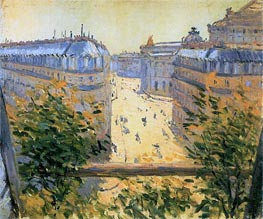
His manner resists tidy summary. At times he worked in the dense, tonal realism of Degas; at others he loosened his brush toward the optical shimmer of Renoir and Pissarro, though always with a cooler chromatic register. What remained constant was his fascination with perspective. Cropped foregrounds, plunging pavements, vertiginous rooftops - View of Rooftops (Snow) of 1878, Boulevard Seen from Above and A Traffic Island of 1880 - betray an eye trained by Japanese prints and quickened, perhaps, by the new camera. Whether he actually photographed his subjects remains uncertain. Either way, the tilted ground he favoured is unmistakable.
The most celebrated of his urban scenes, Paris Street; Rainy Day (1877), holds a strange, almost cinematic stillness. Its figures approach the viewer under their umbrellas, the wet cobbles of the Place de l'Europe reflecting a silver sky; the flat, saturated colour and hard edges prefigure, by half a century, the mood of an Edward Hopper. The Europe Bridge of 1876 looks down an iron span crossed by a top-hatted stroller and his dog. Man on a Balcony (1880) thrusts the viewer onto the balustrade beside its protagonist. Beside these metropolitan canvases, Caillebotte painted quieter interiors - Young Man at His Window (1876) shows his brother René gazing down on the rue de Miromesnil; Portraits in the Country (1875) gathers his mother, aunt, and cousin in the garden at Yerres.
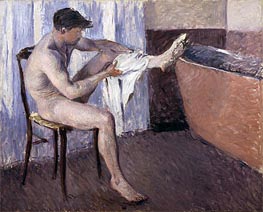
Boating, bathing, and riverside leisure occupied him as well, notably in Oarsman in a Top Hat, also known as Boating Party (1877), which he submitted to the fourth Impressionist exhibition of 1879. There are still lifes of fruit and butcher's meat, a late sequence of flowers, and a handful of male nudes - Homme au bain (1884) among them - unsettling in their frank, domestic intimacy. In 1881 he bought a property at Petit-Gennevilliers on the Seine, and by 1888 he had settled there for good. He built yachts at his own shipyard, raced them, and won. Renoir came often, and the two discussed art and politics late into the evenings. He never married, though a long attachment to Charlotte Berthier, eleven years younger and of modest background, would be remembered in his will.
On 21 February 1894 he collapsed in his garden and died of pulmonary congestion. He was forty-five. He was buried at Père Lachaise, and for decades his reputation lay quiet beneath that of the friends he had supported. Convinced since his twenties, after his brother René's early death, that his own life would be brief, he had drawn up an extraordinary will. To the French state he bequeathed sixty-eight Impressionist paintings - Monets, Renoirs, Pissarros, Sisleys, Degas, Cézannes, Manets - on condition they hang first in the Luxembourg and afterwards in the Louvre. The negotiations were painful; only thirty-eight entered the Luxembourg in 1897, under the executorship of Renoir. That installation nonetheless became the first public showing of the Impressionists in a French museum.
Recognition of his own work arrived slowly. Only in 1964, when the Art Institute of Chicago acquired Paris Street; Rainy Day, did American scholars and curators begin to look at him afresh. A centenary retrospective travelled in 1994 from the Grand Palais to Chicago and Los Angeles - the first comprehensive international survey of his art, and a long-delayed answer to the generation that had overlooked him. In 2022 the French state declared Boating Party a national treasure and toured it through Lyon, Marseille, and Nantes, before gathering it into the 2024 Musée d'Orsay exhibition Caillebotte: Painting Men, which travelled on to the Getty and the Art Institute of Chicago. Perhaps it took that long for his quiet insistence - men at work, men at leisure, men observing other men - to read as subject rather than anomaly.
What lingers in his best pictures is an odd tenderness of observation. The labourers bend, the flâneur pauses, the oarsman leans into his stroke, and none of them performs. He looked at his own class without flattery and at the working world without condescension, and he paid for the Impressionists' rent while he did it. It is a strange, understated career, and in its very restraint it keeps revealing more.
136 Caillebotte Artworks
Page 1 of 6
Giclée Canvas Print
$69.43
$69.43
SKU: 498-GUC
Gustave Caillebotte
Original Size:102 x 146 cm
Musee d'Orsay, Paris, France
Gustave Caillebotte
Original Size:102 x 146 cm
Musee d'Orsay, Paris, France
Giclée Canvas Print
$68.71
$68.71
SKU: 519-GUC
Gustave Caillebotte
Original Size:155 x 108.5 cm
Musee des Beaux Arts, Rennes, France
Gustave Caillebotte
Original Size:155 x 108.5 cm
Musee des Beaux Arts, Rennes, France
Giclée Canvas Print
$65.83
$65.83
SKU: 6582-GUC
Gustave Caillebotte
Original Size:129.5 x 195.6 cm
Minneapolis Institute of Arts, Minnesota, USA
Gustave Caillebotte
Original Size:129.5 x 195.6 cm
Minneapolis Institute of Arts, Minnesota, USA
Giclée Canvas Print
$79.31
$79.31
SKU: 18153-GUC
Gustave Caillebotte
Original Size:81.6 x 73.3 cm
Dallas Museum of Art, Texas, USA
Gustave Caillebotte
Original Size:81.6 x 73.3 cm
Dallas Museum of Art, Texas, USA
Giclée Canvas Print
$79.68
$79.68
SKU: 16833-GUC
Gustave Caillebotte
Original Size:80 x 65 cm
Private Collection
Gustave Caillebotte
Original Size:80 x 65 cm
Private Collection
Giclée Canvas Print
$65.27
$65.27
SKU: 554-GUC
Gustave Caillebotte
Original Size:99.4 x 61.6 cm
Metropolitan Museum of Art, New York, USA
Gustave Caillebotte
Original Size:99.4 x 61.6 cm
Metropolitan Museum of Art, New York, USA
Giclée Canvas Print
$80.22
$80.22
SKU: 18089-GUC
Gustave Caillebotte
Original Size:101 x 81 cm
Private Collection
Gustave Caillebotte
Original Size:101 x 81 cm
Private Collection
Giclée Canvas Print
$67.62
$67.62
SKU: 504-GUC
Gustave Caillebotte
Original Size:116 x 81 cm
Private Collection
Gustave Caillebotte
Original Size:116 x 81 cm
Private Collection
Giclée Canvas Print
$93.16
$93.16
SKU: 6577-GUC
Gustave Caillebotte
Original Size:unknown
Private Collection
Gustave Caillebotte
Original Size:unknown
Private Collection
Giclée Canvas Print
$65.27
$65.27
SKU: 6576-GUC
Gustave Caillebotte
Original Size:unknown
Private Collection
Gustave Caillebotte
Original Size:unknown
Private Collection
Giclée Canvas Print
$74.46
$74.46
SKU: 512-GUC
Gustave Caillebotte
Original Size:87 x 116 cm
Private Collection
Gustave Caillebotte
Original Size:87 x 116 cm
Private Collection
Giclée Canvas Print
$81.47
$81.47
SKU: 4157-GUC
Gustave Caillebotte
Original Size:60 x 73.2 cm
Private Collection
Gustave Caillebotte
Original Size:60 x 73.2 cm
Private Collection
Giclée Canvas Print
$97.94
$97.94
SKU: 6575-GUC
Gustave Caillebotte
Original Size:100 x 125 cm
Private Collection
Gustave Caillebotte
Original Size:100 x 125 cm
Private Collection
Giclée Canvas Print
$70.86
$70.86
SKU: 555-GUC
Gustave Caillebotte
Original Size:157 x 114 cm
National Gallery of Art, Washington, USA
Gustave Caillebotte
Original Size:157 x 114 cm
National Gallery of Art, Washington, USA
Giclée Canvas Print
$78.78
$78.78
SKU: 16831-GUC
Gustave Caillebotte
Original Size:65 x 81.5 cm
Musee d'Orsay, Paris, France
Gustave Caillebotte
Original Size:65 x 81.5 cm
Musee d'Orsay, Paris, France
Giclée Canvas Print
$77.88
$77.88
SKU: 18088-GUC
Gustave Caillebotte
Original Size:131 x 105 cm
Thyssen-Bornemisza Museum, Madrid, Spain
Gustave Caillebotte
Original Size:131 x 105 cm
Thyssen-Bornemisza Museum, Madrid, Spain
Giclée Canvas Print
$82.01
$82.01
SKU: 18090-GUC
Gustave Caillebotte
Original Size:54 x 65 cm
Private Collection
Gustave Caillebotte
Original Size:54 x 65 cm
Private Collection
Giclée Canvas Print
$78.24
$78.24
SKU: 521-GUC
Gustave Caillebotte
Original Size:64 x 82 cm
Musee d'Orsay, Paris, France
Gustave Caillebotte
Original Size:64 x 82 cm
Musee d'Orsay, Paris, France
Giclée Canvas Print
$71.94
$71.94
SKU: 16835-GUC
Gustave Caillebotte
Original Size:144.8 x 114.3 cm
Boston Museum of Fine Arts, Massachusetts, USA
Gustave Caillebotte
Original Size:144.8 x 114.3 cm
Boston Museum of Fine Arts, Massachusetts, USA
Giclée Canvas Print
$76.80
$76.80
SKU: 513-GUC
Gustave Caillebotte
Original Size:212.2 x 276.2 cm
Art Institute of Chicago, Illinois, USA
Gustave Caillebotte
Original Size:212.2 x 276.2 cm
Art Institute of Chicago, Illinois, USA
Giclée Canvas Print
$87.95
$87.95
SKU: 527-GUC
Gustave Caillebotte
Original Size:69 x 62 cm
Thyssen-Bornemisza Museum, Madrid, Spain
Gustave Caillebotte
Original Size:69 x 62 cm
Thyssen-Bornemisza Museum, Madrid, Spain
Giclée Canvas Print
$77.88
$77.88
SKU: 19002-GUC
Gustave Caillebotte
Original Size:65 x 82 cm
Fuji Art Museum, Tokyo, Japan
Gustave Caillebotte
Original Size:65 x 82 cm
Fuji Art Museum, Tokyo, Japan
Giclée Canvas Print
$78.96
$78.96
SKU: 6583-GUC
Gustave Caillebotte
Original Size:65 x 81 cm
Norton Simon Museum, Pasadena, USA
Gustave Caillebotte
Original Size:65 x 81 cm
Norton Simon Museum, Pasadena, USA
Giclée Canvas Print
$79.50
$79.50
SKU: 6574-GUC
Gustave Caillebotte
Original Size:82 x 65 cm
Cleveland Museum of Art, Ohio, USA
Gustave Caillebotte
Original Size:82 x 65 cm
Cleveland Museum of Art, Ohio, USA