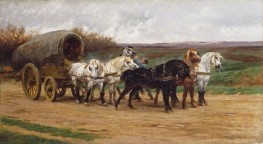
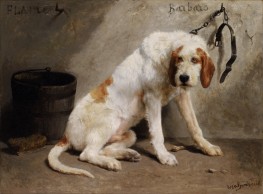
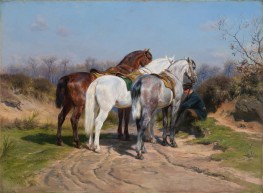
A woman in trousers, permit from the Paris police folded in her pocket, walking the boulevard de l'Hôpital at dawn to study horses at market - this is how Rosa Bonheur (1822 - 1899) prepared the canvas that would make her the most celebrated female painter of the nineteenth century. French by birth, animalière by vocation, she built a career on the close observation of living creatures and refused, with quiet stubbornness, every convention that stood in her way. Her name belongs to the realist current that reshaped European painting between the Salons of Louis-Philippe and the late Belle Époque.
Marie-Rosalie Bonheur was born in Bordeaux on 16 March 1822, the eldest child of Sophie Marquis, a piano teacher, and Oscar-Raymond Bonheur, a landscape and portrait painter of modest means. The family followed Saint-Simonianism, a Christian socialist movement that, unusually for the period, insisted girls be educated alongside boys. That single conviction shaped everything. When the Bonheurs moved to Paris in 1828, six-year-old Rosa was already drawing animals before she could properly read, and her mother taught her the alphabet by asking her to sketch a different creature for each letter. She always credited those lessons - and the early loss of her mother when she was eleven - with binding her imagination to the animal world.
School did not suit her. Disruptive, restless, expelled more than once, she also failed an apprenticeship to a seamstress at twelve. Her father then took over her training himself, and the studio filled with live models: rabbits, goats, sheep, the occasional horse. Bonheur copied drawing books and plaster casts in the academic manner, then graduated to the pastures around Villiers and the still-wooded Bois de Boulogne. By fourteen she was at the Louvre, working her way through Poussin, Rubens, Paulus Potter, Salvator Rosa, Karel Dujardin - the northern animal painters as much as the grand classical tradition. Anatomy mattered to her in a way it rarely mattered to her contemporaries. She studied osteology in the Paris abattoirs and dissected specimens at the École nationale vétérinaire d'Alfort, where she befriended the zoologists Étienne and Isidore Geoffroy Saint-Hilaire. Her notebooks from those years read more like a naturalist's than a painter's.
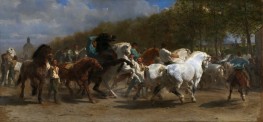
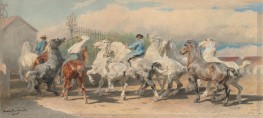
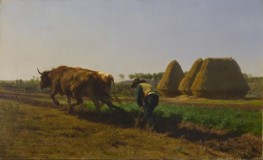
Recognition came early. Ploughing in the Nivernais, commissioned by the state and shown at the Salon of 1849, established her reputation: a wide, low canvas of oxen turning the heavy autumn earth, painted with such respect for the animals' weight and labour that it now hangs in the Musée d'Orsay. Then came the picture that changed her life. The Horse Fair, begun in 1851 and finished in 1855, is nearly five metres wide and depicts the weekly market on the boulevard de l'Hôpital, the dome of the Pitié-Salpêtrière rising behind a churning mass of Percherons and their handlers. To gather material, Bonheur secured one of those famous police permits and went to the market dressed as a man, the better to move unmolested among the dealers. The painting's debut at the Salon of 1853 caused argument and rumour - some critics could not believe a woman had executed it - and that argument was exactly what she needed.
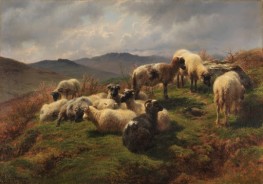
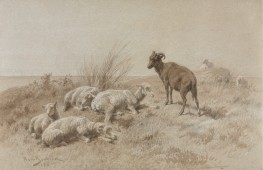
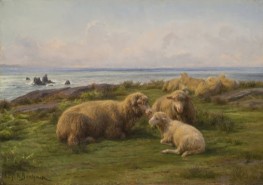
Her dealer, the Belgian-born Ernest Gambart, bought The Horse Fair in 1855 for forty thousand francs and took it to England, where it travelled from gallery to gallery and even, briefly, to Buckingham Palace so that Queen Victoria could examine it in private. William Rossetti praised it. Engravings by Charles George Lewis spread the image into thousands of British and American homes. In 1856 Bonheur herself crossed the Channel with her companion Nathalie Micas, met Ruskin, and travelled north into the Highlands, where she filled sketchbooks with shepherds, cattle and the half-vanished pastoral life that would become Highland Shepherd (1859) and The Highland Raid (1860). The Victorians adored these scenes. For decades she remained, oddly, more famous in Britain than in France.
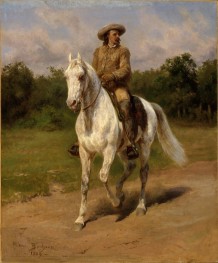
In 1859 her earnings allowed her to buy the Château de By, on the edge of the forest of Fontainebleau, and she lived there for the rest of her life surrounded by a private menagerie. Empress Eugénie pinned the cross of the Legion of Honour on her in 1865 - the first woman artist to receive it - and in 1894 she was promoted to Officer of the Order. She showed at the Palace of Fine Arts and the Woman's Building of the 1893 World's Columbian Exposition in Chicago. The previous year she had befriended the young American sculptor Cyrus Dallin and accompanied him to the encampment of Buffalo Bill's Wild West Show at Neuilly, where she sketched the bison and, in 1890, painted Cody himself on horseback - a meeting of two utterly different myths of the frontier.
She wore trousers, shirts and ties, smoked, hunted, kept her hair short. She never described herself as a man and occasionally referred to womanhood as something far superior to anything the other sex could offer. Nathalie Micas was her companion for more than forty years, until Micas's death in 1889; in her last decade she lived and worked with the American painter Anna Elizabeth Klumpke, whom she made her sole heir. Bonheur never explicitly named her sexuality, but she also never disguised her household, and at a moment when French officialdom regarded such relationships as pathological her openness was, in its understated way, radical. Perhaps the same patient defiance she brought to a recalcitrant horse served her equally well in the rest of her life.
Bonheur died at By on 25 May 1899, aged seventy-seven. She was buried at Père Lachaise beside Micas, and Klumpke would later join them; the shared headstone reads, in French, that friendship is divine affection. Like many realists she fell from critical favour for much of the twentieth century, until Linda Nochlin's 1971 essay Why Have There Been No Great Women Artists? returned her to the conversation, and a 1989 - 1990 retrospective at the National Museum of Women in the Arts in Washington brought her paintings back before American audiences. Today her canvases hang in the Musée d'Orsay, the Metropolitan Museum of Art and the National Gallery in London; four Parisian guinguettes bear her name; Google marked her bicentenary in 2022. What endures is not only the technical command - the muscled flank, the cold light on a wet hide - but the example of a painter who insisted, against considerable opposition, that her subjects and her life were entirely her own.