
The Horse Fair, 1855 by Rosa Bonheur
Canvas Print - 22179-BRO
Location: National Gallery, London, UKOriginal Size: 120 × 260 cm
The Horse Fair by Rosa Bonheur (1855) is reproduced as a museum-quality giclée canvas print. Printed with archival inks on 400 g/m² canvas and hand-varnished for UV protection, it can be made in any size up to 40.5 × 86.6 in, scaled proportionally, with optional framing. Free worldwide shipping available; unframed prints ship in 2 workdays, framed in 7 to 8. Guaranteed 100-year color durability.
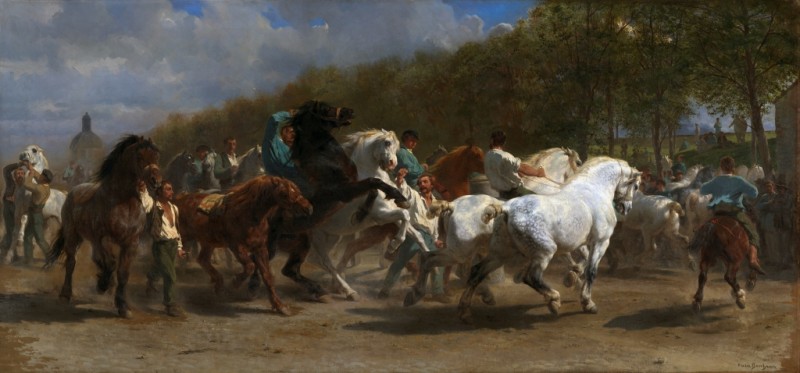
Giclée Canvas Print | $61.99 USD
Your Selection
SKU:22179-BRO

Print/Image Size
Production: 2 Workdays
Free Shipping
Giclée Print Quality on 400 g/m² Canvas, Satin/Gloss
Customize Your Print
Largest Available
40.5″ × 86.6″
Framing: Long Side Up to 28"
Can be Framed
Sizes scale proportionally to the original. Dimensions shown are for the printed area - we always add 1.2 in of blank canvas on every side for stretching.
Questions about this Print
The size you set is the printed image, the part you see once the canvas is stretched. Beyond that size we add 1.2 in of blank canvas on every side, at no extra cost, so the stretcher bars have something to grip. A 10.1 × 21.7 in print therefore arrives as 12.5 × 24 in. Both numbers are shown in Your Selection above and change with the slider.
Yes. The slider covers every size up to 40.5 × 86.6 in, always in the proportions of the original. If you need something larger, or a size that has to fit a frame you already own, write to us with the title and the dimensions and we will tell you what is possible. Every print is made to order, so there is usually a way.
Because the original is an oil painting on canvas. We match the print medium to the original: oil paintings go on canvas, works on paper go on fine art paper. Our canvas is natural cotton, 400 g/m² Canvas, acid-free and pH neutral, and its woven texture gives the most natural impression of Rosa Bonheur's original oil painting. The finish is satin/gloss, which keeps the depth of the dark tones the way varnish does on a painting in a museum; a matte canvas looks dull and pale next to it. More about our print media.
Start with the original, which measures 120 × 260 cm. A print at or near that size reads the way the artist judged it. Printing smaller is easy; enlarging a small original changes its character. For the wall, above a sofa or a sideboard aim for two thirds to three quarters of the furniture width, and hang the center at eye level. Cut paper to size and tape it to the wall before you order. The original hangs in National Gallery, London, UK. Full size guide.
30-day returns on unframed prints. Shipping, framing, care and returns are covered in our Help & FAQ.
About the Painting
More Fine Art Prints by Rosa Bonheur
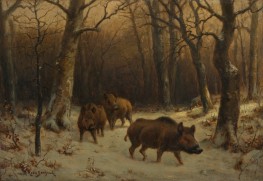
SKU: 22180-BRO
Rosa Bonheur
Original Size:21 × 30.8 cm
Cleveland Museum of Art, Ohio, USA
Rosa Bonheur
Original Size:21 × 30.8 cm
Cleveland Museum of Art, Ohio, USA
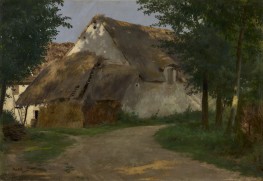
SKU: 22181-BRO
Rosa Bonheur
Original Size:28.4 × 40.3 cm
Cleveland Museum of Art, Ohio, USA
Rosa Bonheur
Original Size:28.4 × 40.3 cm
Cleveland Museum of Art, Ohio, USA
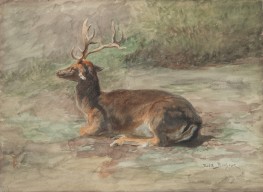
SKU: 22182-BRO
Rosa Bonheur
Original Size:28 × 38.1 cm
Cleveland Museum of Art, Ohio, USA
Rosa Bonheur
Original Size:28 × 38.1 cm
Cleveland Museum of Art, Ohio, USA
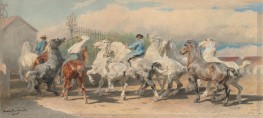
SKU: 22183-BRO
Rosa Bonheur
Original Size:25.9 × 56.7 cm
Cleveland Museum of Art, Ohio, USA
Rosa Bonheur
Original Size:25.9 × 56.7 cm
Cleveland Museum of Art, Ohio, USA
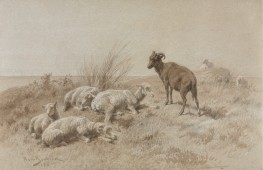
SKU: 22184-BRO
Rosa Bonheur
Original Size:20.8 × 31.8 cm
Cleveland Museum of Art, Ohio, USA
Rosa Bonheur
Original Size:20.8 × 31.8 cm
Cleveland Museum of Art, Ohio, USA
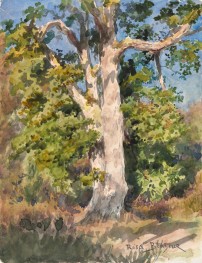
SKU: 22185-BRO
Rosa Bonheur
Original Size:23.6 × 18.1 cm
Cleveland Museum of Art, Ohio, USA
Rosa Bonheur
Original Size:23.6 × 18.1 cm
Cleveland Museum of Art, Ohio, USA
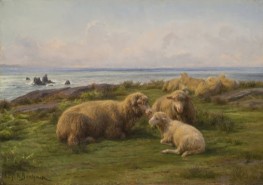
SKU: 22186-BRO
Rosa Bonheur
Original Size:32.4 × 45.7 cm
Public Collection
Rosa Bonheur
Original Size:32.4 × 45.7 cm
Public Collection
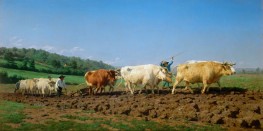
SKU: 22187-BRO
Rosa Bonheur
Original Size:134 × 260 cm
Musee d'Orsay, Paris, France
Rosa Bonheur
Original Size:134 × 260 cm
Musee d'Orsay, Paris, France