
Nicolaes Maes Giclée Fine Art Prints
1634-1693
Dutch Painter - Baroque
Nicolaes Maes canvas prints: 85 works in museum quality, each made to order in the size you choose, with optional framing.
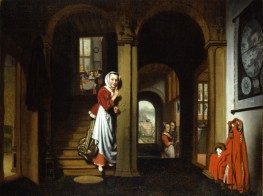
A woman pauses halfway down a staircase, one finger raised to her lips, and glances out at us as though we had arrived just in time. Nicolaes Maes - Dutch, born in Dordrecht in January 1634, buried in Amsterdam on 24 December 1693 - built a career on such moments of quiet complicity before abandoning them almost entirely. He was a genre painter of startling invention for roughly a decade, and then, for thirty years, the most fashionable portraitist in the richest city of the Dutch Republic.
The household he came from smelled of cloth and lye. His father, Gerrit Maes, traded textiles and boiled soap, prospering at both; his mother was Ida Herman Claesdr. Their second son began with a local painter of modest gifts. Around 1648 he went to Amsterdam and entered Rembrandt's studio, where he stayed some five years.
Those years marked him permanently, though not in the way one might expect. Rembrandt's chiaroscuro, his warm and loaded brushwork, his instinct for the psychological pause - Maes absorbed all of it and then applied it to subjects his master rarely touched. The religious pictures came first. Suffer the Little Children to Come unto Me (1652/3, National Gallery, London), Vertumnus and Pomona (possibly 1653, National Gallery of Ireland, Dublin) and the Woman of Samaria at the Well of about 1653 follow Rembrandtesque models while reading their sources afresh. In the Dismissal of Hagar and Ishmael (1653, Metropolitan Museum of Art, New York) Abraham sends the handmaiden and her son into the wilderness, and the drama is carried almost entirely by posture: Hagar's collapse into grief, Ishmael standing apart, already alone. It remains one of the most affecting treatments of a theme to which Rembrandt's pupils returned again and again.
By December 1653 he had come back to Dordrecht for good, or so it must have seemed. On the twenty-eighth of that month he posted the banns of his marriage to Adriana Brouwers, widow of the preacher Arnoldus de Gelder. The match brought him a stepson, Justus de Gelder, who would later number among his pupils.
Then came the extraordinary five years. Between 1654 and 1658 Maes produced a run of domestic interiors - spinners, lacemakers, mothers with infants, old women dozing over a Bible or saying grace before a thin meal - with no real precedent in Dutch painting. Consider The Virtuous Woman (c.1655, the Wallace Collection, London). A housewife sews a shirt in a scrupulously ordered room; an open Bible lies beside her; a small boy appears at the window. The picture reads as Proverbs 31 rendered in oil, its praise of diligence and charity translated into needle, thread and swept floor. Light does the moral work here, as it does throughout these years, falling in warm bands out of a deliberately narrow palette of browns, reds and ochres.
Doorsteps interested him too. A Young Boy Receiving Alms from an Elderly Man (1656, Montreal Museum of Fine Arts) belongs to a group in which milkmaids ring bells, coins change hands and small transactions acquire an unhurried gravity. More radical still was what Maes did with the room itself. Where his contemporaries built shallow three-walled boxes, he opened up suites of spaces - a doorway giving onto a corridor, a corridor onto a stair, a stair onto a lit room beyond - so that a single picture could hold two events at once. The eavesdropper compositions depend on exactly this: mistress above, servants below, the viewer made complicit. Pieter de Hooch and Johannes Vermeer took note, and in matters of storytelling so did Jan Steen.
In the middle or towards the end of the 1650s he travelled to Antwerp and looked hard at Rubens, van Dyck and Jordaens; he is said to have spent a long afternoon in Jordaens's studio, talking about painting. The visit changed his course. From the 1660s onward he painted almost nothing but portraits, and the genre pictures simply stopped. He stayed in Dordrecht until 1673, paying municipal tax on capital of three and then four thousand guilders and rising to lieutenant in the civic guard. Margaretha van Godewijk, Jacob Moelaert and Johannes Vollevens trained with him there.
The move to Amsterdam in 1673 came at exactly the right moment. Abraham van den Tempel and Bartholomeus van der Helst were both dead, leaving the city's wealthiest sitters unserved, and the Rampjaar of 1672 - the invasion of the Republic by French and allied armies - had gutted the art market in Dordrecht. Maes gambled that fashionable portraiture would find buyers among Amsterdam's burghers. It did. Sitters came to regard a place in his queue as a favour granted, and hundreds of canvases from the 1670s and 1680s bear out the demand.
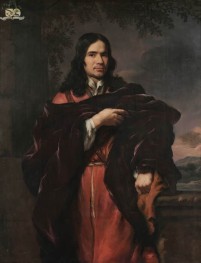
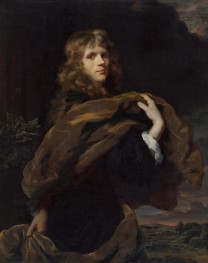
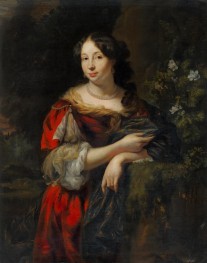
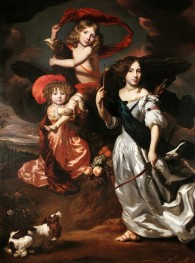
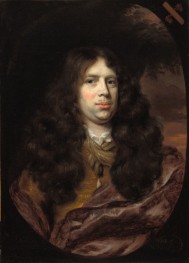
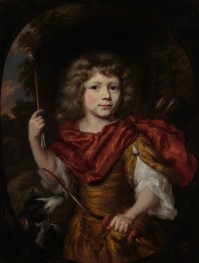
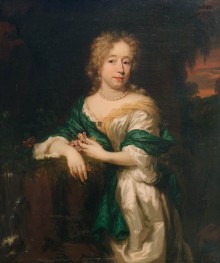
His portrait manner had by then shed its early severity. The sitters of the 1650s stand in dark, unornamented gloom; those of the 1670s lean against a column or a fountain in a garden, under a sunset sky, painted in lighter tones and with a notably freer stroke - van Dyck's Flemish grammar, absorbed and made Dutch, with a French inflection arriving later. Two formats served him repeatedly: a small canvas with a half-length figure inside a painted oval, and a larger one with a three-quarter-length figure and a prop to lean on. Children he sometimes dressed as Ganymede, Apollo or Diana. Only once did he take on a civic group: the Six Governors of the Amsterdam Surgeons' Guild (1680-81, Rijksmuseum, Amsterdam).
Something in him stayed provincial, or perhaps merely stubborn. Twenty years in Amsterdam and Maes never became a citizen; he registered with the Guild of Saint Luke only in 1688, and then only because the municipality demanded a membership list, entering himself as a resident rather than a burgher. Prosperity evidently did not require belonging. His estate held eleven thousand guilders in cash, two houses in Dordrecht and three in Amsterdam. Gout troubled his last years. Adriana was buried in the Oude Kerk on 14 March 1690, and on 24 December 1693 he was laid beside her.
The portraits made his fortune; the genre pictures made his reputation, and they did so largely after his death. Museum visitors now walk past rooms of periwigged Amsterdam worthies to reach the small paintings of listening women and dozing grandmothers, an irony Nicolaes Maes might have enjoyed. Perhaps those pictures are self-portraits of a kind - the work of a man whose real subject was what people do when they believe no one is watching. Three and a half centuries on, the domestic hush he found in Dordrecht kitchens still holds. We recognise it. That is why Maes endures.
The household he came from smelled of cloth and lye. His father, Gerrit Maes, traded textiles and boiled soap, prospering at both; his mother was Ida Herman Claesdr. Their second son began with a local painter of modest gifts. Around 1648 he went to Amsterdam and entered Rembrandt's studio, where he stayed some five years.
Those years marked him permanently, though not in the way one might expect. Rembrandt's chiaroscuro, his warm and loaded brushwork, his instinct for the psychological pause - Maes absorbed all of it and then applied it to subjects his master rarely touched. The religious pictures came first. Suffer the Little Children to Come unto Me (1652/3, National Gallery, London), Vertumnus and Pomona (possibly 1653, National Gallery of Ireland, Dublin) and the Woman of Samaria at the Well of about 1653 follow Rembrandtesque models while reading their sources afresh. In the Dismissal of Hagar and Ishmael (1653, Metropolitan Museum of Art, New York) Abraham sends the handmaiden and her son into the wilderness, and the drama is carried almost entirely by posture: Hagar's collapse into grief, Ishmael standing apart, already alone. It remains one of the most affecting treatments of a theme to which Rembrandt's pupils returned again and again.
By December 1653 he had come back to Dordrecht for good, or so it must have seemed. On the twenty-eighth of that month he posted the banns of his marriage to Adriana Brouwers, widow of the preacher Arnoldus de Gelder. The match brought him a stepson, Justus de Gelder, who would later number among his pupils.
Then came the extraordinary five years. Between 1654 and 1658 Maes produced a run of domestic interiors - spinners, lacemakers, mothers with infants, old women dozing over a Bible or saying grace before a thin meal - with no real precedent in Dutch painting. Consider The Virtuous Woman (c.1655, the Wallace Collection, London). A housewife sews a shirt in a scrupulously ordered room; an open Bible lies beside her; a small boy appears at the window. The picture reads as Proverbs 31 rendered in oil, its praise of diligence and charity translated into needle, thread and swept floor. Light does the moral work here, as it does throughout these years, falling in warm bands out of a deliberately narrow palette of browns, reds and ochres.
Doorsteps interested him too. A Young Boy Receiving Alms from an Elderly Man (1656, Montreal Museum of Fine Arts) belongs to a group in which milkmaids ring bells, coins change hands and small transactions acquire an unhurried gravity. More radical still was what Maes did with the room itself. Where his contemporaries built shallow three-walled boxes, he opened up suites of spaces - a doorway giving onto a corridor, a corridor onto a stair, a stair onto a lit room beyond - so that a single picture could hold two events at once. The eavesdropper compositions depend on exactly this: mistress above, servants below, the viewer made complicit. Pieter de Hooch and Johannes Vermeer took note, and in matters of storytelling so did Jan Steen.
In the middle or towards the end of the 1650s he travelled to Antwerp and looked hard at Rubens, van Dyck and Jordaens; he is said to have spent a long afternoon in Jordaens's studio, talking about painting. The visit changed his course. From the 1660s onward he painted almost nothing but portraits, and the genre pictures simply stopped. He stayed in Dordrecht until 1673, paying municipal tax on capital of three and then four thousand guilders and rising to lieutenant in the civic guard. Margaretha van Godewijk, Jacob Moelaert and Johannes Vollevens trained with him there.
The move to Amsterdam in 1673 came at exactly the right moment. Abraham van den Tempel and Bartholomeus van der Helst were both dead, leaving the city's wealthiest sitters unserved, and the Rampjaar of 1672 - the invasion of the Republic by French and allied armies - had gutted the art market in Dordrecht. Maes gambled that fashionable portraiture would find buyers among Amsterdam's burghers. It did. Sitters came to regard a place in his queue as a favour granted, and hundreds of canvases from the 1670s and 1680s bear out the demand.
His portrait manner had by then shed its early severity. The sitters of the 1650s stand in dark, unornamented gloom; those of the 1670s lean against a column or a fountain in a garden, under a sunset sky, painted in lighter tones and with a notably freer stroke - van Dyck's Flemish grammar, absorbed and made Dutch, with a French inflection arriving later. Two formats served him repeatedly: a small canvas with a half-length figure inside a painted oval, and a larger one with a three-quarter-length figure and a prop to lean on. Children he sometimes dressed as Ganymede, Apollo or Diana. Only once did he take on a civic group: the Six Governors of the Amsterdam Surgeons' Guild (1680-81, Rijksmuseum, Amsterdam).
Something in him stayed provincial, or perhaps merely stubborn. Twenty years in Amsterdam and Maes never became a citizen; he registered with the Guild of Saint Luke only in 1688, and then only because the municipality demanded a membership list, entering himself as a resident rather than a burgher. Prosperity evidently did not require belonging. His estate held eleven thousand guilders in cash, two houses in Dordrecht and three in Amsterdam. Gout troubled his last years. Adriana was buried in the Oude Kerk on 14 March 1690, and on 24 December 1693 he was laid beside her.
The portraits made his fortune; the genre pictures made his reputation, and they did so largely after his death. Museum visitors now walk past rooms of periwigged Amsterdam worthies to reach the small paintings of listening women and dozing grandmothers, an irony Nicolaes Maes might have enjoyed. Perhaps those pictures are self-portraits of a kind - the work of a man whose real subject was what people do when they believe no one is watching. Three and a half centuries on, the domestic hush he found in Dordrecht kitchens still holds. We recognise it. That is why Maes endures.
Page 1 of 4
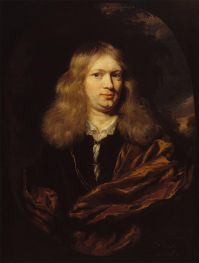
Canvas Print
$61.93
$61.93
SKU: 19874-MNI
Nicolaes Maes
Original Size: 44.6 x 33.8 cm
Museum Mayer van den Bergh, Antwerp, Belgium
Nicolaes Maes
Original Size: 44.6 x 33.8 cm
Museum Mayer van den Bergh, Antwerp, Belgium
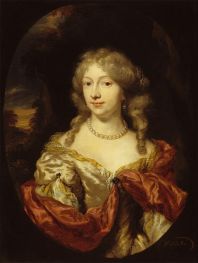
Canvas Print
$61.93
$61.93
SKU: 19875-MNI
Nicolaes Maes
Original Size: 44 x 33.8 cm
Museum Mayer van den Bergh, Antwerp, Belgium
Nicolaes Maes
Original Size: 44 x 33.8 cm
Museum Mayer van den Bergh, Antwerp, Belgium
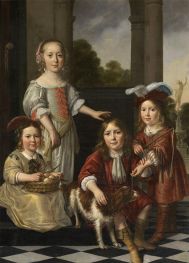
Canvas Print
$67.58
$67.58
SKU: 19810-MNI
Nicolaes Maes
Original Size: 150 x 112 cm
Groeninge Museum, Bruges, Belgium
Nicolaes Maes
Original Size: 150 x 112 cm
Groeninge Museum, Bruges, Belgium
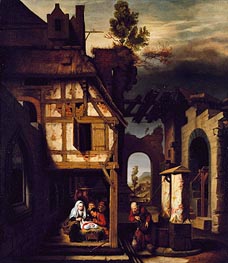
Canvas Print
$81.06
$81.06
SKU: 13364-MNI
Nicolaes Maes
Original Size: 120.7 x 96 cm
J. Paul Getty Museum, Los Angeles, USA
Nicolaes Maes
Original Size: 120.7 x 96 cm
J. Paul Getty Museum, Los Angeles, USA
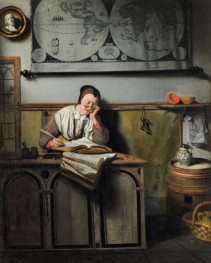
Canvas Print
$75.43
$75.43
SKU: 23512-MNI
Nicolaes Maes
Original Size: 66 x 53.7 cm
Saint Louis Art Museum, St. Louis, USA
Nicolaes Maes
Original Size: 66 x 53.7 cm
Saint Louis Art Museum, St. Louis, USA
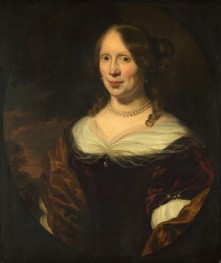
Canvas Print
$79.01
$79.01
SKU: 23468-MNI
Nicolaes Maes
Original Size: 76.5 x 66 cm
Kunsthistorisches Museum, Vienna, Austria
Nicolaes Maes
Original Size: 76.5 x 66 cm
Kunsthistorisches Museum, Vienna, Austria
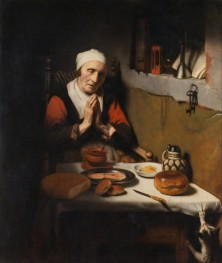
Canvas Print
$79.35
$79.35
SKU: 23490-MNI
Nicolaes Maes
Original Size: 134 x 113 cm
Rijksmuseum, Amsterdam, Netherlands
Nicolaes Maes
Original Size: 134 x 113 cm
Rijksmuseum, Amsterdam, Netherlands
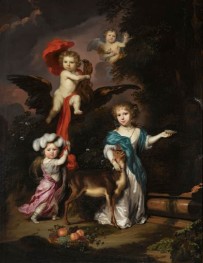
Canvas Print
$72.70
$72.70
SKU: 23527-MNI
Nicolaes Maes
Original Size: 90.7 x 70.2 cm
Private Collection
Nicolaes Maes
Original Size: 90.7 x 70.2 cm
Private Collection
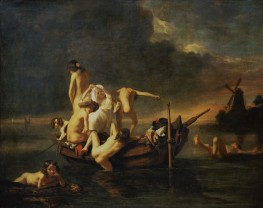
Canvas Print
$74.40
$74.40
SKU: 23469-MNI
Nicolaes Maes
Original Size: 72.5 x 91.5 cm
Louvre Museum, Paris, France
Nicolaes Maes
Original Size: 72.5 x 91.5 cm
Louvre Museum, Paris, France
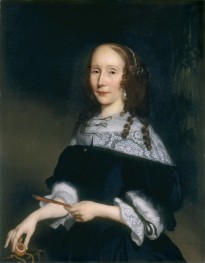
Canvas Print
$73.55
$73.55
SKU: 23526-MNI
Nicolaes Maes
Original Size: 91.7 x 72.4 cm
Thyssen-Bornemisza Museum, Madrid, Spain
Nicolaes Maes
Original Size: 91.7 x 72.4 cm
Thyssen-Bornemisza Museum, Madrid, Spain
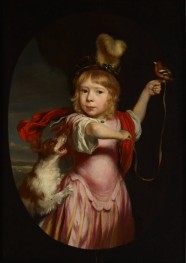
Canvas Print
$61.93
$61.93
SKU: 23529-MNI
Nicolaes Maes
Original Size: 42.4 x 29.7 cm
Minneapolis Institute of Arts, USA
Nicolaes Maes
Original Size: 42.4 x 29.7 cm
Minneapolis Institute of Arts, USA
Canvas Print
$71.84
$71.84
SKU: 23519-MNI
Nicolaes Maes
Original Size: 135.5 x 104.5 cm
Royal Museums of Fine Arts of Belgium, Brussels
Nicolaes Maes
Original Size: 135.5 x 104.5 cm
Royal Museums of Fine Arts of Belgium, Brussels
Canvas Print
$74.23
$74.23
SKU: 23531-MNI
Nicolaes Maes
Original Size: 114.7 x 90.9 cm
Bavarian National Museum, Munich, Germany
Nicolaes Maes
Original Size: 114.7 x 90.9 cm
Bavarian National Museum, Munich, Germany
Canvas Print
$74.06
$74.06
SKU: 23530-MNI
Nicolaes Maes
Original Size: 114.9 x 91.7 cm
Bavarian National Museum, Munich, Germany
Nicolaes Maes
Original Size: 114.9 x 91.7 cm
Bavarian National Museum, Munich, Germany
Canvas Print
$69.80
$69.80
SKU: 23454-MNI
Nicolaes Maes
Original Size: 188 x 139.7 cm
Haggerty Museum of Art at Marquette University, Milwaukee, USA
Nicolaes Maes
Original Size: 188 x 139.7 cm
Haggerty Museum of Art at Marquette University, Milwaukee, USA
Canvas Print
$70.14
$70.14
SKU: 23452-MNI
Nicolaes Maes
Original Size: 92.5 x 122 cm
Dordrechts Museum, Dordrecht, Netherlands
Nicolaes Maes
Original Size: 92.5 x 122 cm
Dordrechts Museum, Dordrecht, Netherlands
Canvas Print
$61.93
$61.93
SKU: 23509-MNI
Nicolaes Maes
Original Size: 41.9 x 31.8 cm
Fogg Art Museum at Harvard University, Cambridge, USA
Nicolaes Maes
Original Size: 41.9 x 31.8 cm
Fogg Art Museum at Harvard University, Cambridge, USA
Canvas Print
$61.93
$61.93
SKU: 23528-MNI
Nicolaes Maes
Original Size: 44.8 x 33.8 cm
National Museum in Cracow, Kraków, Poland
Nicolaes Maes
Original Size: 44.8 x 33.8 cm
National Museum in Cracow, Kraków, Poland
Canvas Print
$78.84
$78.84
SKU: 23521-MNI
Nicolaes Maes
Original Size: 66 x 53 cm
Private Collection
Nicolaes Maes
Original Size: 66 x 53 cm
Private Collection
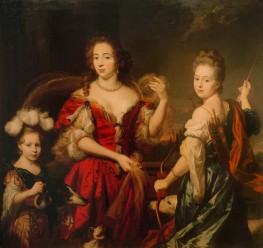
Canvas Print
$88.91
$88.91
SKU: 23520-MNI
Nicolaes Maes
Original Size: 137.5 x 143.5 cm
Anhalt Art Gallery, Dessau, Germany
Nicolaes Maes
Original Size: 137.5 x 143.5 cm
Anhalt Art Gallery, Dessau, Germany
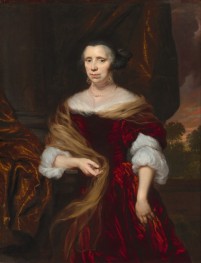
Canvas Print
$71.84
$71.84
SKU: 23488-MNI
Nicolaes Maes
Original Size: 116 x 91 cm
National Gallery of Art, Washington, USA
Nicolaes Maes
Original Size: 116 x 91 cm
National Gallery of Art, Washington, USA
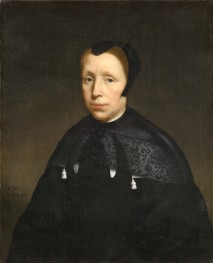
Canvas Print
$76.11
$76.11
SKU: 23523-MNI
Nicolaes Maes
Original Size: 75 x 59.3 cm
Kunstmuseum Basel, Switzerland
Nicolaes Maes
Original Size: 75 x 59.3 cm
Kunstmuseum Basel, Switzerland
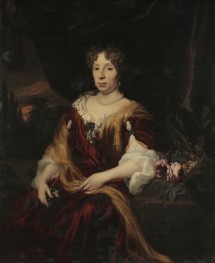
Canvas Print
$76.79
$76.79
SKU: 23461-MNI
Nicolaes Maes
Original Size: 120 x 97.5 cm
Museo de Arte, Ponce, Puerto Rico
Nicolaes Maes
Original Size: 120 x 97.5 cm
Museo de Arte, Ponce, Puerto Rico
Canvas Print
$73.21
$73.21
SKU: 23491-MNI
Nicolaes Maes
Original Size: 123 x 96 cm
Rijksmuseum, Amsterdam, Netherlands
Nicolaes Maes
Original Size: 123 x 96 cm
Rijksmuseum, Amsterdam, Netherlands