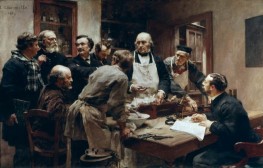
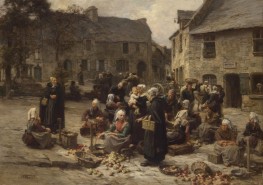
Léon-Augustin Lhermitte Giclée Fine Art Prints 1 of 2
1844-1925
French Realist Painter
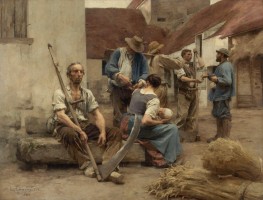
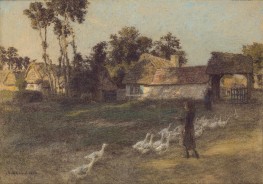
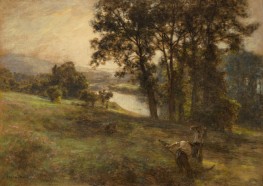
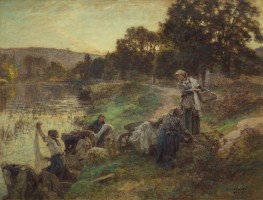
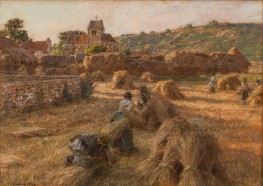
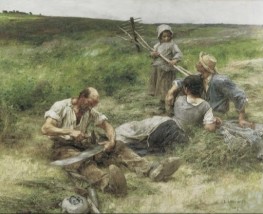
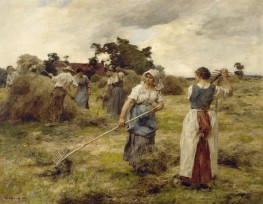
In the summer of 1882 the Paris Salon hung a large canvas of farm labourers being handed their wages at a kitchen table. No drama, no sermon, no picturesque rags. Léon Augustin Lhermitte (1844 - 1925), French painter, etcher and pastellist of the naturalist school, had arrived at the subject that would hold him for the next four decades: rural labour, recorded with the sobriety of a man who had grown up inside it.
He was born on 31 July 1844 at Mont-Saint-Père, a village of vineyards and wheat in Picardy, into a household that was cultivated but far from prosperous. His father taught in the village school, saw the drawings his son made, and chose to encourage them. Such decisions are rarely recorded. This one built a career.
In 1863 Lhermitte entered the Special School of Drawing and Mathematics in Paris - the Petite École, later the National School of Decorative Arts - and came under Horace Lecoq de Boisbaudran, a teacher whose method has outlasted his own paintings. Lecoq trained his students to look hard, then turn away and reconstruct the scene from memory. Nothing could have suited Lhermitte better. A harvest field does not hold still; a scythe swings, a sack is hoisted, a back straightens for a moment and bends again. The École des Beaux-Arts followed, but memory remained the true foundation.
England came early. Crossing the Channel for the first time in 1869, he met Alphonse Legros, another of Lecoq's pupils, and formed lasting friendships with Henri Fantin-Latour and James McNeill Whistler. London became a second professional home, returned to again and again, with pictures reaching British collectors through the dealers Paul Durand-Ruel and Edwin Edwards. That English connection mattered: it gave him buyers and standing well outside the French Salon system.
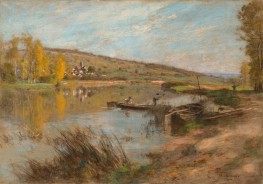
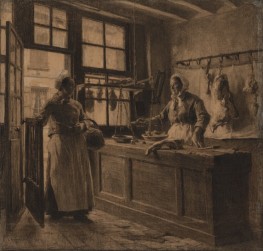
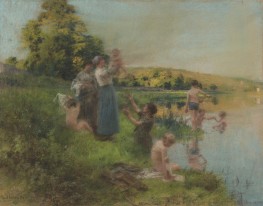
Black and white occupied him as seriously as colour. Between 1874 and 1881 he contributed six plates to the etching album L'Eau-forte en…, published by Alfred Cadart, and his charcoal drawings - dense, velvety, worked through a tonal range closer to painting than to sketching - earned him a seat on the jury of the second International Exhibition of Black and White in Paris in 1886, in the charcoal section. His handling of pastel drew particular admiration. Where others used chalk for portraits and pleasantries, he pushed it into the register of full painting, building figures from broken strokes and letting the tooth of the paper carry the light.
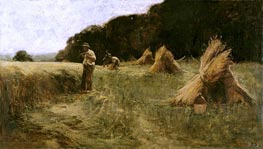
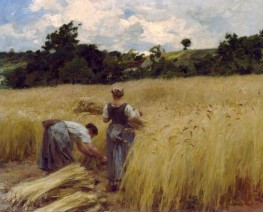
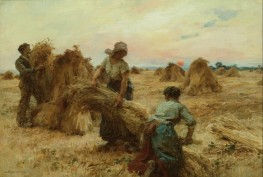
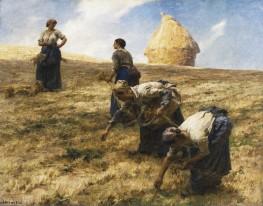
The Harvesters' Pay, shown in 1882, altered his standing entirely. Colleagues took notice, the State bought the canvas, and the press found him a label he never shook off: the painter of the harvesters. What we see in it is exhaustion rather than heroism - bodies slack after the day's work, the transaction itself almost incidental. Five years later he returned to related ground with The Gleaners of 1887. Comparisons with Jean-François Millet were inevitable, and Lhermitte did not resist them, though his own eye stayed cooler and more documentary, less drawn to the biblical cadence Millet gave to bent backs.
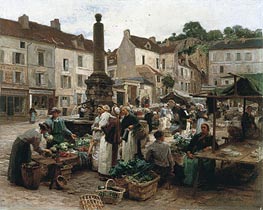
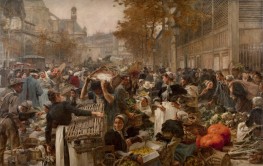
Not everything was rural. Les Halles, exhibited at the Salon of 1895, took him into the produce market at the centre of Paris, among stalls, baskets and the early-morning crowd - the same working world, transposed onto paving stones. The picture's afterlife reads like a small parable of official taste. Hung first at the Hôtel de Ville, moved to the Petit Palais in 1904, it was taken down in 1942 and put into store, initially at the Auteuil municipal depot and then at Ivry. Restoration came late, funded by the Rungis market, the modern successor to the very halls he had painted. The canvas is on view at the Petit Palais once more.
Honours accumulated across the last quarter-century of his life. He sat on the jury of the Universal Exhibition of 1900 in Paris, served in the delegation of the Société Nationale des Beaux-Arts from 1901 to 1905, and was named a rosati of honour in 1902. On 28 October 1905 the Academy of Fine Arts elected him a full member in the painting section. Promotion to commander of the Legion of Honour followed in 1910. Léon Augustin Lhermitte died in Paris on 28 July 1925, three days short of his eighty-first birthday.
Vincent van Gogh, working through his own dark Dutch peasant subjects in the 1880s, followed Lhermitte's compositions in the illustrated press with something close to hunger, and told his brother Theo that he ranked the modern painters of rural life beside Michelangelo and Rembrandt. The comparison is extravagant, and it tells us less about absolute stature than about what younger artists found there: proof that ordinary labour could carry the full weight of serious painting. Perhaps that is why the pictures still hold. He asks no pity of us. He shows us a body at rest between one task and the next, and lets the fatigue speak for itself. A century after his death, in a culture that has largely lost sight of where its bread comes from, his fields look less like nostalgia than like evidence.