
Judith Leyster Giclée Fine Art Prints
1609-1660
Dutch Baroque Painter
In 1893, beneath a forged signature on a canvas long admired as a Frans Hals, a small monogram surfaced: two initials laced through a star. It belonged to Judith Jans Leyster, baptised in Haarlem on 28 July 1609 and buried outside that city in February 1660, a Dutch Golden Age painter of genre scenes, portraits and the occasional still life. For close to two hundred years her name had been detached from her pictures. The star was both signature and joke.
Her father, Jan Willemsz Leyster, was a Haarlem cloth maker turned brewer; she was his eighth child. In 1618 he acquired a brewery called the Leystar - the lead star, as Dutch mariners named the North Star. Surname and brewery sign met in one word, and she made the coincidence her own.
Documentation of her training is thin. Samuel Ampzing, a Haarlem poet, named her in his 1628 survey of the city, Beschrijvinge ende lof der stadt Haerlem, which implies a local reputation before she turned twenty. She may have learned with Frans Pietersz de Grebber, whose Haarlem studio was among the more respected of the 1620s. Her father's bankruptcy took the family into the province of Utrecht, where she is thought to have met the Utrecht Caravaggisti - Hendrick Terbrugghen, Gerrit van Honthorst - and their tenebrist appetite for artificial light and figures pressed close to the picture plane. Some believe she painted to support the household. Necessity and vocation are not always separable.
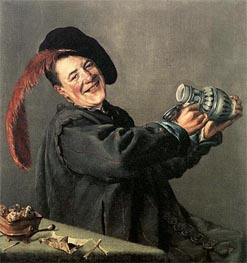
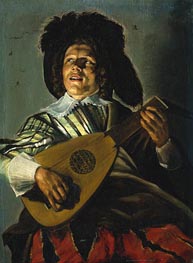
Serenade, now in the Rijksmuseum, and The Jolly Toper both carry the date 1629, her earliest signed works; she was twenty. From that year she used her own monogram, a small administrative act announcing professional independence. By 1633 she had entered the Haarlem Guild of St Luke. Whether she was the first woman on its rolls remains contested - Sara van Baalbergen appears in 1631 - and since the records rarely name a medium, embroiderers, potters and widows continuing a husband's trade are hard to separate from painters.
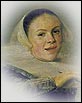
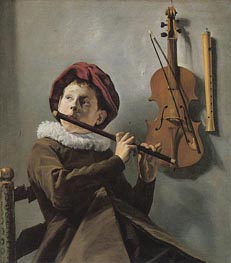
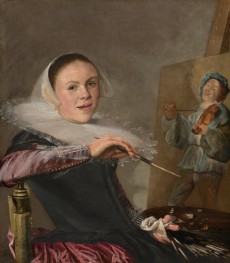
The Self-Portrait of about 1633, now in the National Gallery of Art in Washington, D.C., may have been her guild presentation piece. In it she turns in her chair to face us, brush and palette in hand, lips parted as though caught mid-sentence - a pose loose by the standards of Dutch portraiture, looser still beside earlier self-portraits by women. She wears a dark formal dress and a wide lace collar, implausible studio clothing and deliberately so: painters then dressed for the standing they wanted, not the labour they did. On the easel behind her sits a finished fiddler, a sample of her stock in trade. The picture is advertisement, credential and performance at once.
Within two years of joining she had three male apprentices. One left for Frans Hals without the guild's permission, and Leyster went to law. The boy's mother paid four guilders in damages, half the sum claimed; Hals settled with a three-guilder fine and kept the pupil; Leyster was fined for failing to register the apprentice. Petty, procedural, revealing. Here is a woman running a workshop inside a system that treated her as a full member and billed her accordingly. Her paintings drew wider notice afterwards.
In 1636 she married Jan Miense Molenaer, a prolific painter working the same ground of portraits, genre and history subjects. The couple moved to Amsterdam, where his clientele already existed, stayed eleven years, then settled at Heemstede near Haarlem, sharing a studio in a small house on what is now Groenendaal Park. Five children were born; two reached adulthood. Almost all her dated work falls between 1629 and 1635, after which the record thins to a tulip book of 1643, a portrait of 1652 and a still life of 1654 that surfaced from a private collection only in this century. Whether the quiet means lost pictures, unsigned collaboration with her husband, or a household absorbing her hours, no document says.
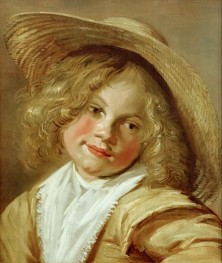
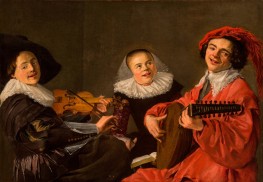
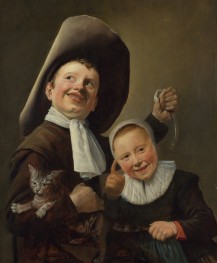
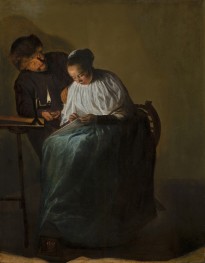
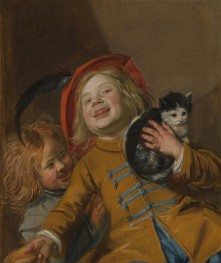
Her casts were small - one to three figures against plain grounds, generally in good humour. Children laugh, musicians tune up, drinkers hold a glass at the angle that promises trouble. More unusual are the interiors at night, lit by candle or lamp and observed from inside a woman's day rather than from the tavern door. The Proposition, in the Mauritshuis at The Hague, is the sharpest of them. A woman bends over her sewing; a man leans from the shadow, holding out coins. Light does the narrating, the low red glow of the foot warmer and the shadow across her hands, and it is less naturalistic light than argued light, arranged to prove her concentration will not break. Dutch carries a coarse second meaning for the verb to sew, and the scene has been read as a transaction declined; Frima Fox Hofrichter sees a refusal of the stock comedy of the grasping woman, while Ann Sutherland Harris reads the man as an honest suitor. Perhaps only a painter who had sat with a needle by lamplight would make a woman's attention the subject.
Comparable pictures came from Molenaer, from Frans and Dirck Hals, from Jan Steen; the market was the expanding Dutch middle class. Formal portraits she painted rarely. Her only known history painting, David with the Head of Goliath of 1633, keeps her usual arrangement of a single figure close to the front of the space. In 1648 the Haarlem writer Theodore Schrevel placed her among women who could compete with men and called her the true leading star of art, catching the pun and meaning it.
She died in 1660, aged fifty, and was buried at a farm just outside Haarlem. The inventory of her estate credited paintings to the wife of Molenaer. That phrase did a great deal of quiet damage. The Louvre discovery of 1893 came out of a sale, not a scholarly quest: The Jolly Companions had passed through the Bond Street dealer Wertheimer, praised as one of the finest Hals paintings in existence and sold on for £4,500. When the monogram appeared beneath the false signature the buyers went to court, settling on 31 May 1893 at a reduced £3,500 plus costs. Nobody, it was later observed, threw a cap in the air at the discovery of a painter who could match Hals.
Cornelis Hofstede de Groot published the first article on her that same year, attributing seven paintings, six of them monogrammed. Rehabilitation came slowly. As late as the mid-twentieth century a British writer could cite her canvases as proof that a woman's hand lacked the vigour of Hals's brushwork - a verdict on pictures that had convinced the same market they were Hals for two centuries. Attitudes shifted in the closing decades of the last century, and Judith Leyster now hangs in Washington, Amsterdam and The Hague under her own name. What lingers is not the injustice, well rehearsed by now, but the quality of her looking: the foot warmer, the unbroken thread, the fiddler waiting on the easel. Leyster paints people in the moment before something changes. That is difficult to catch, and she caught it early, often, and without fuss.
Her father, Jan Willemsz Leyster, was a Haarlem cloth maker turned brewer; she was his eighth child. In 1618 he acquired a brewery called the Leystar - the lead star, as Dutch mariners named the North Star. Surname and brewery sign met in one word, and she made the coincidence her own.
Documentation of her training is thin. Samuel Ampzing, a Haarlem poet, named her in his 1628 survey of the city, Beschrijvinge ende lof der stadt Haerlem, which implies a local reputation before she turned twenty. She may have learned with Frans Pietersz de Grebber, whose Haarlem studio was among the more respected of the 1620s. Her father's bankruptcy took the family into the province of Utrecht, where she is thought to have met the Utrecht Caravaggisti - Hendrick Terbrugghen, Gerrit van Honthorst - and their tenebrist appetite for artificial light and figures pressed close to the picture plane. Some believe she painted to support the household. Necessity and vocation are not always separable.
Serenade, now in the Rijksmuseum, and The Jolly Toper both carry the date 1629, her earliest signed works; she was twenty. From that year she used her own monogram, a small administrative act announcing professional independence. By 1633 she had entered the Haarlem Guild of St Luke. Whether she was the first woman on its rolls remains contested - Sara van Baalbergen appears in 1631 - and since the records rarely name a medium, embroiderers, potters and widows continuing a husband's trade are hard to separate from painters.
The Self-Portrait of about 1633, now in the National Gallery of Art in Washington, D.C., may have been her guild presentation piece. In it she turns in her chair to face us, brush and palette in hand, lips parted as though caught mid-sentence - a pose loose by the standards of Dutch portraiture, looser still beside earlier self-portraits by women. She wears a dark formal dress and a wide lace collar, implausible studio clothing and deliberately so: painters then dressed for the standing they wanted, not the labour they did. On the easel behind her sits a finished fiddler, a sample of her stock in trade. The picture is advertisement, credential and performance at once.
Within two years of joining she had three male apprentices. One left for Frans Hals without the guild's permission, and Leyster went to law. The boy's mother paid four guilders in damages, half the sum claimed; Hals settled with a three-guilder fine and kept the pupil; Leyster was fined for failing to register the apprentice. Petty, procedural, revealing. Here is a woman running a workshop inside a system that treated her as a full member and billed her accordingly. Her paintings drew wider notice afterwards.
In 1636 she married Jan Miense Molenaer, a prolific painter working the same ground of portraits, genre and history subjects. The couple moved to Amsterdam, where his clientele already existed, stayed eleven years, then settled at Heemstede near Haarlem, sharing a studio in a small house on what is now Groenendaal Park. Five children were born; two reached adulthood. Almost all her dated work falls between 1629 and 1635, after which the record thins to a tulip book of 1643, a portrait of 1652 and a still life of 1654 that surfaced from a private collection only in this century. Whether the quiet means lost pictures, unsigned collaboration with her husband, or a household absorbing her hours, no document says.
Her casts were small - one to three figures against plain grounds, generally in good humour. Children laugh, musicians tune up, drinkers hold a glass at the angle that promises trouble. More unusual are the interiors at night, lit by candle or lamp and observed from inside a woman's day rather than from the tavern door. The Proposition, in the Mauritshuis at The Hague, is the sharpest of them. A woman bends over her sewing; a man leans from the shadow, holding out coins. Light does the narrating, the low red glow of the foot warmer and the shadow across her hands, and it is less naturalistic light than argued light, arranged to prove her concentration will not break. Dutch carries a coarse second meaning for the verb to sew, and the scene has been read as a transaction declined; Frima Fox Hofrichter sees a refusal of the stock comedy of the grasping woman, while Ann Sutherland Harris reads the man as an honest suitor. Perhaps only a painter who had sat with a needle by lamplight would make a woman's attention the subject.
Comparable pictures came from Molenaer, from Frans and Dirck Hals, from Jan Steen; the market was the expanding Dutch middle class. Formal portraits she painted rarely. Her only known history painting, David with the Head of Goliath of 1633, keeps her usual arrangement of a single figure close to the front of the space. In 1648 the Haarlem writer Theodore Schrevel placed her among women who could compete with men and called her the true leading star of art, catching the pun and meaning it.
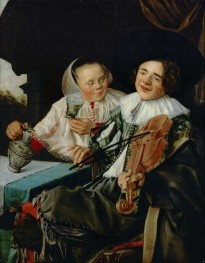
She died in 1660, aged fifty, and was buried at a farm just outside Haarlem. The inventory of her estate credited paintings to the wife of Molenaer. That phrase did a great deal of quiet damage. The Louvre discovery of 1893 came out of a sale, not a scholarly quest: The Jolly Companions had passed through the Bond Street dealer Wertheimer, praised as one of the finest Hals paintings in existence and sold on for £4,500. When the monogram appeared beneath the false signature the buyers went to court, settling on 31 May 1893 at a reduced £3,500 plus costs. Nobody, it was later observed, threw a cap in the air at the discovery of a painter who could match Hals.
Cornelis Hofstede de Groot published the first article on her that same year, attributing seven paintings, six of them monogrammed. Rehabilitation came slowly. As late as the mid-twentieth century a British writer could cite her canvases as proof that a woman's hand lacked the vigour of Hals's brushwork - a verdict on pictures that had convinced the same market they were Hals for two centuries. Attitudes shifted in the closing decades of the last century, and Judith Leyster now hangs in Washington, Amsterdam and The Hague under her own name. What lingers is not the injustice, well rehearsed by now, but the quality of her looking: the foot warmer, the unbroken thread, the fiddler waiting on the easel. Leyster paints people in the moment before something changes. That is difficult to catch, and she caught it early, often, and without fuss.
12 Judith Leyster Artworks
Giclée Canvas Print
$92.34
$92.34
SKU: 3138-LEJ
Judith Leyster
Original Size:89 x 85 cm
Rijksmuseum, Amsterdam, Netherlands
Judith Leyster
Original Size:89 x 85 cm
Rijksmuseum, Amsterdam, Netherlands
Giclée Canvas Print
$63.83
$63.83
SKU: 3136-LEJ
Judith Leyster
Original Size:45.5 x 35 cm
Rijksmuseum, Amsterdam, Netherlands
Judith Leyster
Original Size:45.5 x 35 cm
Rijksmuseum, Amsterdam, Netherlands
Giclée Canvas Print
$83.20
$83.20
SKU: 3135-LEJ
Judith Leyster
Original Size:73 x 62 cm
National Museum, Stockholm, Sweden
Judith Leyster
Original Size:73 x 62 cm
National Museum, Stockholm, Sweden
Giclée Canvas Print
$84.78
$84.78
SKU: 23008-LEJ
Judith Leyster
Original Size:74.6 x 65.1 cm
National Gallery of Art, Washington, USA
Judith Leyster
Original Size:74.6 x 65.1 cm
National Gallery of Art, Washington, USA
Giclée Canvas Print
$87.77
$87.77
SKU: 23007-LEJ
Judith Leyster
Original Size:68 x 62.5 cm
The Kremer Collection, Amsterdam, Netherlands
Judith Leyster
Original Size:68 x 62.5 cm
The Kremer Collection, Amsterdam, Netherlands
Giclée Canvas Print
$63.83
$63.83
SKU: 23010-LEJ
Judith Leyster
Original Size:36.2 x 31 cm
Private Collection
Judith Leyster
Original Size:36.2 x 31 cm
Private Collection
Giclée Canvas Print
$67.19
$67.19
SKU: 23009-LEJ
Judith Leyster
Original Size:61 x 87 cm
Public Collection
Judith Leyster
Original Size:61 x 87 cm
Public Collection
Giclée Canvas Print
$79.86
$79.86
SKU: 23004-LEJ
Judith Leyster
Original Size:59.4 x 48.8 cm
National Gallery, London, UK
Judith Leyster
Original Size:59.4 x 48.8 cm
National Gallery, London, UK
Giclée Canvas Print
$77.74
$77.74
SKU: 23006-LEJ
Judith Leyster
Original Size:89.1 x 73.5 cm
Philadelphia Museum of Art, Pennsylvania, USA
Judith Leyster
Original Size:89.1 x 73.5 cm
Philadelphia Museum of Art, Pennsylvania, USA
Giclée Canvas Print
$63.83
$63.83
SKU: 23003-LEJ
Judith Leyster
Original Size:30.8 x 24.2 cm
Mauritshuis Royal Picture Gallery, The Hague, Netherlands
Judith Leyster
Original Size:30.8 x 24.2 cm
Mauritshuis Royal Picture Gallery, The Hague, Netherlands
Giclée Canvas Print
$81.61
$81.61
SKU: 23005-LEJ
Judith Leyster
Original Size:61 x 52 cm
Rijksmuseum, Amsterdam, Netherlands
Judith Leyster
Original Size:61 x 52 cm
Rijksmuseum, Amsterdam, Netherlands
Giclée Canvas Print
$75.46
$75.46
SKU: 23002-LEJ
Judith Leyster
Original Size:68 x 57 cm
Louvre Museum, Paris, France
Judith Leyster
Original Size:68 x 57 cm
Louvre Museum, Paris, France