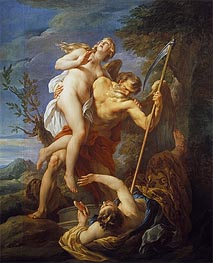
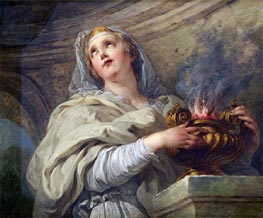
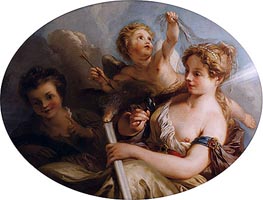
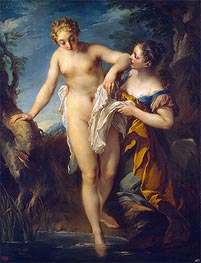
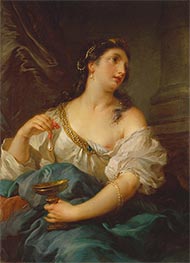
One day after finishing a canvas titled Time Saving Truth from Falsehood and Envy, painted for his friend and patron François Berger, François Lemoyne took a sword and stabbed himself nine times in the chest and throat. It was 4 June 1737, and the man who died that morning in Paris held the title of Premier peintre du Roi, the most honored position a painter could occupy in France. Born in Paris in 1688, Lemoyne belongs to the founding generation of the French rococo - a decorator of ceilings on the grandest scale, teacher of François Boucher and Charles-Joseph Natoire, and, for one brief season, the acknowledged successor to Charles Le Brun.
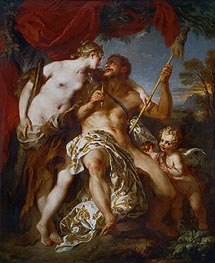
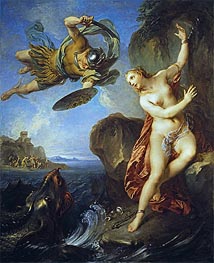
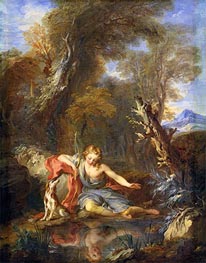
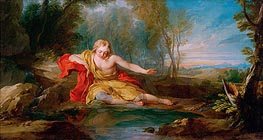
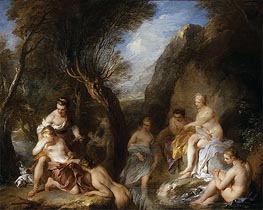
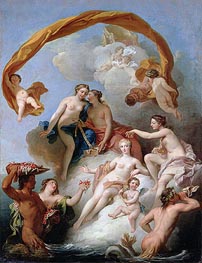
His training was orthodox and thorough. Under Louis Galloche, with whom he studied until 1713, he absorbed the academic disciplines of drawing and composition, and in 1711 he won the Prix de Rome, the coveted scholarship that sent young painters south to measure themselves against Italy. Rome gave him Raphael, Correggio, and Titian. Rubens, however, left the deepest mark, above all through the Flemish master's handling of color - that warm, breathing quality of flesh and light which Lemoyne carried into his own mythologies.
Back in Paris, he was received as a full member of the Académie royale de peinture et de sculpture in 1718. Ambition drove him from the start. He wanted nothing less than recognition as the heir of Le Brun, the organizing genius of Versailles under Louis XIV, and so, with equal determination, did Jean-François de Troy. The rivalry between the two men runs like a fault line through French painting of the 1720s. A second Italian journey in 1723 sharpened Lemoyne's instincts further. In the Palazzo Barberini he studied Pietro da Cortona's vast illusionistic ceiling, and in the works of the Venetians, Paolo Veronese above all, he found a silvery pageantry that gradually tilted his style toward the Italian manner.
Opportunity arrived in 1727. The duc d'Antin, director of the Bâtiments du Roi, announced a competition intended to revive history painting within the Académie. Only one Salon had been held since 1704, so the public display of the twelve submitted works was itself an event. Critical opinion favored the entries of Charles-Antoine Coypel and Noël-Nicolas Coypel, yet the prize of 5,000 livres was divided, diplomatically and to nobody's satisfaction, between Lemoyne and de Troy. Both winners felt cheated. For a man of Lemoyne's ambition, half a victory was hardly a victory at all.
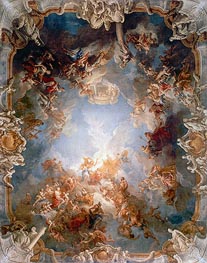
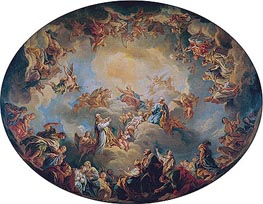
Vindication came at Versailles. In 1728 he received the royal commission to decorate the ceiling of the Salon d'Hercule, and from 1733 to 1736 he labored over the enormous Apotheosis of Hercules, an open heaven of ascending figures painted à ciel ouvert. He had seen what Cortona achieved in Rome and set out to prove that a French painter could command Baroque illusion as convincingly as any Italian. When the scaffolding came down, the praise was unanimous, with Voltaire and Cardinal Fleury among those who added their voices. Elected a professor of the Académie in 1733, Lemoyne reached the summit in 1736, when Louis XV named him Premier peintre du Roi. His studio, meanwhile, was shaping the two artists who would define the coming age: Natoire and Boucher.
Then, within months, the collapse. Why François Lemoyne killed himself has never been settled. Historians have proposed exhaustion after years of relentless work, the corrosive intrigue of the court at Versailles, grief at the death of his wife, an unstable temperament, and a perfectionist's despair at falling short of an ideal no brush could reach. David Wakefield described him as hardworking, meticulous, and grave - qualities that made the great ceiling possible and may also have left the man dangerously exposed. Six months separated the unveiling of the Hercules ceiling from the nine sword wounds. Perhaps the commission had given his life a structure that its completion quietly took away.
With Lemoyne's death, the fashion for vast allegorical ceilings in France effectively ended, as if the genre could not survive its last great practitioner. Yet his sensibility endured through his pupils, above all Boucher, who carried the lighter graces of the rococo into the age of Madame de Pompadour. Modern scholarship has been kind to him: Pierre Rosenberg finds in his art a refinement and an inwardness rare among decorators, while Philip Conisbee senses a sensuous beauty close to Correggio. Visitors to Versailles still pause beneath the Salon d'Hercule and look up. What they see is not merely a triumph of French painting over Italian precedent, but the last, luminous statement of a man who gave everything to a ceiling and found nothing left for himself.