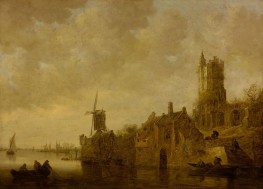
Jan van Goyen canvas prints: 10 works in museum quality, each made to order in the size you choose, with optional framing.
Jan Josephszoon van Goyen (1596-1656) was a Dutch landscape painter of the Golden Age, known for river views, dunes, winter scenes and seascapes painted in a narrow range of browns, grays and muted greens. He worked quickly enough to leave more than a thousand paintings, yet he died owing a fortune.
He was born in Leiden on 13 January 1596, at Schoolsteeg 4, the son of the shoemaker Joseph Jansz. van Goyen. His early training was restless, as the Leiden burgomaster Jan Jansz. Orlers recorded in his 1641 description of the city. At ten the boy went to the minor master Coenraet Schilperoort, but after three months he had learned all he wanted there. His father then took him to Isaac Claesz. van Swanenburg, a painter who also served as burgomaster, and next to an obscure local painter, Jan Arentsz. de Man. Along the way he declared that he had no intention of becoming a glazier. Several more settled years followed with the painter Willem Gerritsz in Hoorn, and at nineteen he traveled to France with this former teacher.
On his return he spent a year in Haarlem with Esaias van de Velde, the one teacher who decisively shaped his work. In 1618 he married Annetje Willemsdr. van Raelst and joined the Leiden Guild of Saint Luke as an independent master. His earliest signed paintings date from about that year.
Between 1632 and 1634, in the same years that Rembrandt and Jan Lievens also left Leiden, van Goyen moved to The Hague, where he became a citizen in 1634. A small daughter, Elsje, had been buried in the Grote Kerk there in 1632. By 1638 he was one of the heads of the local painters' guild, a post he held until 1640 or took up again that year. Partly under the influence of the marine painter Jan Porcellis, to whom he had sold a house in 1629, he developed what is now called the tonal landscape: a reduced palette, wide skies and alternating bands of shadow and light across the land, arranged with growing complexity in his later work.
His method was economical. On thin oak panels coated with a light brown, reddish or ochre ground, he sketched the scene rapidly in ink, then worked in grays, umbers, ochre and earthy greens bound in a varnish-oil medium. Shadows stayed thin and transparent, letting the ground show through, while lights were built up thickly with lead white. He would brush loose layers over the whole surface and then find, in the patches of color that emerged, the places to add boats, figures and buildings. His landscapes seldom sold for much, and painting fast with cheap pigments let him make up in quantity what each picture lacked in price. Whether he adopted this speed for commercial or artistic reasons remains an open question.
The raw material came from walks, some of which took him as far as Kleve in Germany and into northern France, filling sketchbooks first with pen drawings and later with hundreds of black chalk studies. Only one, the so-called Dresden sketchbook, survives intact. From these notes he painted the canals around The Hague, the countryside near Delft, Rotterdam, Leiden and Gouda, the dunes at Scheveningen that fascinated him, and the river towns of Dordrecht, Rhenen and Arnhem, as in his View of Arnhem. Between 1638 and 1653 he painted the Valkhof at Nijmegen some thirty times. In 1648 he visited Antwerp and painted Fort Lillo on the Scheldt. Topography was a starting point, not a rule: he could set Leiden's Hooglandse Kerk beside a river it never stood on. Portraits, history scenes and still lifes he never painted at all.
Painting alone never satisfied his need for money. He worked as an art dealer, appraiser and auctioneer, and in 1637 he was drawn into the tulip craze. On 27 January he bought nine bulbs for 90 guilders from Allert Claesz. van Ravesteyn, a former burgomaster of The Hague, promising two paintings in payment, one by Salomon van Ruysdael, which he never delivered. On 4 February he bought another lot from him for 843 guilders, unaware that the market had collapsed in Haarlem the day before. When van Ravesteyn died in 1641, van Goyen still owed him 897 guilders. More damaging in the long run was property: he bought plots on the Dunne Bierkade, the Nieuwe Molstraat and the newly dug Prinsegracht and had about six houses built. The animal painter Paulus Potter rented one and lived for a time as his neighbor. As his debts grew, van Goyen sharply increased his output between 1641 and 1647, and he held three auctions of his own and others' works between 1647 and 1654. One in 1652 brought in 3,750 guilders.
His registered pupils were Jan Steen and Adriaen van der Kabel, and possibly Nicolaes Berchem. Steen, like van Goyen a Catholic, moved into his house in 1649, married his daughter Grietje that year and painted the van Goyen family. Their first child, Thaddeus, was born in 1651. The eldest daughter, Maria, also married in 1649, to the painter Jacques de Claeuw. In 1651 the city of The Hague commissioned a vast view of itself from the southeast, almost five meters wide, for which he received 650 guilders, though he applied that same year for a deferral of his debts. In 1653 he asked the city to set off money still due against what he owed it. Two aldermen agreed, but a clerk struck out the resolution and the decision lapsed. Around this time Gerard ter Borch and Bartholomeus van der Helst both painted his portrait. In 1652 and 1654 he had to sell his collection of paintings and prints. In 1654 he rented out his own house on the Dunne Bierkade and moved to a smaller one on the Wagenstraat, and Steen left for Delft. His last decade nonetheless produced some of his finest work, including Storm on the Haarlemmermeer and his views of Dordrecht. The art historian H. U. Beck judged the freely composed seascapes of the 1650s to be the summit of his career.
Van Goyen died on the Wagenstraat on 27 April 1656, 18,000 guilders in debt. Annetje accepted the estate only on condition that she would not be liable for whatever remained unpaid, and Jan Steen and his father, the Leiden brewer Havick Steen, stood by her. Once the houses and furniture had been sold, she moved into the Hofje van Nieuwkoop almshouse, where she died in 1672. His tonal manner was imitated by dozens of followers and shaped painters such as Herman Saftleven and Abraham van Beijeren. In 1833 J. M. W. Turner paid tribute with Van Goyen Looking Out for a Subject, and in 1889 Vincent van Gogh wrote from the asylum that the wheat field beyond his barred window recalled a perspective by van Goyen. A View of Dordrecht was returned to the heirs of the dealer Jacques Goudstikker and bought back in 2008. The great view of The Hague belongs to the Haags Historisch Museum, and in 2009 it had to be hoisted out through a window over the Hofvijver to travel to an exhibition in Washington. Other works hang in the Thyssen-Bornemisza Museum in Madrid.