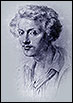
Venice held him so completely that he never left. Friedrich von Nerly (24 November 1807, Erfurt - 21 October 1878, Venice), born Christian Friedrich Nehrlich, was a German Romantic painter whose luminous vedute of the lagoon city secured his reputation across Europe. He arrived as a traveller; he remained for over four decades, painting the water, stone, and light of a place he made entirely his own.
Nerly's childhood was marked by early loss. His father, a postal official in Erfurt, died while the boy was still young. From 1815, an uncle in Hamburg - a musician - took charge of his upbringing. Drawing instruction came first from an aunt, then from another uncle, the lithographer Heinrich Joachim Herterich, in whose workshop the young Nehrlich found his earliest professional footing. Working alongside Herterich brought a decisive connection: a friendship with the lithographer's business partner, Johannes Michael Speckter, and through the Speckter family, an introduction to the painter and art historian Carl Friedrich von Rumohr. Rumohr recognised something worth cultivating. In 1823, Nerly entered his tutelage, and for the next four years absorbed the older man's rigorous approach to pictorial composition and art-historical thinking.
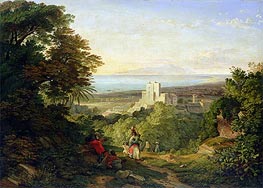
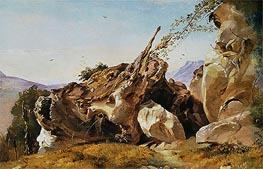
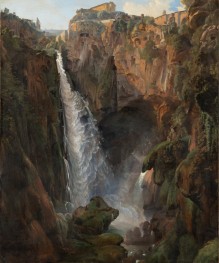
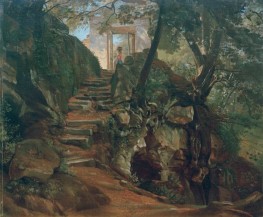
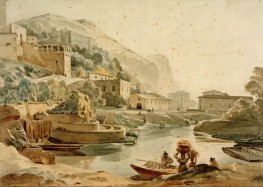
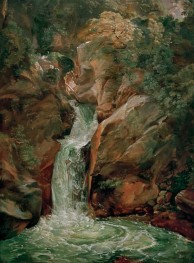
In 1827, teacher and student set out on a journey southward through the Harz Mountains toward Italy. By the close of 1828, they had reached Rome. The city's pull was immediate. Nehrlich decided to stay - and promptly reinvented himself, adopting the surname "Nerly" in a bid to sound more Italian. Perhaps the gesture was practical; perhaps it spoke to a deeper wish to belong. Whatever the impulse, the name stuck. He quickly became a visible figure in Rome's expatriate art world, assuming responsibility for organising the annual Cervaro Festival on behalf of the Deutscher Kuenstlerverein, the German Artists' Association based in the city. He held this role until 1835, a period during which he absorbed the lessons of Italian light and classical form that would shape everything to come.
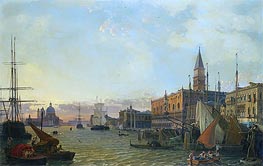
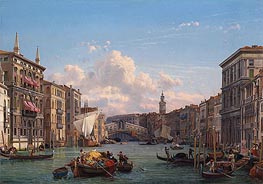
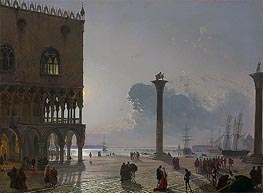
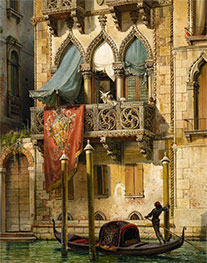
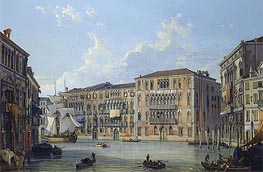
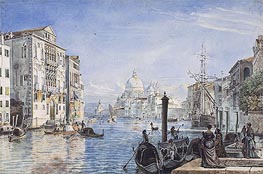
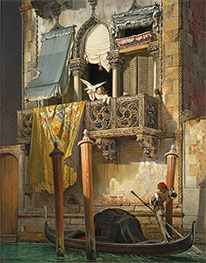
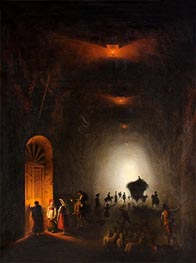
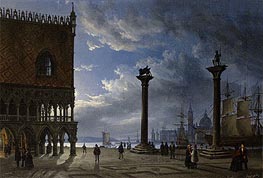
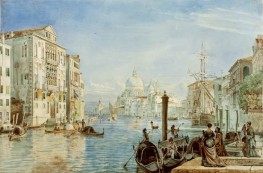
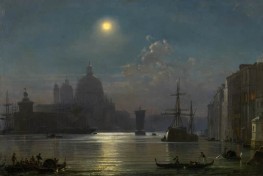
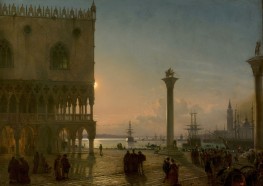
After a brief tour through southern Italy, Nerly settled permanently in Venice. Here his mature work took definitive shape. The canal views, nocturnal scenes, and architectural studies he produced over the following decades reveal a painter attuned to atmosphere with uncommon precision. Gondolas glide beneath moonlit skies; the facades of San Marco and the Palazzo Ducale emerge from mist with a tonal subtlety that owes something to the Venetian Old Masters and something to the Romantic sensibility he carried from the north. His handling of reflected light on water - rendered not with theatrical excess but with patient, observational honesty - distinguishes these paintings from the more formulaic tourist views that flooded the market. In the best of his vedute, architecture and atmosphere become inseparable.
Settled life brought personal stability as well. In 1840, he married Agathe Alginovich (1810-89), the adoptive daughter of the Marchese Maruzzi, and the couple had one son, Friedrich Paul Nerly, who would himself pursue painting. Recognition from beyond Venice followed: in 1852, King William I of Wuerttemberg awarded von Nerly the Knight's Cross in the Order of the Crown, conferring the noble prefix "von" that he carried for the remainder of his life.
Nerly died in Venice on 21 October 1878 and was buried in the Protestant section of the San Michele cemetery - the island of the dead that he had so often observed from across the water. His legacy found a permanent home five years later, when his son donated the entire art collection to the city of Erfurt, stipulating that it form the basis of a public museum. The Angermuseum opened in 1886, fulfilling that wish. A street in Erfurt still bears his name.
What endures in Friedrich von Nerly's work is something quieter than spectacle. His Venice is not the Venice of grand gesture but of precise, sustained looking - a city caught between solidity and dissolution, between stone and shimmer. That a German painter from landlocked Erfurt could render water and sky with such intimate authority remains one of the small, genuine surprises of nineteenth-century European painting.