Bellermann canvas prints: 5 works in museum quality, each made to order in the size you choose, with optional framing.
Ferdinand Konrad Bellermann (1814-1889) was a German landscape painter and self-taught naturalist, known for his views of Venezuela. He sketched them on the spot in the 1840s and kept turning them into paintings in his Berlin studio until the end of his life.
He was born in Erfurt on 14 March 1814, the eldest of several children of a tanner. When his father died young, the mother was left without means. An uncle, the merchant Johann Christian Bellermann, helped the family, and later letters to Ferdinand were sent to the uncle's house in Erfurt, which suggests that the children grew up there. The boy still had to earn money, and he did so by herding sheep. His gift for drawing was noticed in time, and in 1828, at fourteen, he was sent to the Free Drawing School in Weimar to train as a porcelain painter. The plan was probably for him to work afterward at a porcelain factory in Volkstedt owned by relatives. His eyesight seems to have been too weak for such fine work, so he broke off the training and went back to Erfurt. A small drawing he made at fifteen survives in Erfurt. It shows the cathedral and the church of St. Severus framed by trees, following the models after Claude Lorrain that the Weimar teachers used for composition. The buildings are a little stiff but exactly observed.
Weimar also gave him lasting friendships, above all with the painter Friedrich Preller, who became an important guide for him. In 1833 Bellermann moved to Berlin to study landscape painting with Wilhelm Schirmer and Carl Blechen. He went on long sketching tours through Thuringia and to the Baltic island of Rügen, and along the way he taught himself a great deal of botany. Walther Scheidig, for many years director of the Weimar museum, later described him as the scientist within his circle of painter friends.
The journey that shaped his career came in 1840. With Preller and two of Preller's pupils he traveled to Norway by way of Belgium and the Netherlands, on poor roads and with rough lodgings. On his return he painted a large Norwegian landscape whose accuracy, down to the rock formations, drew attention. King Frederick William IV of Prussia bought it, and its whereabouts are unknown today. The picture persuaded Alexander von Humboldt that hardly any artist was better suited to record the plants and landscapes of South America with both artistic and scientific precision. The voyage itself was the idea of a Hamburg merchant, not of Humboldt or the king. Humboldt's letter of recommendation stated that Bellermann traveled on His Majesty's behalf, a phrase meant to open doors for him, and it is why later accounts often called the trip a royal commission.
Bellermann landed at La Guaira on 10 July 1842 and stayed in Venezuela until 28 September 1845. In the port he drew the people and the streets, and in La Guaira, Caracas and Maiquetía he recorded buildings still in ruins from the earthquake of 1812. He spent much time on the heights of Galipán above the coast, where a waterfall and the abundance of ferns held his attention. In Caracas he saw the ceremonies of 1842 for the return of Simón Bolívar's remains from Santa Marta and wrote a careful account of them. He came to know the geographer Agustín Codazzi and the German merchant families Blohm and Vollmer. Following routes Humboldt had suggested, he crossed much of the country. In May 1843 he visited the Cueva del Guácharo with the botanists Karl Moritz and Nikolaus Funck, and on 3 November 1844 he reached Mérida, whose snow peaks and Andean flora Humboldt had never seen himself. He brought home a large body of pencil, pen and pastel drawings, oil sketches and some finished paintings, among them views of the harbors of La Guaira, Puerto Cabello, Angostura and Maracaibo, and figures such as Guajiro Indians and llaneros, the cattle herders of the plains.
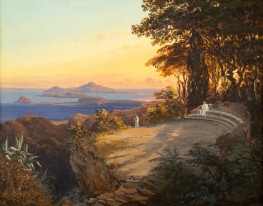
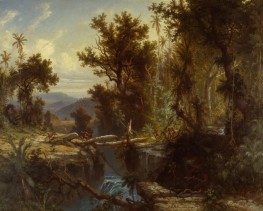
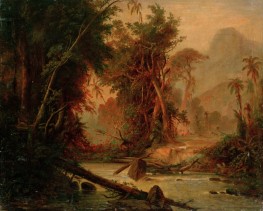
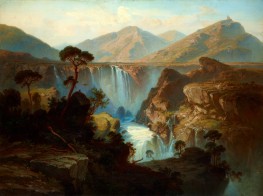
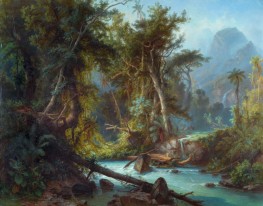
He was back in Germany in November 1845. In the studio he built his pictures from the color sketches. He did not abandon the habits of eighteenth-century landscape: twilight light and dark trees set at the sides like stage wings frame many of his tropical scenes. His palette favors browns, ochers and golden tones, deep greens and bluish grays. The Berlin Academy made him professor of drawing in 1849, and in 1866 he succeeded his old teacher Schirmer in the chair of landscape painting. There he championed Humboldt's view that tropical vegetation could widen the scope of European landscape art. His Venezuelan pictures helped to win funding for later expeditions, such as that of the naturalist Karl Ferdinand Appun. In 1879 he painted Humboldt's visit to the Cueva del Guácharo, a scene he could know only from his own trip to the cave. When he died in Berlin on 11 August 1889, an unfinished evening on the Orinoco stood on his easel.
In Venezuela his drawings are valued as a record of ports, towns and customs in the decades after independence. For the 200th anniversary of his birth, the Angermuseum in Erfurt held a large retrospective from October 2014 to January 2015.