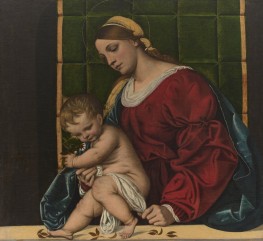
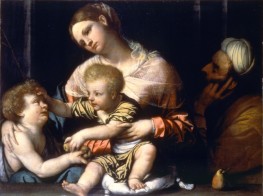
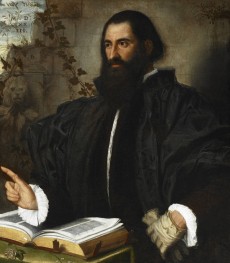
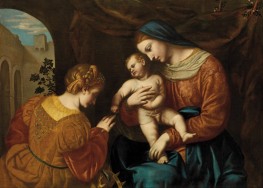
Moretto da Brescia canvas prints: 49 works in museum quality, each made to order in the size you choose, with optional framing.
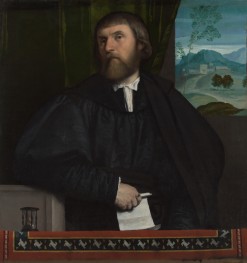
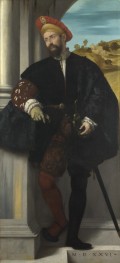
Alessandro Bonvicino, called Moretto da Brescia (c. 1498-1554), was an Italian Renaissance painter who spent almost his entire career in Brescia, then a city under Venetian rule. He painted calm, devout altarpieces for the churches of the region and a handful of portraits whose influence far outweighed their number. His full-length Portrait of a Man of 1526, now in the National Gallery in London, appears to be the first independent full-length portrait made in Italy.
His year of birth is known only indirectly: a document of 1548 gives his age as roughly fifty. His father's family came from Ardesio, and the name Moretto was inherited from his grandfather. Painting was already the family trade. His father Pietro, who died before 1515, and an uncle, also named Alessandro, were both painters, though almost nothing by either survives. No record of his training exists. He probably learned the basics from his father, and his early work belongs to the Brescian tradition shaped by Vincenzo Foppa. Older accounts name other teachers, including a period with Titian in Venice, but none of this is documented.
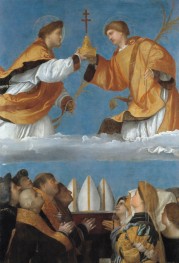
He was working independently very young. In 1514 he received a commission to paint scenes from the life of Mary Magdalene in a chapel of Santa Croce in Brescia, now lost. Between 1515 and 1518 he worked with Floriano Ferramola on the organ shutters of the Old Cathedral, the Duomo Vecchio. His panels of the city's patron saints Faustinus and Giovita, now in Santa Maria in Valvendra at Lovere, are so assured that some scholars once doubted his birth date. By 1516 he was already referred to as a master. His earliest dated painting, a Christ on the Cross with a donor of 1518 in the Accademia Carrara in Bergamo, has since lost its date to a careless restoration.
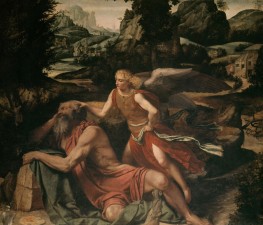
From 1521 to 1524 he shared the decoration of the Chapel of the Sacrament in San Giovanni Evangelista with Girolamo Romanino. Moretto's contributions there include the Gathering of the Manna, a Last Supper, Elijah and the Angel, the evangelists Mark and Luke and six half-length prophets. Because his work shows Venetian influence, historians have suggested that he spent time in Padua or Venice, but this remains conjecture. Between 1524 and 1526 he painted the Assumption of the Virgin for the Duomo Vecchio. The London portrait followed in 1526. Its sitter is plainly a wealthy nobleman, yet not a member of a ruling house, which makes the full-length format all the more unusual. He leans on a column that closes off most of the view behind him.
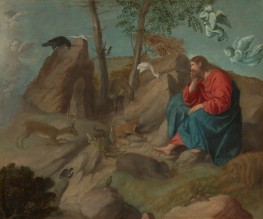
In a letter of December 1528, Lorenzo Lotto invited Moretto to join the decoration of Santa Maria Maggiore in Bergamo. He was paid in January 1529 for the journey and for work in the choir, though that work has never been identified. He collaborated several times with the organ builder Giovanni Giacomo Antegnati. The two met in Milan in 1530 to discuss restoring the organ of Salò Cathedral, and in 1536 Moretto painted the shutters of Antegnati's new organ in the Duomo Vecchio. In the early 1530s he delivered major altarpieces for San Francesco, Santa Maria Calchera and San Giovanni Evangelista, including the Massacre of the Innocents. From the same years comes Saint Justina with a unicorn and a kneeling donor, now in Vienna and once attributed to Pordenone. Its debt to Raphael suggests that Moretto knew Raphael's work from engravings, since he never went to Rome. Between 1531 and 1534 he also painted the Sleeping Elijah, the Sacrifice of Isaac and the evangelists Mark and Luke for the cathedral's own Sacrament Chapel.
By 1533 he could afford a house in the parish of San Clemente. That year, during an outbreak of plague, the Virgin was said to have appeared to a shepherd boy at Paitone, and Moretto painted the Madonna for the sanctuary built there. According to his nineteenth-century biographer Fenaroli, he prepared for the work with prayer and fasting. He was known in the city as a pious and respected citizen and belonged to at least two of its leading confraternities. Records show him at meetings of the cathedral body between 1535 and 1547 and involved in various financial dealings from 1541 to 1552. In 1535 he traveled to Solarolo at the invitation of Isabella d'Este.
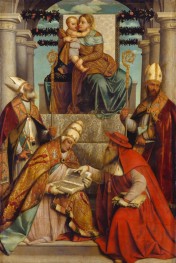
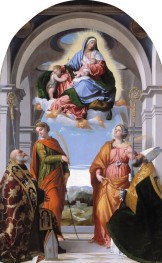
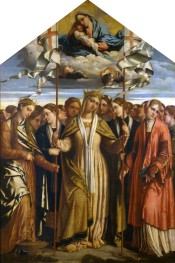
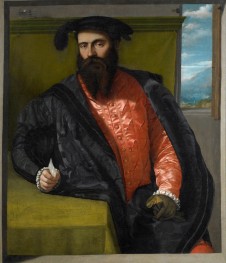
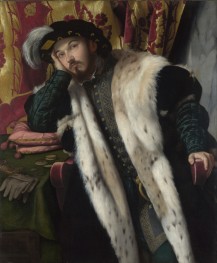
The Rovelli Altarpiece of 1539, now in the Pinacoteca Tosio Martinengo, is his most famous work. In it Saint Nicholas of Bari presents to the Virgin the pupils of the schoolmaster Galeazzo Rovelli, and the half-dome behind the saint holds a view of an Indian coastline. In 1540 he painted a Madonna in Glory with five saints for San Giorgio in Braida in Verona, and in 1541 an Assumption for Santi Nazaro e Celso in Brescia. In 1543 he frescoed rooms in the Palazzo Salvadego with ladies of the Martinengo family. A portrait of the writer Pietro Aretino, recorded for 1544, is lost. In 1548 he completed the Madonna di San Clemente for his own parish church. His Portrait of a Young Man in London, painted after 1540, has been tentatively connected with a member of the Martinengo family, but the sitter remains uncertain. Throughout these decades his style balanced Venetian color, learned from Titian and Palma Vecchio, against the clear forms of central Italy, all held in the cool, silvery-gray tonality characteristic of Lombard painting.
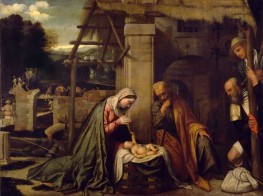
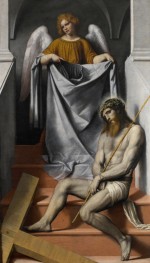
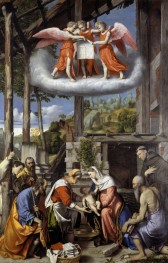
Around 1550, when he was past fifty, he married Maria Moreschini. They had two daughters, Caterina and Isabella, and a son, Pietro Vincenzo, who later joined the Jesuits. Among his last works are a Nativity for Santa Maria delle Grazie and Christ with the Angel, both now in the Pinacoteca Tosio Martinengo. In 1553-54 he painted the Paschal Supper for the cathedral's Sacrament Chapel. He made his will on November 9, 1554. On December 22 his executors sold one of his houses, so he must have died between those two dates.
His unfinished Melchizedek and Abraham was completed by Luca Mombello in 1555. Moretto left nearly 200 documented works, many still in the churches of Brescia and the surrounding countryside, and admirers came to call him the "Raphael of Brescia". His pupil Giovanni Battista Moroni took up the full-length format and the column motif of the London portrait and became one of the leading portraitists of the mid-sixteenth century, and Callisto Piazza also learned from his example. One altarpiece, painted in 1541 for Santa Maria della Ghiara in Verona, later reached Berlin and was destroyed in the Second World War. Outside Brescia his paintings hang in the National Gallery in London, the Metropolitan Museum in New York, the Kunsthistorisches Museum in Vienna, the Städel in Frankfurt, the Brera in Milan and the Louvre. In 2017 an asteroid was named after him.