Old Man in Sorrow (On the Threshold of Eternity), 1890 by Vincent van Gogh
Canvas Print - 12926-VVG

Location: Kroller-Mueller Museum, Otterlo, Netherlands
Original Size: 81 × 65 cm

Own a museum-grade giclée Canvas Print of Old Man in Sorrow (On the Threshold of Eternity) by Vincent van Gogh (1890). It is printed with archival pigments on 400 g/m² canvas and hand-varnished with a UV-protective layer. Set your exact proportional size—anything up to 35.4 × 27.9 in, with optional framing. Free worldwide shipping for rolled artworks. Unframed prints ship within 48 h, framed prints in 7-8 days. Guaranteed 100-year color durability.
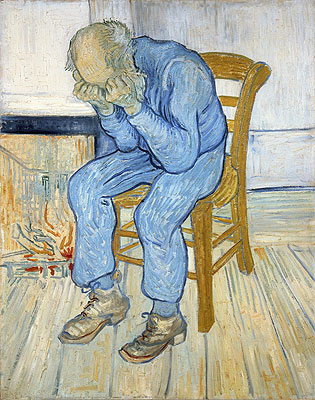
Old Man in Sorrow (On the Threshold of Eternity), 1890 | Vincent van Gogh | Giclée Canvas Print

Giclée Canvas Print | $66.95 USD

Your Selection

SKU:12926-VVG
Print Size

Customize Your Print

By using the red up or down arrows, you have the option to proportionally increase or decrease the printed area in inches as per your preference.

*Max printing size: 35.4 × 27.9 in
*Max framing size: Long side up to 28"

If you want a painting which is not in our catalogue

Your Questions Answered: Fine Art Prints, Framing, Care & Delivery

Giclée Print Quality 400 g/m² Canvas (Satin Gloss) + 1.2 in Borders for Stretching 100+ Year Colour Guarantee Free WorldWide Shipping!

Most people search for “canvas print” or “wall art” - but what they’re really looking for is a giclée print: a museum-grade reproduction of the original masterpiece, printed with archival pigment inks on fine art canvas.

Giclée (pronounced 'zhee-clay') is a French term meaning 'to spray,' referring to how ink is precisely sprayed onto canvas or paper, creating incredibly detailed fine art prints. It’s the gold standard in museum-quality printing, loved by artists, galleries, and museums worldwide.

Your artwork will be printed on premium canvas using vibrant archival inks, faithfully capturing every brushstroke and subtle nuance of Vincent van Gogh's original. To ensure lasting beauty, each print is finished with a protective UV varnish. Far superior to ordinary posters, your canvas print will look and feel like a real painting, retaining its vivid colors and pristine details for more than 100 years.

About Giclée Fine Art Printing

Here's a simple trick: use painter’s tape to mark the print size directly on your wall, and step back to see how it feels. Generally, larger sizes around 36 in wide work beautifully in living rooms or open spaces. Medium sizes around 24 in fit nicely in bedrooms, hallways, or offices. Hanging it above a sofa? Choose a print that's roughly two-thirds the width of your couch. Still unsure? Start with our popular 21.7 × 17.0 in size—it fits comfortably in most spaces!

For a more artistic approach: choosing a size closer to the original artwork ensures you experience the artist’s intended visual impact and authenticity. Of course, since most of us don't live in spacious baroque palaces, your available space and personal taste should ultimately guide your decision.

In many cases, yes! If you need a specific size to fit a particular space or frame, feel free to reach out—we're happy to see what’s possible. Because each print is made to order, we can often accommodate custom dimensions as long as they respect the proportions of the original painting.Just send us an email at info@topartprint.com with the title of the artwork and the size you're looking for. We’ll get back to you quickly with options and pricing.

Good to know: when you choose the size of your artwork, the Print Size shown in the Your Selection box refers to the actual image area—that’s the part you’ll see once the canvas is stretched or framed.

The Total Size includes an additional 1.2 in white border on each side, added specifically for stretching.
So yes—this white border is added on top of your selected print size. You get the full artwork at the dimensions you picked, plus extra canvas to make stretching smooth and professional.

For example, if you select a 21.7 × 17.0 in print, the full canvas you receive will measure 24.0 × 19.4 in—giving your framer plenty of room to create a clean, gallery-quality stretch.

Both options are wonderful choices! Going unframed gives you maximum flexibility—you can take your print to a local framing shop for personalized options and expert advice tailored to your décor. This is especially great if you have specific design ideas or want to match existing frames in your home.

However, keep in mind that a print truly comes to life when properly framed. Art professionals often say: 'The frame contributes 30% of the artwork’s overall impact.' A well-chosen frame elevates and completes your print.

If you choose our framing option, your print will arrive professionally framed and ready to hang right out of the box. We focus exclusively on traditional framing methods, ensuring every artwork receives the respectful presentation it deserves—this is why we don't offer gallery wrap options.

Important shipping note: Due to courier restrictions, we can ship framed prints up to 28 in on the longest side. Larger prints will arrive safely rolled in a tube, ready for you to frame locally.

For more detailed information, please see our complete guide to fine art framing methods.

We've carefully selected this premium canvas because it brings out the absolute best in Vincent van Gogh's work. Made from natural cotton with a 400 g/m² weight, it has just the right texture to capture every brushstroke and detail of the original painting.

What makes our canvas special? The satin-gloss finish. Think of how paintings look in museums with that beautiful varnish—that's exactly the effect we're going for. This glossy surface makes colors pop with incredible vibrancy while giving deep, rich blacks that matte canvases simply can't achieve. The result? Your print has that authentic 'real painting' look with extraordinary depth and life.

Plus, our canvas is acid-free and pH-neutral, so it'll stay beautiful for generations. We believe Old Man in Sorrow (On the Threshold of Eternity) deserves nothing less than this museum-quality treatment.

Every print is made just for you—no mass production here! Once you place your order, we begin creating your Old Man in Sorrow (On the Threshold of Eternity) print with care and precision.

Unframed prints are crafted in 1–3 business days.
Framed prints take 7–8 business days to build and finish.

Shipping options:
Standard Delivery (Free): Up to two unframed prints per order, provided that the short side does not exceed 59 cm (approx. 23 inches), with delivery in 10–14 working days.
Express Shipping: Delivered in 2–4 working days; costs vary by weight, volume, and destination. After adding the artwork to your cart, use the Shipping estimates tool there for exact pricing.

Note for framed prints: Because they’re bulkier and higher-value, framed artworks ship only via express tracked service and do not qualify for free standard delivery.

Packaging:
Unframed prints: Safely rolled in postal tubes.
Framed prints: Packed in reinforced boxes with corner protectors and bubble wrap.

You’ll receive a tracking number as soon as your order leaves our studio—so you can follow every step of its journey!

It’s super easy! Your giclée print is designed to last over 100 years when properly displayed. We’ve already applied a UV-protective varnish, so there’s no need for any extra treatments on your part.

Just follow these simple tips:
  • Hang your print away from direct sunlight and high humidity
  • Dust gently with a soft, dry cloth if needed
  • Avoid touching the printed surface directly
  • Keep the room temperature relatively stable
That’s it! With these basic precautions, your Vincent van Gogh print will retain its vibrant colors and pristine condition for generations to come.

We want you to truly love your art. Since each piece is custom-made just for you, we kindly recommend double-checking the size and details before placing your order. But if something’s not right—especially in terms of quality—we’re here to help and will make it right.

We offer a 30-day return policy and accept returns for items damaged during shipping. Our return process is simple and straightforward:
Step 1 – Let us know: Send an email to info@topartprint.com with your order number and a brief explanation of the issue.
Step 2 – Send it back: We’ll reply with clear instructions for returning the print. Please return it in its original packaging and in good condition. You cover return shipping (unless we sent a damaged/incorrect item). After inspection, we'll send a replacement or refund the product price.
Please note: shipping costs are non-refundable.

For framed artworks: Since framed prints are handcrafted specifically for your order, returns are accepted only at our discretion and require a valid reason. But don’t worry—our support team is friendly, responsive, and ready to assist.

About the Painting
What Van Gogh does with color here is nothing short of revolutionary. That electric, pulsating blue that envelops the hunched figure isn't merely decorative - it's an emotional state made visible, radiating psychological temperature rather than physical reality. Against this dominant cool tone, the sickly yellow-green of the wooden floorboards and the sullen orange flicker of the neglected fire create a visual discord that perfectly mimics the internal turmoil of the subject. This isn't color used for aesthetic pleasure; it's emotional weaponry deployed with devastating accuracy. The contrast between the cool blue of isolation and the warm yellows that fail to comfort him speaks volumes about the impenetrable nature of profound grief.

The technique reveals a painter who has transformed conventional approaches into something visceral and immediate. Look at those brushstrokes - each one following the slumped contours of the old man's body, as if the paint itself is weighed down by despair. The diagonal slashes across the floorboards vibrate with nervous energy, while the background walls dissolve into indeterminate pale washes, as if the world beyond pain becomes insubstantial. This isn't technique for technique's sake; it's the visual equivalent of a primal scream. Van Gogh doesn't just apply paint; he hurls his nervous system at the canvas. The varying thickness - substantial on the figure, thinner in the background - creates a physical hierarchy that mirrors the emotional focus of the work.

The composition traps us inside this moment of private anguish with deliberate claustrophobia. Those diagonal floorboards pull us relentlessly toward the hunched figure, offering no visual escape from this confrontation with raw human suffering. The simple wooden chair, rendered in acid yellow, becomes less a support than a stage for this drama of despair. The small fire positioned to the left offers only a pathetic hint of comfort that clearly fails to reach the old man in his isolation. Every element in the visual structure intensifies our encounter with suffering in its most unvarnished form. The circular shape formed by the man's curved posture creates a self-contained universe of pain that simultaneously draws us in and shuts us out.

The figure dominates everything - a man entirely consumed by his grief, face buried in hands, body contorted on that simple chair. The posture speaks volumes; it's the physical manifestation of a soul in torment. Dressed in worn workman's clothes of uniform blue, he sits before a modest hearth where flames flicker with minimal warmth. The wooden floor stretches out in sickly yellows and greens, its planks running diagonally across the canvas like pathways leading nowhere. The walls behind remain indistinct and pale, creating a stark, almost desolate interior that mirrors the emotional wasteland within the man himself. There's no attempt to beautify this scene - it's human anguish laid bare with unflinching honesty.

Most paintings of suffering from this period would offer us the comfortable distance of narrative or religious context - a Saint Sebastian, a mythological hero, some framework that safely contains the pain. Van Gogh offers no such comfort here. This is human misery stripped of all pretense and storytelling niceties. The face remains hidden - not because Van Gogh couldn't paint faces (he was a masterful portraitist) but because this concealment universalizes the experience. It could be anyone. It could be us. In refusing to show the face, Van Gogh transforms a specific old man into an emblem of the human condition itself.

The historical context adds another layer of gut-wrenching poignancy to this already powerful image. Created in 1890 during one of Van Gogh's periods of recovery at the asylum in Saint-Rémy, it represents his reworking of an earlier drawing from his time in Brabant. That he returned to this image of absolute desolation during his own psychological struggle speaks volumes. The model was possibly another patient at the asylum, adding a layer of shared suffering to the work's creation. What began as an exercise in revisiting earlier work becomes instead a devastating statement on human vulnerability. The boundary between subject and artist blurs - this isn't just observation but shared experience rendered visible.

This painting isn't merely seen; it's felt physically. The agony in that hunched blue figure transmits itself to viewers with almost viral directness. In our age of carefully curated emotions and performative identities, Van Gogh's unfiltered portrayal of human anguish feels more necessary than ever. This isn't pretty painting designed to match sofas; it's art that reminds us what it means to be devastatingly, vulnerably human. The title itself - "Old Man in Sorrow (On the Threshold of Eternity)" - suggests that moment of existential reckoning between endurance and surrender, the liminal space where human suffering meets its ultimate boundary.

The genius of "Old Man in Sorrow" lies in its refusal of sentimentality despite its profoundly emotional subject. There's no attempt to beautify this suffering or soften its impact. Instead, every formal element - the compressed space, the vibrating color relationships, the agitated brushwork - serves to amplify the psychological truth at the heart of the image. In this way, Van Gogh achieves what few artists ever manage: he makes visible something as intangible and private as grief, rendering it with such truth that it continues to resonate across more than a century.

This is why Van Gogh remains the most vital of the Post-Impressionists long after his death. While his contemporaries were often concerned with formal innovation for its own sake, Van Gogh's technical experiments were always in service of emotional authenticity. In "Old Man in Sorrow," we don't see a style; we see a soul laid bare. And in that unflinching truthfulness lies art's highest purpose - not to decorate our lives but to illuminate them, not to distract us from suffering but to help us recognize it as part of our shared humanity.

Top