
John Frederick Lewis Giclée Fine Art Prints 1 of 2
1804-1876
English Romanticism Painter
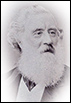
At a dinner in 1855, newly installed as President of the Society of Painters in Water Colours, John Frederick Lewis rose to address the assembled company - and after a long silence, sat down again without uttering a word. It was a moment perfectly in character for an artist who let his pictures do all the talking. Born in London on 14 July 1804 and dying on 15 August 1876, Lewis became one of the most distinctive British painters of the nineteenth century, an Orientalist whose luminous, obsessively detailed scenes of Middle Eastern life set new standards for the genre and whose influence reached well beyond England.
His father, Frederick Christian Lewis, was an engraver and landscape painter of German descent - the family name had originally been Ludwig before his grandfather settled in England. Artistic talent ran deep in the household. A younger brother, Charles George Lewis, became a respected reproductive engraver, working especially after Edwin Landseer. Landseer himself, a childhood neighbour, proved a formative companion. Together, the two boys trained in the workshop of Sir Thomas Lawrence, and Lewis began his career much as Landseer did: painting animals. He published prints of big cats and domesticated creatures in 1826, and completed two large animal scenes in Windsor Great Park, works now held by the Royal Collection and Tate Britain.
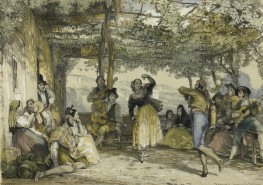
A European tour in 1827 marked a turning point. That year Lewis took up watercolour, a medium that would define his reputation for decades. Between 1832 and 1834 he travelled through Spain and Morocco, producing drawings later published as lithographs in two volumes: Sketches and Drawings of the Alhambra (1835) and Lewis's Sketches of Spain and Spanish Character (1836). So strongly were these works associated with him that contemporaries dubbed him "Spanish Lewis" - partly to distinguish him from his brother Frederick Christian, known as "Indian Lewis" after departing for the subcontinent in 1834.
Spain, however, was only a prologue. In 1837 Lewis set out on the journey that would reshape his art. Passing through Italy and Greece, he reached Constantinople by 1840, then continued south to Egypt. For a decade, from 1841 to 1851, he lived in Cairo in considerable style, occupying a traditional upper-class mansion that would reappear as a backdrop in his paintings - sometimes more than twenty years after he had left it. William Makepeace Thackeray, visiting his old friend, described Lewis as a "languid Lotus-eater" drifting through a hazy, tobacco-scented existence, dressed in local costume complete with a Damascus scimitar. Perhaps that languor was deceptive. Behind it lay intense, disciplined observation - hundreds of precise drawings recording architecture, textiles, latticed screens, and the fall of light through carved wooden mashrabiya.
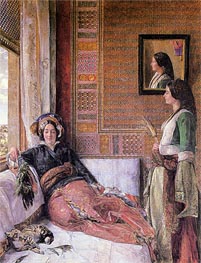
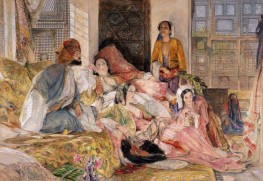
No other English artist of the period sustained such a long residence in the Ottoman Empire. David Roberts, the other major British Orientalist, passed through Spain and the Middle East but never settled. William James Muller had visited Cairo in 1838, yet briefly. Lewis immersed himself. In 1847, while still abroad, he married Marian Harper in Alexandria, and she would later model for several of his celebrated harem compositions. Notably, Lewis never painted a nude figure. His interiors imagine the harem not as a site of voyeuristic fantasy but as a space of quiet domesticity - closer in spirit to an English drawing room than to the overwrought fantasies of many Continental painters. Only Lord Leighton, among British contemporaries, approached similar restraint.
Returning to England in 1851, Lewis settled at Walton-on-Thames from 1854 and began transforming his Cairo drawings into finished paintings. His watercolour The Hareem, exhibited in London in 1850, had already caused a sensation - praised by John Ruskin - though it remains the only major work certainly completed during the Cairo years. Through the 1850s he continued in watercolour, building each image with a minute, jewel-like touch on a white ground. Independently of the Pre-Raphaelites, he had arrived at a remarkably similar technique: luminous, precise, glowing with accumulated colour.
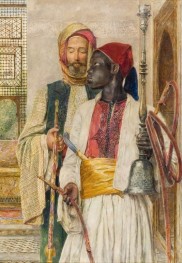
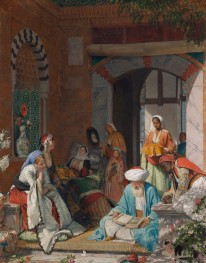
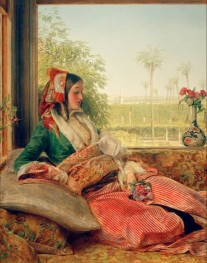
Yet watercolour proved financially punishing. In a rare surviving letter, Lewis complained bitterly that the medium was "thoroly unremunerative" - all labour and little reward. By the late 1850s he shifted decisively to oils, which were quicker to produce and commanded better prices. His usual practice in the 1860s involved painting two versions of the same composition: one in oils for exhibition at the Royal Academy, one in watercolour, attempting to push the price of the latter closer to the former. Among the finest works from these years is The Reception (1873), an elaborate oil drawn from memories and sketches of his Cairo house, and the exquisite pair An Armenian Lady, Cairo (1855) and The Coffee Bearer (1857), in which a background figure from the earlier painting was reworked as a standalone subject.
Institutional recognition came steadily if not early. Lewis was elected an Associate of the Royal Academy in 1859 and a full Royal Academician in 1865. His presidency of the Society of Painters in Water Colours, assumed in 1855, ended awkwardly: the Society forbade members from exhibiting oils, and Lewis, now committed to the medium, resigned in 1858. His exacting rendering of Islamic architecture, furnishings, and costume influenced artists beyond Britain - among them Jean-Leon Gerome, the leading French Orientalist, whose later works owe a clear debt to the Englishman's realism.
Lewis was a man of few words and fewer letters. That reticence left biographers with scant material; no full-length study appeared until 2014. He continued painting almost to the end of his life, but a health crisis around 1873 left him diminished, and he died three years later. For decades afterward his name faded from public view. Then, beginning in the 1970s, collectors rediscovered him with a fervour that has only intensified. Today, fine examples of his work command prices in the millions at auction. The silence he maintained so stubbornly in life has been answered, at last, by the eloquence of his surfaces - those shimmering, light-drenched interiors where every tile, every thread, every shadow speaks.
His father, Frederick Christian Lewis, was an engraver and landscape painter of German descent - the family name had originally been Ludwig before his grandfather settled in England. Artistic talent ran deep in the household. A younger brother, Charles George Lewis, became a respected reproductive engraver, working especially after Edwin Landseer. Landseer himself, a childhood neighbour, proved a formative companion. Together, the two boys trained in the workshop of Sir Thomas Lawrence, and Lewis began his career much as Landseer did: painting animals. He published prints of big cats and domesticated creatures in 1826, and completed two large animal scenes in Windsor Great Park, works now held by the Royal Collection and Tate Britain.
A European tour in 1827 marked a turning point. That year Lewis took up watercolour, a medium that would define his reputation for decades. Between 1832 and 1834 he travelled through Spain and Morocco, producing drawings later published as lithographs in two volumes: Sketches and Drawings of the Alhambra (1835) and Lewis's Sketches of Spain and Spanish Character (1836). So strongly were these works associated with him that contemporaries dubbed him "Spanish Lewis" - partly to distinguish him from his brother Frederick Christian, known as "Indian Lewis" after departing for the subcontinent in 1834.
Spain, however, was only a prologue. In 1837 Lewis set out on the journey that would reshape his art. Passing through Italy and Greece, he reached Constantinople by 1840, then continued south to Egypt. For a decade, from 1841 to 1851, he lived in Cairo in considerable style, occupying a traditional upper-class mansion that would reappear as a backdrop in his paintings - sometimes more than twenty years after he had left it. William Makepeace Thackeray, visiting his old friend, described Lewis as a "languid Lotus-eater" drifting through a hazy, tobacco-scented existence, dressed in local costume complete with a Damascus scimitar. Perhaps that languor was deceptive. Behind it lay intense, disciplined observation - hundreds of precise drawings recording architecture, textiles, latticed screens, and the fall of light through carved wooden mashrabiya.
No other English artist of the period sustained such a long residence in the Ottoman Empire. David Roberts, the other major British Orientalist, passed through Spain and the Middle East but never settled. William James Muller had visited Cairo in 1838, yet briefly. Lewis immersed himself. In 1847, while still abroad, he married Marian Harper in Alexandria, and she would later model for several of his celebrated harem compositions. Notably, Lewis never painted a nude figure. His interiors imagine the harem not as a site of voyeuristic fantasy but as a space of quiet domesticity - closer in spirit to an English drawing room than to the overwrought fantasies of many Continental painters. Only Lord Leighton, among British contemporaries, approached similar restraint.
Returning to England in 1851, Lewis settled at Walton-on-Thames from 1854 and began transforming his Cairo drawings into finished paintings. His watercolour The Hareem, exhibited in London in 1850, had already caused a sensation - praised by John Ruskin - though it remains the only major work certainly completed during the Cairo years. Through the 1850s he continued in watercolour, building each image with a minute, jewel-like touch on a white ground. Independently of the Pre-Raphaelites, he had arrived at a remarkably similar technique: luminous, precise, glowing with accumulated colour.
Yet watercolour proved financially punishing. In a rare surviving letter, Lewis complained bitterly that the medium was "thoroly unremunerative" - all labour and little reward. By the late 1850s he shifted decisively to oils, which were quicker to produce and commanded better prices. His usual practice in the 1860s involved painting two versions of the same composition: one in oils for exhibition at the Royal Academy, one in watercolour, attempting to push the price of the latter closer to the former. Among the finest works from these years is The Reception (1873), an elaborate oil drawn from memories and sketches of his Cairo house, and the exquisite pair An Armenian Lady, Cairo (1855) and The Coffee Bearer (1857), in which a background figure from the earlier painting was reworked as a standalone subject.
Institutional recognition came steadily if not early. Lewis was elected an Associate of the Royal Academy in 1859 and a full Royal Academician in 1865. His presidency of the Society of Painters in Water Colours, assumed in 1855, ended awkwardly: the Society forbade members from exhibiting oils, and Lewis, now committed to the medium, resigned in 1858. His exacting rendering of Islamic architecture, furnishings, and costume influenced artists beyond Britain - among them Jean-Leon Gerome, the leading French Orientalist, whose later works owe a clear debt to the Englishman's realism.
Lewis was a man of few words and fewer letters. That reticence left biographers with scant material; no full-length study appeared until 2014. He continued painting almost to the end of his life, but a health crisis around 1873 left him diminished, and he died three years later. For decades afterward his name faded from public view. Then, beginning in the 1970s, collectors rediscovered him with a fervour that has only intensified. Today, fine examples of his work command prices in the millions at auction. The silence he maintained so stubbornly in life has been answered, at last, by the eloquence of his surfaces - those shimmering, light-drenched interiors where every tile, every thread, every shadow speaks.
42 John Frederick Lewis Artworks
Page 1 of 2
Giclée Paper Art Print
$60.06
$60.06
SKU: 8496-LJF
John Frederick Lewis
Original Size:45.7 x 30.5 cm
Laing Art Gallery, Newcastle-upon-Tyne, UK
John Frederick Lewis
Original Size:45.7 x 30.5 cm
Laing Art Gallery, Newcastle-upon-Tyne, UK
Giclée Paper Art Print
$63.88
$63.88
SKU: 21476-LJF
John Frederick Lewis
Original Size:50.6 x 68.3 cm
Birmingham Museum of Art, Alabama, USA
John Frederick Lewis
Original Size:50.6 x 68.3 cm
Birmingham Museum of Art, Alabama, USA
Giclée Paper Art Print
$60.06
$60.06
SKU: 21507-LJF
John Frederick Lewis
Original Size:26.5 x 37.2 cm
Art Institute of Chicago, Illinois, USA
John Frederick Lewis
Original Size:26.5 x 37.2 cm
Art Institute of Chicago, Illinois, USA
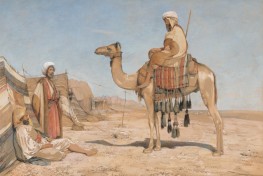
Giclée Paper Art Print
$60.06
$60.06
SKU: 21484-LJF
John Frederick Lewis
Original Size:35 x 51.8 cm
Yale Center for British Art, Connecticut, USA
John Frederick Lewis
Original Size:35 x 51.8 cm
Yale Center for British Art, Connecticut, USA
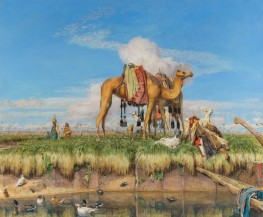
Giclée Canvas Print
$79.69
$79.69
SKU: 21480-LJF
John Frederick Lewis
Original Size:62.2 x 74.3 cm
Yale Center for British Art, Connecticut, USA
John Frederick Lewis
Original Size:62.2 x 74.3 cm
Yale Center for British Art, Connecticut, USA
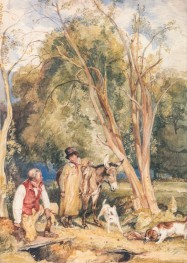
Giclée Paper Art Print
$60.06
$60.06
SKU: 21489-LJF
John Frederick Lewis
Original Size:26.7 x 19.3 cm
Yale Center for British Art, Connecticut, USA
John Frederick Lewis
Original Size:26.7 x 19.3 cm
Yale Center for British Art, Connecticut, USA
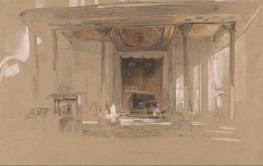
Giclée Paper Art Print
$60.06
$60.06
SKU: 21505-LJF
John Frederick Lewis
Original Size:29.8 x 47.6 cm
Yale Center for British Art, Connecticut, USA
John Frederick Lewis
Original Size:29.8 x 47.6 cm
Yale Center for British Art, Connecticut, USA
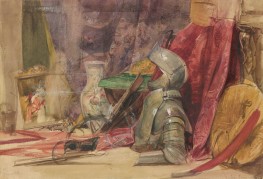
Giclée Paper Art Print
$60.06
$60.06
SKU: 21503-LJF
John Frederick Lewis
Original Size:19.6 x 28.7 cm
The Morgan Library & Museum, New York, USA
John Frederick Lewis
Original Size:19.6 x 28.7 cm
The Morgan Library & Museum, New York, USA
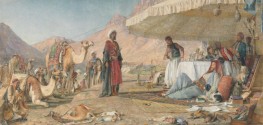
Giclée Paper Art Print
$60.06
$60.06
SKU: 21487-LJF
John Frederick Lewis
Original Size:66.7 x 136 cm
Yale Center for British Art, Connecticut, USA
John Frederick Lewis
Original Size:66.7 x 136 cm
Yale Center for British Art, Connecticut, USA
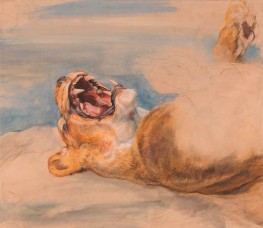
Giclée Paper Art Print
$60.06
$60.06
SKU: 21492-LJF
John Frederick Lewis
Original Size:36 x 42 cm
Yale Center for British Art, Connecticut, USA
John Frederick Lewis
Original Size:36 x 42 cm
Yale Center for British Art, Connecticut, USA
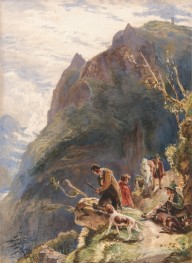
Giclée Paper Art Print
$60.06
$60.06
SKU: 21488-LJF
John Frederick Lewis
Original Size:27.9 x 20.6 cm
Yale Center for British Art, Connecticut, USA
John Frederick Lewis
Original Size:27.9 x 20.6 cm
Yale Center for British Art, Connecticut, USA
Giclée Paper Art Print
$60.06
$60.06
SKU: 21474-LJF
John Frederick Lewis
Original Size:43.2 x 30.5 cm
Museum and Art Gallery, Birmingham, UK
John Frederick Lewis
Original Size:43.2 x 30.5 cm
Museum and Art Gallery, Birmingham, UK
Giclée Paper Art Print
$60.06
$60.06
SKU: 21478-LJF
John Frederick Lewis
Original Size:35.5 x 43.3 cm
Cleveland Museum of Art, Ohio, USA
John Frederick Lewis
Original Size:35.5 x 43.3 cm
Cleveland Museum of Art, Ohio, USA
Giclée Paper Art Print
$67.19
$67.19
SKU: 21485-LJF
John Frederick Lewis
Original Size:56.2 x 76 cm
Yale Center for British Art, Connecticut, USA
John Frederick Lewis
Original Size:56.2 x 76 cm
Yale Center for British Art, Connecticut, USA
Giclée Canvas Print
$75.50
$75.50
SKU: 21479-LJF
John Frederick Lewis
Original Size:90.8 x 70.8 cm
Yale Center for British Art, Connecticut, USA
John Frederick Lewis
Original Size:90.8 x 70.8 cm
Yale Center for British Art, Connecticut, USA
Giclée Canvas Print
$63.42
$63.42
SKU: 21494-LJF
John Frederick Lewis
Original Size:46 x 35 cm
Public Collection
John Frederick Lewis
Original Size:46 x 35 cm
Public Collection
Giclée Paper Art Print
$60.06
$60.06
SKU: 21483-LJF
John Frederick Lewis
Original Size:35 x 51 cm
Yale Center for British Art, Connecticut, USA
John Frederick Lewis
Original Size:35 x 51 cm
Yale Center for British Art, Connecticut, USA
Giclée Paper Art Print
$62.89
$62.89
SKU: 21497-LJF
John Frederick Lewis
Original Size:47 x 67.3 cm
Victoria and Albert Museum, London, UK
John Frederick Lewis
Original Size:47 x 67.3 cm
Victoria and Albert Museum, London, UK
Giclée Paper Art Print
$65.72
$65.72
SKU: 21482-LJF
John Frederick Lewis
Original Size:42 x 52 cm
Yale Center for British Art, Connecticut, USA
John Frederick Lewis
Original Size:42 x 52 cm
Yale Center for British Art, Connecticut, USA
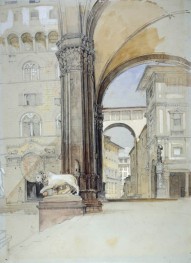
Giclée Paper Art Print
$60.06
$60.06
SKU: 21508-LJF
John Frederick Lewis
Original Size:35.3 x 25.7 cm
Ashmolean Museum, Oxford, UK
John Frederick Lewis
Original Size:35.3 x 25.7 cm
Ashmolean Museum, Oxford, UK
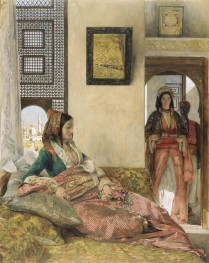
Giclée Paper Art Print
$72.49
$72.49
SKU: 21498-LJF
John Frederick Lewis
Original Size:61.5 x 49 cm
Victoria and Albert Museum, London, UK
John Frederick Lewis
Original Size:61.5 x 49 cm
Victoria and Albert Museum, London, UK
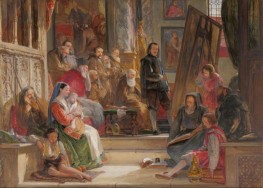
Giclée Paper Art Print
$65.37
$65.37
SKU: 21511-LJF
John Frederick Lewis
Original Size:54.6 x 75.6 cm
Private Collection
John Frederick Lewis
Original Size:54.6 x 75.6 cm
Private Collection
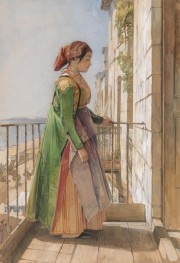
Giclée Paper Art Print
$60.06
$60.06
SKU: 21490-LJF
John Frederick Lewis
Original Size:42.5 x 29 cm
Yale Center for British Art, Connecticut, USA
John Frederick Lewis
Original Size:42.5 x 29 cm
Yale Center for British Art, Connecticut, USA
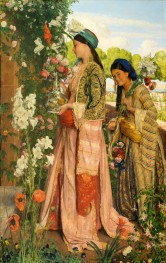
Giclée Canvas Print
$63.42
$63.42
SKU: 21472-LJF
John Frederick Lewis
Original Size:127.2 x 87.7 cm
Museum and Art Gallery, Birmingham, UK
John Frederick Lewis
Original Size:127.2 x 87.7 cm
Museum and Art Gallery, Birmingham, UK