
Frida Kahlo Giclée Fine Art Prints 1 of 4
1907-1954
Mexican Аrtist
A steel handrail pierced her pelvis. She was eighteen years old. The collision between a wooden bus and an electric streetcar on a September afternoon in 1925 would define the life and art of Magdalena Carmen Frida Kahlo y Calderón - not as a limitation, but as an inexhaustible well of creative transformation. Born on 6 July 1907 in Coyoacán, then a village on the outskirts of Mexico City, and dying in the same house forty-seven years later, Frida Kahlo forged an artistic identity so singular that her face has become as recognizable as any of her paintings.
Her origins were already marked by cultural complexity. Guillermo Kahlo, her father, was a German immigrant who had settled in Mexico after epilepsy interrupted his university studies. Her mother, Matilde Calderón y González, came from Oaxaca, born to an Indigenous father and a mother of Spanish descent. This mestiza heritage - European and Indigenous Mexican intertwined - would later become central to Kahlo's visual vocabulary. The family home, La Casa Azul in Coyoacán, provided the stage for both her earliest years and her final ones. Childhood brought its first trial: polio at age six left her right leg thinner and shorter than the left, isolating her from peers and binding her more closely to her father, who shared the experience of living with disability and who taught her photography, literature, and a love of nature.
Academically ambitious, Kahlo enrolled in 1922 at the elite National Preparatory School, one of only thirty-five women among two thousand students. She aimed to become a physician. Politics and intellectual debate consumed her; she joined a rebellious group called the Cachuchas, whose members would later form part of Mexico's intellectual elite. Medicine, however, was not to be her path. The bus accident shattered her spine in three places, fractured her pelvis, broke her right leg in eleven places, and left her collarbone and shoulder damaged. Months of immobilization followed. Confined to bed, she began to paint.
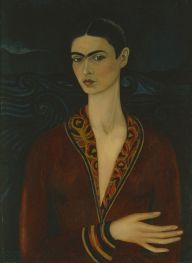
A specially made easel allowed her to work while lying down. A mirror mounted above it gave her a subject she knew intimately: herself. "I paint myself because I am often alone and I am the subject I know best," she later explained. Perhaps solitude and pain together gave her brush its unsparing clarity. Her earliest works drew from European sources - Renaissance masters like Sandro Botticelli and Bronzino, and avant-garde movements such as Neue Sachlichkeit and Cubism. Yet these influences would soon yield to something more rooted in Mexican soil.
In 1927, Kahlo joined the Mexican Communist Party, and through its circles met the muralist Diego Rivera. She showed him her paintings; he recognized genuine talent. They married in August 1929, a union her parents famously called "a marriage between an elephant and a dove" - Rivera was tall and heavy, Kahlo petite and fragile. The relationship would prove tumultuous, punctuated by mutual infidelities, divorce in 1939, and remarriage in 1940. It also proved artistically generative. Moving to Cuernavaca with Rivera, Kahlo began absorbing the folk art traditions that would become her signature mode. The city sharpened her sense of Mexican identity. She started wearing traditional Indigenous clothing - the long colorful skirts, the huipils, the elaborate headdresses - particularly favoring the dress of women from the Isthmus of Tehuantepec, whose allegedly matriarchal society had come to symbolize authentic Mexican cultural heritage.
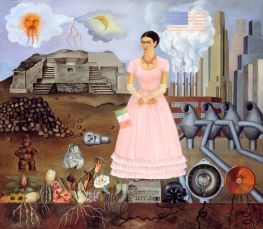
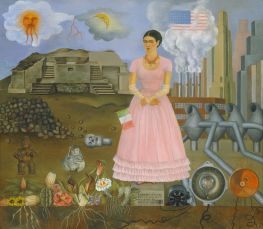
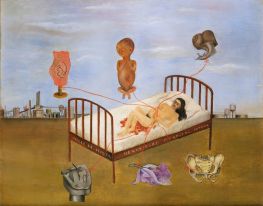
The early 1930s took the couple to the United States. San Francisco proved productive; Kahlo developed her folk art style further and exhibited for the first time, showing Frieda and Diego Rivera at the Sixth Annual Exhibition of the San Francisco Society of Women Artists. Detroit brought hardship - a miscarriage, her mother's death, and a growing distaste for American capitalism. Yet difficulties seemed to concentrate her vision. She experimented with etching and fresco, adopted the retablo format - small religious paintings on metal sheets made by amateur artists to thank saints for deliverance from calamity - and began emphasizing themes of suffering, wounds, and pain. Henry Ford Hospital and My Birth, both from 1932, emerged from this period. In Self-Portrait on the Border of Mexico and the United States, also from 1932, she positions herself between two worlds, the industrial North and the mythic South, a visual meditation on cultural collision.
Recognition began arriving in the late 1930s. André Breton, the Surrealist leader, visited Rivera in Mexico in April 1938 and became captivated by Kahlo's work, describing it as "a ribbon around a bomb." He arranged her first solo exhibition at the Julien Levy Gallery in New York that November. The show was a success; half of the twenty-five paintings sold despite the Great Depression. Georgia O'Keeffe attended the opening. Time magazine, though condescending in tone, gave her coverage. Commissions followed from prominent figures including the president of the Museum of Modern Art.
Paris in 1939 proved more complicated. Breton had failed to clear her paintings from customs and no longer owned a gallery. With Marcel Duchamp's help, she eventually exhibited at the Renou et Colle Gallery, though the venue refused to show most of her works, deeming them too shocking. The Louvre, however, purchased The Frame - making Kahlo the first Mexican artist to enter their collection. She found the Surrealists insufferable, calling them "this bunch of coocoo lunatics" in a letter. Yet their attention had placed her on the international stage.
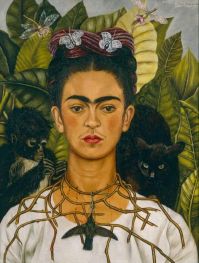
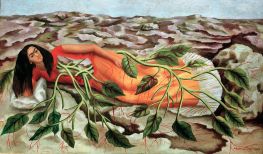
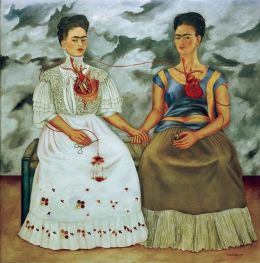
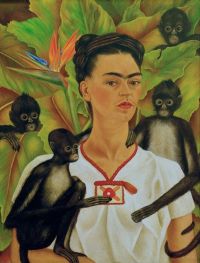
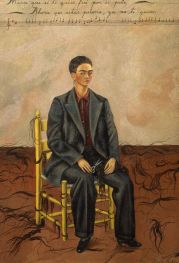
Returning to Mexico, Kahlo entered an exceptionally productive phase following her divorce and subsequent remarriage to Rivera. The Two Fridas, Self-Portrait with Cropped Hair, and Self-Portrait with Thorn Necklace and Hummingbird all date from 1939 and 1940. These works deploy a complex iconography drawing on Aztec mythology and Catholic symbolism - monkeys, skeletons, hearts, blood, thorns - to explore questions of identity, gender, and the body. Roots grow from her painted form, tying her to Mexican earth. Hair becomes a symbol of the feminine, violently shorn in one canvas where she sits in a man's suit, scissors menacingly close to her body. Dualities proliferate: life and death, pre-modernity and modernity, male and female.
In 1943, Kahlo began teaching at La Esmeralda, the recently reformed national school of painting, sculpture, and engraving. She encouraged informality, urged her students to appreciate folk art and derive subjects from the streets, and when her health deteriorated too severely for her to commute, she held classes at La Casa Azul. Four devoted students - Fanny Rabel, Arturo García Bustos, Guillermo Monroy, and Arturo Estrada - became known as "Los Fridos."
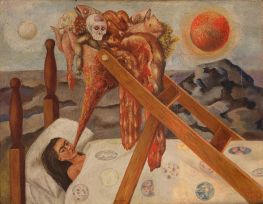
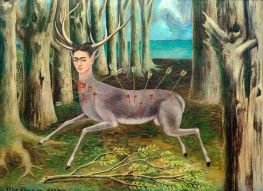
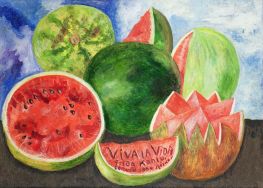
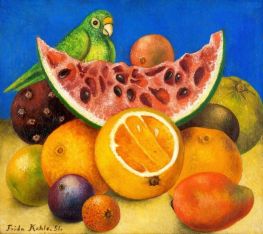
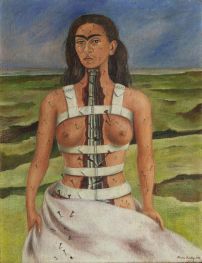
Her health had never been robust; now it began a steeper decline. Between 1940 and 1954, she wore twenty-eight separate supportive corsets of steel, leather, and plaster. A bone graft operation on her spine in 1945 failed. Paintings from this period - The Broken Column, Without Hope, Tree of Hope, Stand Fast, The Wounded Deer - make visible her physical disintegration. Brushstrokes grew hastier, colors more brash, the overall style more feverish. Still lifes of fruit and flowers increasingly incorporated political symbols: flags, doves. She had rejoined the Communist Party in 1948 and remained committed to revolutionary causes even as her body failed.
In August 1953, her right leg was amputated below the knee due to gangrene. Depression deepened. That April, photographer Lola Alvarez Bravo had staged Kahlo's first solo exhibition in Mexico at the Galería Arte Contemporaneo. Doctors had ordered bed rest, so Kahlo had her four-poster bed transported to the gallery. She arrived by ambulance, was carried on a stretcher to the bed, and held court from there throughout the evening. It was both a triumph and a farewell.
Frida Kahlo died on 13 July 1954, officially of pulmonary embolism, though some biographers believe she took her own life. Her last diary entry reads: "I joyfully await the exit - and I hope never to return." Her body lay in state at the Palacio de Bellas Artes under a Communist flag before being cremated. Rivera called her death "the most tragic day of my life."
For two decades after her death, Kahlo remained largely overshadowed by her husband's fame. Rediscovery came in the late 1970s, driven by feminist scholars questioning the exclusion of women from art history and by the Chicano Movement claiming her as an icon. Retrospectives in Mexico City and Chicago in 1978, a landmark exhibition at the Whitechapel Gallery in London in 1982, and Hayden Herrera's bestselling biography in 1983 propelled her into international consciousness. By 1984, Mexico declared her works part of the national cultural heritage, prohibiting their export.
Today Kahlo stands as one of the most significant artists of the twentieth century. Her paintings command extraordinary prices - The Dream (The Bed) from 1940 sold in 2025 for 54.7 million dollars, the highest auction price ever achieved by a female artist. Her face appears on merchandise, fashion collections, and murals worldwide. This phenomenon, sometimes called "Fridamania," risks reducing a complex artist to a simplified icon of suffering and resistance. Yet the paintings themselves - intimate in scale, unflinching in their examination of pain, identity, and the female body - continue to demand a more attentive gaze. In works like The Two Fridas, we see not merely autobiography but an interrogation of selfhood itself, the divided subject sitting with her own double, their hearts exposed and connected by a single arterial thread. Such images transcend their historical moment. They ask what it means to inhabit a body, a culture, a gender - questions that remain as urgent now as when Kahlo first posed them from her bed in La Casa Azul.
Her origins were already marked by cultural complexity. Guillermo Kahlo, her father, was a German immigrant who had settled in Mexico after epilepsy interrupted his university studies. Her mother, Matilde Calderón y González, came from Oaxaca, born to an Indigenous father and a mother of Spanish descent. This mestiza heritage - European and Indigenous Mexican intertwined - would later become central to Kahlo's visual vocabulary. The family home, La Casa Azul in Coyoacán, provided the stage for both her earliest years and her final ones. Childhood brought its first trial: polio at age six left her right leg thinner and shorter than the left, isolating her from peers and binding her more closely to her father, who shared the experience of living with disability and who taught her photography, literature, and a love of nature.
Academically ambitious, Kahlo enrolled in 1922 at the elite National Preparatory School, one of only thirty-five women among two thousand students. She aimed to become a physician. Politics and intellectual debate consumed her; she joined a rebellious group called the Cachuchas, whose members would later form part of Mexico's intellectual elite. Medicine, however, was not to be her path. The bus accident shattered her spine in three places, fractured her pelvis, broke her right leg in eleven places, and left her collarbone and shoulder damaged. Months of immobilization followed. Confined to bed, she began to paint.
A specially made easel allowed her to work while lying down. A mirror mounted above it gave her a subject she knew intimately: herself. "I paint myself because I am often alone and I am the subject I know best," she later explained. Perhaps solitude and pain together gave her brush its unsparing clarity. Her earliest works drew from European sources - Renaissance masters like Sandro Botticelli and Bronzino, and avant-garde movements such as Neue Sachlichkeit and Cubism. Yet these influences would soon yield to something more rooted in Mexican soil.
In 1927, Kahlo joined the Mexican Communist Party, and through its circles met the muralist Diego Rivera. She showed him her paintings; he recognized genuine talent. They married in August 1929, a union her parents famously called "a marriage between an elephant and a dove" - Rivera was tall and heavy, Kahlo petite and fragile. The relationship would prove tumultuous, punctuated by mutual infidelities, divorce in 1939, and remarriage in 1940. It also proved artistically generative. Moving to Cuernavaca with Rivera, Kahlo began absorbing the folk art traditions that would become her signature mode. The city sharpened her sense of Mexican identity. She started wearing traditional Indigenous clothing - the long colorful skirts, the huipils, the elaborate headdresses - particularly favoring the dress of women from the Isthmus of Tehuantepec, whose allegedly matriarchal society had come to symbolize authentic Mexican cultural heritage.
The early 1930s took the couple to the United States. San Francisco proved productive; Kahlo developed her folk art style further and exhibited for the first time, showing Frieda and Diego Rivera at the Sixth Annual Exhibition of the San Francisco Society of Women Artists. Detroit brought hardship - a miscarriage, her mother's death, and a growing distaste for American capitalism. Yet difficulties seemed to concentrate her vision. She experimented with etching and fresco, adopted the retablo format - small religious paintings on metal sheets made by amateur artists to thank saints for deliverance from calamity - and began emphasizing themes of suffering, wounds, and pain. Henry Ford Hospital and My Birth, both from 1932, emerged from this period. In Self-Portrait on the Border of Mexico and the United States, also from 1932, she positions herself between two worlds, the industrial North and the mythic South, a visual meditation on cultural collision.
Recognition began arriving in the late 1930s. André Breton, the Surrealist leader, visited Rivera in Mexico in April 1938 and became captivated by Kahlo's work, describing it as "a ribbon around a bomb." He arranged her first solo exhibition at the Julien Levy Gallery in New York that November. The show was a success; half of the twenty-five paintings sold despite the Great Depression. Georgia O'Keeffe attended the opening. Time magazine, though condescending in tone, gave her coverage. Commissions followed from prominent figures including the president of the Museum of Modern Art.
Paris in 1939 proved more complicated. Breton had failed to clear her paintings from customs and no longer owned a gallery. With Marcel Duchamp's help, she eventually exhibited at the Renou et Colle Gallery, though the venue refused to show most of her works, deeming them too shocking. The Louvre, however, purchased The Frame - making Kahlo the first Mexican artist to enter their collection. She found the Surrealists insufferable, calling them "this bunch of coocoo lunatics" in a letter. Yet their attention had placed her on the international stage.
Returning to Mexico, Kahlo entered an exceptionally productive phase following her divorce and subsequent remarriage to Rivera. The Two Fridas, Self-Portrait with Cropped Hair, and Self-Portrait with Thorn Necklace and Hummingbird all date from 1939 and 1940. These works deploy a complex iconography drawing on Aztec mythology and Catholic symbolism - monkeys, skeletons, hearts, blood, thorns - to explore questions of identity, gender, and the body. Roots grow from her painted form, tying her to Mexican earth. Hair becomes a symbol of the feminine, violently shorn in one canvas where she sits in a man's suit, scissors menacingly close to her body. Dualities proliferate: life and death, pre-modernity and modernity, male and female.
In 1943, Kahlo began teaching at La Esmeralda, the recently reformed national school of painting, sculpture, and engraving. She encouraged informality, urged her students to appreciate folk art and derive subjects from the streets, and when her health deteriorated too severely for her to commute, she held classes at La Casa Azul. Four devoted students - Fanny Rabel, Arturo García Bustos, Guillermo Monroy, and Arturo Estrada - became known as "Los Fridos."
Her health had never been robust; now it began a steeper decline. Between 1940 and 1954, she wore twenty-eight separate supportive corsets of steel, leather, and plaster. A bone graft operation on her spine in 1945 failed. Paintings from this period - The Broken Column, Without Hope, Tree of Hope, Stand Fast, The Wounded Deer - make visible her physical disintegration. Brushstrokes grew hastier, colors more brash, the overall style more feverish. Still lifes of fruit and flowers increasingly incorporated political symbols: flags, doves. She had rejoined the Communist Party in 1948 and remained committed to revolutionary causes even as her body failed.
In August 1953, her right leg was amputated below the knee due to gangrene. Depression deepened. That April, photographer Lola Alvarez Bravo had staged Kahlo's first solo exhibition in Mexico at the Galería Arte Contemporaneo. Doctors had ordered bed rest, so Kahlo had her four-poster bed transported to the gallery. She arrived by ambulance, was carried on a stretcher to the bed, and held court from there throughout the evening. It was both a triumph and a farewell.
Frida Kahlo died on 13 July 1954, officially of pulmonary embolism, though some biographers believe she took her own life. Her last diary entry reads: "I joyfully await the exit - and I hope never to return." Her body lay in state at the Palacio de Bellas Artes under a Communist flag before being cremated. Rivera called her death "the most tragic day of my life."
For two decades after her death, Kahlo remained largely overshadowed by her husband's fame. Rediscovery came in the late 1970s, driven by feminist scholars questioning the exclusion of women from art history and by the Chicano Movement claiming her as an icon. Retrospectives in Mexico City and Chicago in 1978, a landmark exhibition at the Whitechapel Gallery in London in 1982, and Hayden Herrera's bestselling biography in 1983 propelled her into international consciousness. By 1984, Mexico declared her works part of the national cultural heritage, prohibiting their export.
Today Kahlo stands as one of the most significant artists of the twentieth century. Her paintings command extraordinary prices - The Dream (The Bed) from 1940 sold in 2025 for 54.7 million dollars, the highest auction price ever achieved by a female artist. Her face appears on merchandise, fashion collections, and murals worldwide. This phenomenon, sometimes called "Fridamania," risks reducing a complex artist to a simplified icon of suffering and resistance. Yet the paintings themselves - intimate in scale, unflinching in their examination of pain, identity, and the female body - continue to demand a more attentive gaze. In works like The Two Fridas, we see not merely autobiography but an interrogation of selfhood itself, the divided subject sitting with her own double, their hearts exposed and connected by a single arterial thread. Such images transcend their historical moment. They ask what it means to inhabit a body, a culture, a gender - questions that remain as urgent now as when Kahlo first posed them from her bed in La Casa Azul.
75 Frida Kahlo Artworks
Page 1 of 4
Giclée Canvas Print
$75.47
$75.47
SKU: 20616-KAH
Frida Kahlo
Original Size:63.5 x 49.5 cm
Public Collection
Frida Kahlo
Original Size:63.5 x 49.5 cm
Public Collection
Giclée Canvas Print
$63.84
$63.84
SKU: 20648-KAH
Frida Kahlo
Original Size:28 x 36 cm
Public Collection
Frida Kahlo
Original Size:28 x 36 cm
Public Collection
Giclée Canvas Print
$63.84
$63.84
SKU: 20659-KAH
Frida Kahlo
Original Size:31 x 35 cm
Private Collection
Frida Kahlo
Original Size:31 x 35 cm
Private Collection
Giclée Canvas Print
$63.84
$63.84
SKU: 20605-KAH
Frida Kahlo
Original Size:22.4 x 30 cm
Private Collection
Frida Kahlo
Original Size:22.4 x 30 cm
Private Collection
Giclée Canvas Print
$63.84
$63.84
SKU: 20635-KAH
Frida Kahlo
Original Size:41 x 35 cm
Public Collection
Frida Kahlo
Original Size:41 x 35 cm
Public Collection
Giclée Canvas Print
$63.84
$63.84
SKU: 20599-KAH
Frida Kahlo
Original Size:30.5 x 49.9 cm
Private Collection
Frida Kahlo
Original Size:30.5 x 49.9 cm
Private Collection
Giclée Canvas Print
$69.84
$69.84
SKU: 20663-KAH
Frida Kahlo
Original Size:52 x 72 cm
Public Collection
Frida Kahlo
Original Size:52 x 72 cm
Public Collection
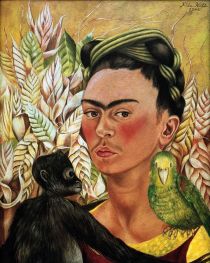
Giclée Canvas Print
$73.65
$73.65
SKU: 20598-KAH
Frida Kahlo
Original Size:53.3 x 43.2 cm
Public Collection
Frida Kahlo
Original Size:53.3 x 43.2 cm
Public Collection
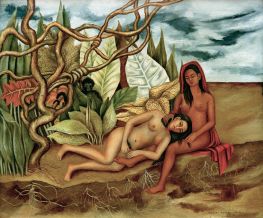
Giclée Canvas Print
$63.84
$63.84
SKU: 20597-KAH
Frida Kahlo
Original Size:25 x 30.2 cm
Private Collection
Frida Kahlo
Original Size:25 x 30.2 cm
Private Collection
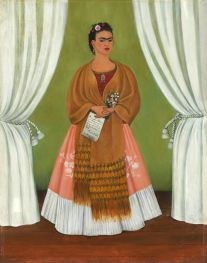
Giclée Canvas Print
$77.41
$77.41
SKU: 20656-KAH
Frida Kahlo
Original Size:76.2 x 61 cm
Public Collection
Frida Kahlo
Original Size:76.2 x 61 cm
Public Collection
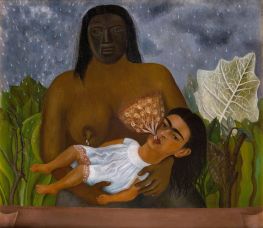
Giclée Canvas Print
$63.84
$63.84
SKU: 20649-KAH
Frida Kahlo
Original Size:30.5 x 35 cm
Public Collection
Frida Kahlo
Original Size:30.5 x 35 cm
Public Collection
Giclée Canvas Print
$96.76
$96.76
SKU: 20609-KAH
Frida Kahlo
Original Size:173 x 173 cm
Public Collection
Frida Kahlo
Original Size:173 x 173 cm
Public Collection
Giclée Canvas Print
$63.84
$63.84
SKU: 20633-KAH
Frida Kahlo
Original Size:38 x 48.5 cm
Public Collection
Frida Kahlo
Original Size:38 x 48.5 cm
Public Collection
Giclée Canvas Print
$74.77
$74.77
SKU: 20612-KAH
Frida Kahlo
Original Size:81.5 x 63 cm
Public Collection
Frida Kahlo
Original Size:81.5 x 63 cm
Public Collection
Giclée Canvas Print
$75.65
$75.65
SKU: 20631-KAH
Frida Kahlo
Original Size:78 x 61 cm
Private Collection
Frida Kahlo
Original Size:78 x 61 cm
Private Collection
Giclée Canvas Print
$63.84
$63.84
SKU: 20647-KAH
Frida Kahlo
Original Size:30.5 x 38 cm
Public Collection
Frida Kahlo
Original Size:30.5 x 38 cm
Public Collection
Giclée Canvas Print
$68.96
$68.96
SKU: 20651-KAH
Frida Kahlo
Original Size:86.5 x 61.7 cm
Public Collection
Frida Kahlo
Original Size:86.5 x 61.7 cm
Public Collection
Giclée Canvas Print
$63.84
$63.84
SKU: 20662-KAH
Frida Kahlo
Original Size:25.7 x 28.2 cm
Public Collection
Frida Kahlo
Original Size:25.7 x 28.2 cm
Public Collection
Giclée Canvas Print
$63.84
$63.84
SKU: 20646-KAH
Frida Kahlo
Original Size:40 x 30.7 cm
Public Collection
Frida Kahlo
Original Size:40 x 30.7 cm
Public Collection
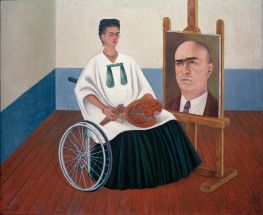
Giclée Canvas Print
$66.37
$66.37
SKU: 20619-KAH
Frida Kahlo
Original Size:41.5 x 50 cm
Private Collection
Frida Kahlo
Original Size:41.5 x 50 cm
Private Collection
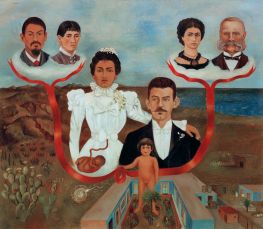
Giclée Canvas Print
$63.84
$63.84
SKU: 20613-KAH
Frida Kahlo
Original Size:30.7 x 34.5 cm
Museum of Modern Art, New York, USA
Frida Kahlo
Original Size:30.7 x 34.5 cm
Museum of Modern Art, New York, USA
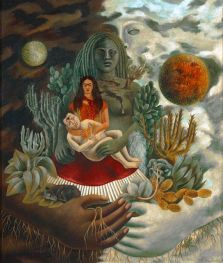
Giclée Canvas Print
$83.56
$83.56
SKU: 20634-KAH
Frida Kahlo
Original Size:70 x 60.5 cm
Public Collection
Frida Kahlo
Original Size:70 x 60.5 cm
Public Collection
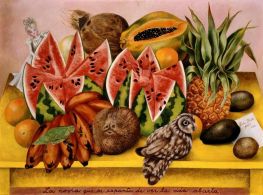
Giclée Canvas Print
$74.77
$74.77
SKU: 20666-KAH
Frida Kahlo
Original Size:63 x 81.5 cm
Public Collection
Frida Kahlo
Original Size:63 x 81.5 cm
Public Collection
Giclée Canvas Print
$63.84
$63.84
SKU: 20655-KAH
Frida Kahlo
Original Size:40 x 27.9 cm
Museum of Modern Art, New York, USA
Frida Kahlo
Original Size:40 x 27.9 cm
Museum of Modern Art, New York, USA