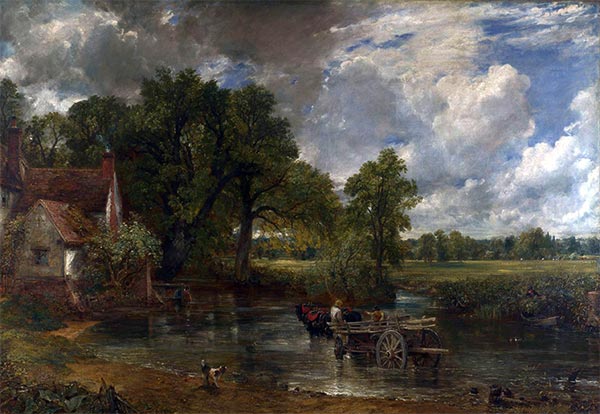
The Hay Wain, 1821 by John Constable
Canvas Print - 2900-COJ

Location: National Gallery, London, UK
Original Size: 130.2 × 185.4 cm

Own a museum-grade giclée Canvas Print of The Hay Wain by Constable (1821). It is printed with archival pigments on 400 g/m² canvas and hand-varnished with a UV-protective layer. Set your exact proportional size—anything up to 41.1 × 59.1 in, with optional framing. Free worldwide shipping for rolled artworks. Unframed prints ship within 48 h, framed prints in 7-8 days. Guaranteed 100-year color durability.
The Hay Wain, 1821 | Constable | Giclée Canvas Print

Giclée Canvas Print | $59.23 USD

Your Selection

SKU:2900-COJ
Print Size

Customize Your Print

By using the red up or down arrows, you have the option to proportionally increase or decrease the printed area in inches as per your preference.

*Max printing size: 41.1 × 59.1 in
*Max framing size: Long side up to 28"

If you want a painting which is not in our catalogue

Your Questions Answered: Fine Art Prints, Framing, Care & Delivery

Giclée Print Quality 400 g/m² Canvas (Satin Gloss) + 1.2 in Borders for Stretching 100+ Year Colour Guarantee Free WorldWide Shipping!

Most people search for “canvas print” or “wall art” - but what they’re really looking for is a giclée print: a museum-grade reproduction of the original masterpiece, printed with archival pigment inks on fine art canvas.

Giclée (pronounced 'zhee-clay') is a French term meaning 'to spray,' referring to how ink is precisely sprayed onto canvas or paper, creating incredibly detailed fine art prints. It’s the gold standard in museum-quality printing, loved by artists, galleries, and museums worldwide.

Your artwork will be printed on premium canvas using vibrant archival inks, faithfully capturing every brushstroke and subtle nuance of Constable's original. To ensure lasting beauty, each print is finished with a protective UV varnish. Far superior to ordinary posters, your canvas print will look and feel like a real painting, retaining its vivid colors and pristine details for more than 100 years.

About Giclée Fine Art Printing

Here's a simple trick: use painter’s tape to mark the print size directly on your wall, and step back to see how it feels. Generally, larger sizes around 36 in wide work beautifully in living rooms or open spaces. Medium sizes around 24 in fit nicely in bedrooms, hallways, or offices. Hanging it above a sofa? Choose a print that's roughly two-thirds the width of your couch. Still unsure? Start with our popular 15.1 × 21.7 in size—it fits comfortably in most spaces!

For a more artistic approach: choosing a size closer to the original artwork ensures you experience the artist’s intended visual impact and authenticity. Of course, since most of us don't live in spacious baroque palaces, your available space and personal taste should ultimately guide your decision.

In many cases, yes! If you need a specific size to fit a particular space or frame, feel free to reach out—we're happy to see what’s possible. Because each print is made to order, we can often accommodate custom dimensions as long as they respect the proportions of the original painting.Just send us an email at info@topartprint.com with the title of the artwork and the size you're looking for. We’ll get back to you quickly with options and pricing.

Good to know: when you choose the size of your artwork, the Print Size shown in the Your Selection box refers to the actual image area—that’s the part you’ll see once the canvas is stretched or framed.

The Total Size includes an additional 1.2 in white border on each side, added specifically for stretching.
So yes—this white border is added on top of your selected print size. You get the full artwork at the dimensions you picked, plus extra canvas to make stretching smooth and professional.

For example, if you select a 15.1 × 21.7 in print, the full canvas you receive will measure 17.4 × 24.0 in—giving your framer plenty of room to create a clean, gallery-quality stretch.

Both options are wonderful choices! Going unframed gives you maximum flexibility—you can take your print to a local framing shop for personalized options and expert advice tailored to your décor. This is especially great if you have specific design ideas or want to match existing frames in your home.

However, keep in mind that a print truly comes to life when properly framed. Art professionals often say: 'The frame contributes 30% of the artwork’s overall impact.' A well-chosen frame elevates and completes your print.

If you choose our framing option, your print will arrive professionally framed and ready to hang right out of the box. We focus exclusively on traditional framing methods, ensuring every artwork receives the respectful presentation it deserves—this is why we don't offer gallery wrap options.

Important shipping note: Due to courier restrictions, we can ship framed prints up to 28 in on the longest side. Larger prints will arrive safely rolled in a tube, ready for you to frame locally.

For more detailed information, please see our complete guide to fine art framing methods.

We've carefully selected this premium canvas because it brings out the absolute best in Constable's work. Made from natural cotton with a 400 g/m² weight, it has just the right texture to capture every brushstroke and detail of the original painting.

What makes our canvas special? The satin-gloss finish. Think of how paintings look in museums with that beautiful varnish—that's exactly the effect we're going for. This glossy surface makes colors pop with incredible vibrancy while giving deep, rich blacks that matte canvases simply can't achieve. The result? Your print has that authentic 'real painting' look with extraordinary depth and life.

Plus, our canvas is acid-free and pH-neutral, so it'll stay beautiful for generations. We believe The Hay Wain deserves nothing less than this museum-quality treatment.

Every print is made just for you—no mass production here! Once you place your order, we begin creating your The Hay Wain print with care and precision.

Unframed prints are crafted in 1–3 business days.
Framed prints take 7–8 business days to build and finish.

Shipping options:
Standard Delivery (Free): Up to two unframed prints per order, provided that the short side does not exceed 59 cm (approx. 23 inches), with delivery in 10–14 working days.
Express Shipping: Delivered in 2–4 working days; costs vary by weight, volume, and destination. After adding the artwork to your cart, use the Shipping estimates tool there for exact pricing.

Note for framed prints: Because they’re bulkier and higher-value, framed artworks ship only via express tracked service and do not qualify for free standard delivery.

Packaging:
Unframed prints: Safely rolled in postal tubes.
Framed prints: Packed in reinforced boxes with corner protectors and bubble wrap.

You’ll receive a tracking number as soon as your order leaves our studio—so you can follow every step of its journey!

It’s super easy! Your giclée print is designed to last over 100 years when properly displayed. We’ve already applied a UV-protective varnish, so there’s no need for any extra treatments on your part.

Just follow these simple tips:
  • Hang your print away from direct sunlight and high humidity
  • Dust gently with a soft, dry cloth if needed
  • Avoid touching the printed surface directly
  • Keep the room temperature relatively stable
That’s it! With these basic precautions, your Constable print will retain its vibrant colors and pristine condition for generations to come.

We want you to truly love your art. Since each piece is custom-made just for you, we kindly recommend double-checking the size and details before placing your order. But if something’s not right—especially in terms of quality—we’re here to help and will make it right.

We offer a 30-day return policy and accept returns for items damaged during shipping. Our return process is simple and straightforward:
Step 1 – Let us know: Send an email to info@topartprint.com with your order number and a brief explanation of the issue.
Step 2 – Send it back: We’ll reply with clear instructions for returning the print. Please return it in its original packaging and in good condition. You cover return shipping (unless we sent a damaged/incorrect item). After inspection, we'll send a replacement or refund the product price.
Please note: shipping costs are non-refundable.

For framed artworks: Since framed prints are handcrafted specifically for your order, returns are accepted only at our discretion and require a valid reason. But don’t worry—our support team is friendly, responsive, and ready to assist.

About the Painting

In 1821, the painting now commonly referred to as The Hay Wain made its appearance at the Royal Academy. At the time, Britain’s countryside was gradually receding in the face of accelerating industrial forces - factories, locomotive engines, and steam power dominated the output of many contemporary artists. Yet here, there is no intrusion of modernity. Instead, the canvas offers a vision of unaltered rural Suffolk. The place portrayed is close to Flatford Mill, a watermill leased by the artist’s family. A closer look reveals the edge of the mill’s red brick wall at the painting’s extreme right, with Willy Lott’s modest farmhouse on the left. The wagon at the center fords a shallow millpond and is poised to cross over to the fields on the far side where the rhythm of the harvest continues, signaled by the men at work with scythes and pitchforks. When it was first unveiled under a different title, “Landscape: Noon,” it found a degree of critical admiration, but no purchase.

Essential to understanding this artwork is its arrangement of elements. The house on the left and the small boat on the right give the composition a sturdy foundation, flanking the central activity: a team of horses pulling the wooden wagon through the reflective waters. The eye is drawn across the scene in stages - from the foreground, where a dog stands on muddy ground, to the middle where the horses are halted halfway through the ford, then off to the distant meadows. Trees anchor the center and stretch upward, crowned by shifting skies. These clouds hold as much drama as the rural labor below, their shapes suggesting passing weather. In keeping with earlier Flemish and Dutch traditions, the painting emphasizes nature’s lived reality rather than any classical notion of a perfect Arcadia.

Yet this is not simply documentation. The palette, dominated by earthy greens and browns, reveals how the artist sought to portray the world with carefully attuned nuance. The scene is neither bright nor somber. Instead, it captures an atmosphere that hovers between sunshine and a possible shower, reflecting England’s mercurial weather. One notes the flashes of deeper red scattered throughout - the bricks of the farmhouse, the horses’ fringed collars, and the rooflines. These glimpses of color lend warmth and subtle contrast, balancing the more subdued tones. Overall, the colors register the dampness of the fields, the moisture in the summer sky, and the sense of soft, enveloping light that pervades the landscape.

The approach to technique shows an unrelenting fascination with nature. While the painting was executed largely in London, it was grounded in numerous plein-air sketches made in the Stour Valley. In the finished canvas, the brushstrokes remain visible and energetic, especially in the foliage and sky. One can sense the underpaint layers where a brown ground was sometimes left exposed, lending an immediacy to certain passages. Working from smaller oil studies - one featuring the hay wagon itself and others focusing on Willy Lott’s farmhouse - the artist built a large-scale composition that retains a spontaneous character. The paint application in the sky, for instance, shifts from thinner layers to denser deposits, articulating clouds that appear to shift and break with the breeze.

Historically, this painting sits among a series of large works the artist produced featuring the River Stour, all shown at the Royal Academy between 1819 and 1825. Though overshadowed by more dramatic and urban subjects of the day, this depiction of an older, slower-paced life may have struck some as anachronistic. Yet it eventually gained acclaim beyond British shores. At the 1824 Paris Salon, it garnered significant attention, winning a gold medal from Charles X. Stories circulated of French visitors to the earlier Royal Academy exhibition who were impressed by the unadorned realism and raw truth of the English rural setting. In retrospect, it stands as a reminder of how an artist’s devotion to everyday scenes could become radical when confronting a Europe where modern forces were inexorably on the rise.

Viewed in this light, the painting demonstrates a desire to remember and immortalize the rural Suffolk of its creator’s childhood. The wagon, which might not precisely match the design of period hay carts, is in fact reminiscent of earlier Flemish paintings, echoing the depth and breadth of Rubens’s landscapes. Its presence in the water - front wheel already turning - draws the viewer into a narrative of ongoing labor, balanced by the stillness of a scene largely devoid of mechanized invention. These details underscore how the artwork transcends simple description. It distills a lived environment, shaped by old, long-standing rhythms of harvest and river crossing. The enduring appeal of this canvas lies in its ability to communicate the essential experience of an unhurried countryside, observed with careful scrutiny and affection, yet presented with the sweeping ambition of a grand history painting.

Even the name by which it is now known was never the artist’s choice - it was a nickname given by a close friend, emphasizing the central motif. This quiet composition, celebrating the harmony of land, water, and humble labor, is at heart an invitation. Observers can linger over the dog in the foreground or note the figure stooping by the water with a pitcher, adding small ripples of humanity. For all its gentle qualities, the painting quietly asserts a conviction: that the everyday scenery of East Anglian life holds as much aesthetic power as any classical ruin or grand industrial feat. In capturing the essence of this corner of England, it captures also the pulse of rural existence - seemingly timeless, though in 1821 already threatened by the approaching currents of modern progress.

Top