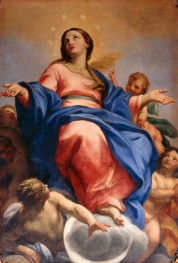
Maratta canvas print: one work in museum quality, made to order in the size you choose, with optional framing.
Carlo Maratta (1625-1713), also called Maratti, was the leading painter in Rome during the second half of the 17th century, a master of altarpieces, frescoes and portraits who joined the measured classicism of Raphael and the Carracci to the light and movement of the Roman Baroque. Popes, cardinals, kings and English travelers on the Grand Tour sought his work, and in old age he presided over Roman art much as Bernini had before him.
He came from Camerano, near Ancona in the Marche, then part of the Papal States. According to the Italian tradition his family had roots in Dalmatia and had crossed the Adriatic to escape Ottoman rule. The boy's drawings caught the eye of the painter Andrea Camassei, who urged that he be sent to Rome. In 1636 he made the journey with a family friend, the cleric Corintio Benicampi. In Rome his half-brother Bernabeo Francioni, a painter of little success, took him in and in 1637 brought him to the workshop of Andrea Sacchi. Maratta stayed with Sacchi for many years and became close to him. Like every Roman apprentice he copied ancient statues and the great paintings of the Renaissance and the generation of Annibale Carracci, Guido Reni and Guercino. Sacchi's studio was also a meeting place where leading artists drew from the model and argued about painting. Sacchi held that a picture should tell its story with only a few figures, a principle his pupil kept for life.
The earliest painting by Maratta that survives is a Glory of Saints of 1645 for the cathedral of Monterotondo, ordered by Taddeo Barberini, a nephew of Pope Urban VIII. In 1648 he painted a fresco of Constantine ordering the destruction of pagan idols in the Lateran Baptistery after Sacchi's designs. Around this time he spent a period in Ancona, perhaps to gain some distance from his master and his brother, and there he studied the altarpieces of Titian and Guercino. The effect showed in his first independent public commission in Rome, the Adoration of the Shepherds of 1650 for San Giuseppe dei Falegnami. Its Virgin, with large eyes and an oval face framed by dark hair, is typical of his early figures.
From then on official commissions came without interruption. Between 1651 and 1656 he decorated the Alaleona Chapel in Sant'Isidoro with altarpieces and frescoes of the life of Saint Joseph, a project that made his reputation and began his friendship with the scholar Giovanni Pietro Bellori, later his biographer. For the French collector Louis Phélypeaux de La Vrillière he painted a scene of the Emperor Augustus closing the Temple of Janus (Lille), measuring himself against Reni, Guercino, Poussin and Pietro da Cortona, who had all supplied pictures for the same Paris gallery. After Alexander VII Chigi became pope in 1655, Maratta's career gained pace. For him he painted the Visitation of 1656 in Santa Maria della Pace, and he worked under Cortona on the gallery of the Quirinal Palace, where he first used the pale, clear colors of his later manner. The pope, a Sienese, also ordered two altarpieces for the Chigi Chapel in Siena Cathedral.
In the early 1660s Maratta painted an Immaculate Conception for another chapel in Sant'Isidoro, part of a scheme directed by Bernini. The Virgin holds the Christ Child, who helps her crush the serpent of heresy; through copies and engravings the image spread across Catholic Europe. In 1664 he became head of the Accademia di San Luca and pressed young artists to draw from ancient art. His many images of the Virgin earned him the nickname Carluccio delle Madonne, "little Carlo of the Madonnas" - critics meant it as mockery, admirers as praise for how well he handled the theme.
The ceiling he frescoed in 1674 in the Palazzo Altieri for Pope Clement X shows the personified Clemency, a play on the pope's name, following a program written by Bellori. At that very moment Giovanni Battista Gaulli was covering the nave of the nearby Gesù with figures that seem to burst out of the frame; Maratta kept his scene within its borders and used few figures. For the Gesù itself he painted the Death of Saint Francis Xavier. For Louis XIV he completed Apollo and Daphne in 1681 (Brussels), one of the most admired pictures of its day, to which Bellori devoted a whole pamphlet; it brought Maratta the title of painter to the French king.
He was much in demand as a portraitist. His Andrea Sacchi of about 1655 (Prado) is plain and concentrated; his Pope Clement IX of 1669 (Vatican) recalls Raphael, Titian and Velázquez. Many Englishmen sat to him in Rome - as early as 1645 he had sketched antiquities for John Evelyn - and Sir Robert Walpole later collected his work.
Around 1679 or 1680 his mistress, Francesca Gommi, bore him a daughter, Faustina. He recognized her legally in 1698, and after his wife died in 1700 he married Faustina's mother. Faustina's face appears in several late paintings, among them Cleopatra Dissolving the Pearl of about 1692 (Palazzo Venezia, Rome). She became a respected poet, married the poet Giambattista Felice Zappi and joined the Academy of Arcadia. Maratta retired with her to Genzano, near Rome, into a small palace he had designed himself; in 1703 the local lord, Giangiorgio Sforza Cesarini, whose advances she had refused, attacked her and tried to abduct her, and the painter moved back to Rome for good.
As commissions grew scarce around 1700, he turned increasingly to restoration, working on Raphael's frescoes in the Villa Farnesina and Annibale Carracci's gallery in the Palazzo Farnese. In 1702 he was named superintendent of Rome's antiquities, and Clement XI had him restore the Raphael Rooms in the Vatican. Elected head of the Accademia again in 1700, he was confirmed for life in 1706, an honor no one had received before. The same pope knighted him in 1704. He designed sculpture as well: the tomb of Innocent XI in Saint Peter's, carved by Pierre-Étienne Monnot, the colossal Apostles for the Lateran, and his own funerary monument in Santa Maria degli Angeli. His self-portrait of after 1695 (Brussels) shows him younger than he was, while a figure of Painting writes his name on Minerva's shield. One of his last works is the Baptism of 1710 for the Certosa di San Martino in Naples. When he could no longer paint, he still ran his studio.
Maratta died in Rome in 1713 at 88; members of the Accademia carried his coffin to Santa Maria degli Angeli. In his will he arranged for the relics of the martyr Saint Faustina to be taken to Camerano, in memory of his daughter. Bellori had already judged him the only living artist worthy of a place in his Lives of 1672, and Anton Raphael Mengs later wrote that Maratta had kept Roman painting from the decline seen elsewhere. Through his many pupils his style shaped Italian art well into the 18th century, before Neoclassical critics dismissed it; only in the 20th century was he studied seriously again. In 2024 an electrician working in the Villa Farnesina uncovered frescoes by him from the late 17th century, hidden for nearly two hundred years and still in excellent condition.