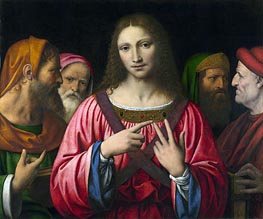
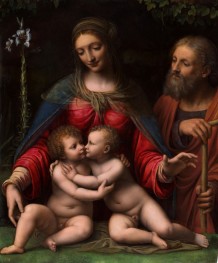
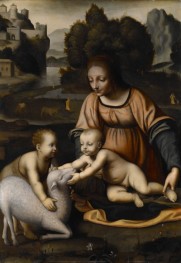
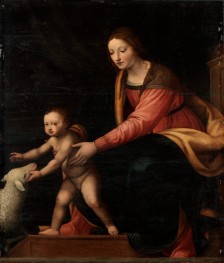
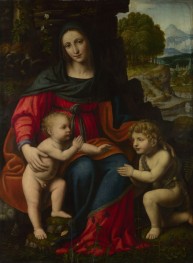
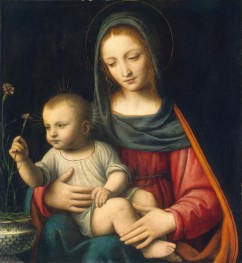
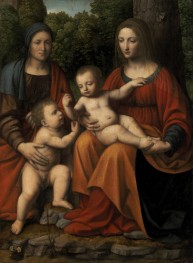
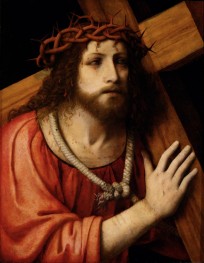
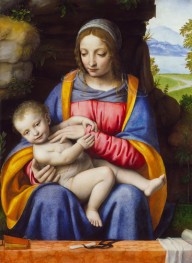
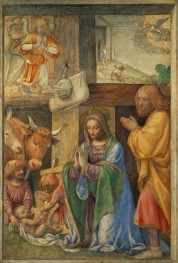
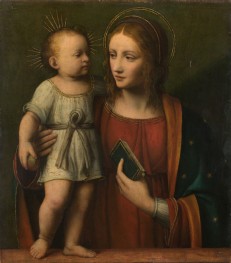
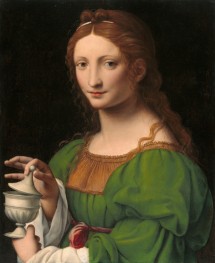
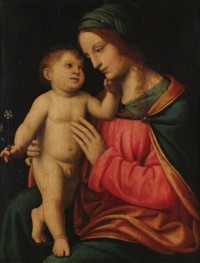
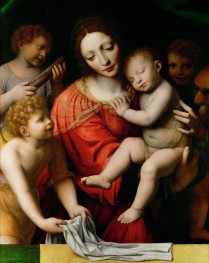
Look closely at a Madonna whose eyes are drawn long and faintly lowered, whose smile withholds more than it offers, and you may not be looking at Leonardo at all, but at the painter who understood him best. Bernardino Luini (c. 1480/82 - June 1532) was a Lombard artist of the Italian High Renaissance, born Bernardino de Scapis at Runo, a hamlet in the commune of Dumenza, in the hills above Lake Maggiore. Generations of collectors acquired his panels as Leonardos. That confusion is at once his misfortune and the surest measure of his gift.
Of the life itself, remarkably little survives. Archives are thin, contracts scattered, and the biography must be reconstructed largely from walls and panels. In 1500 he arrived in Milan with his father, entering a city still absorbing the shock of Leonardo's decade at the Sforza court. Among the Leonardeschi - the Milanese painters who gathered in that wake, Giovanni Antonio Boltraffio among them - he would become the most widely loved. Lomazzo, writing later, named Giovan Stefano Scotto as his teacher; other accounts place him with Ambrogio Bergognone, whose sober Lombard piety left a trace on him. Between 1504 and 1507 he appears to have worked in Treviso, where a Madonna with Child carries the signature Bernardinus Mediolanensis faciebat, an attribution still contested.
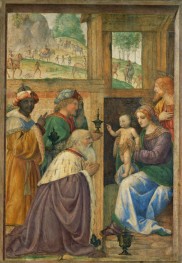
The earliest surviving frescoes take him back to the lakes. An Adoration of the Magi in San Pietro at Luino, painted around 1505, shows a young artist already equal to buon fresco and its unforgiving pace, while a fresco of Saint Gerard in the presbytery of Monza Cathedral has long been given to his hand. Provincial in setting, ambitious in intent - both works declare a painter who expected to be seen.
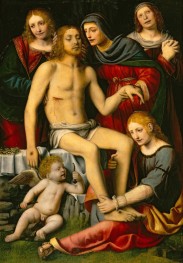
Returning to Milan in 1509, he took on a polyptych of which a single panel now remains: the Saint Anthony of Padua in the Museo Poldi Pezzoli, a figure whose weighty stillness owes something to Bernardino Zenale's polyptych at Cantù. The decade that followed was industrious. Frescoes went up in the Oratory of Santa Maria Nuova at Pilastrello; a Lamentation over the Dead Christ was painted for Santa Maria della Passione; at the Abbey of Chiaravalle he left the Madonna della Buonanotte, so named for its place beside the stair the monks climbed to their dormitory. San Giorgio al Palazzo received his frescoes in 1516, the Certosa di Pavia not long after.
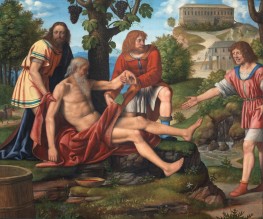
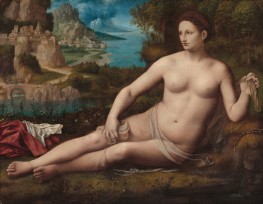
Between 1509 and 1514 came the cycle for the Villa Pelucca at Sesto San Giovanni, detached long ago and now among the holdings of the Pinacoteca di Brera in Milan. Girolamo Rabia, the patron behind that undertaking, also set him to mythological subjects for the Palazzo Rabia; those scenes are today divided between the Gemäldegalerie in Berlin and the National Gallery of Art in Washington, D.C. Secular work of this kind gave him room to loosen. Nymphs and pagan fables asked a different register from altarpieces, and he supplied it without strain.
In 1521 he travelled to Rome. What he found there - Raphael above all - altered his sense of composition, and the change registers in the Pelucca frescoes carried out between 1520 and 1523, as in related works now at the Brera. Figures grow more monumental, groupings more rhetorical. Two years later he produced the polyptych for the Basilica of San Magno at Legnano: an enthroned Madonna and Child ringed by angels with musical instruments, surmounted by God the Father.
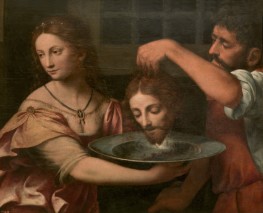
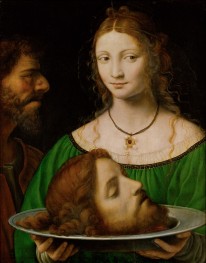
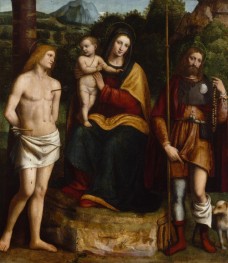
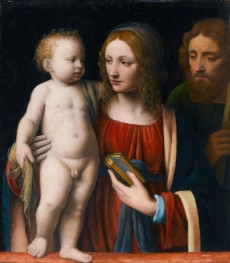
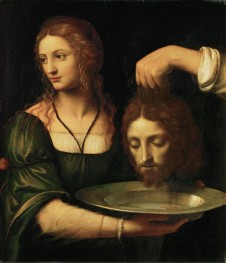
Around 1525 he began the frescoes on the lives of the Virgin and Christ at the sanctuary of Santa Maria dei Miracoli in Saronno, a commission that would call him back years later; the counterfaçade of Sant'Abbondio in Como was painted in the same year. Local tradition holds that amaretto was born of his stay at Saronno, a legend that has proved more durable than most documents. From these middle years come a Holy Family in the Museo del Prado, two versions of Salome now in the Museum of Fine Arts, Boston, and the Uffizi, a Portrait of a Lady in Washington, and a Virgin with Child and Saints of 1526 in the Lee of Fareham collection at Richmond.
Lugano gave him his great public statement. In 1529, across the wall of Santa Maria degli Angeli, he set out a Passion and Crucifixion of enormous scale, a crowded field of soldiers, mourners and horses held together by an architecture of crosses. Nothing else in his output is so ambitious. He returned to Saronno in 1531 to add further frescoes, and in his final years the pull of Leonardo grew stronger rather than weaker: the Saint Anne in the Pinacoteca Ambrosiana and the Saint Catherine in the Hermitage are saturated with sfumato, their contours dissolving into shadow. He died in Milan in 1532. His son Aurelio became a painter of standing in his own right.
Posterity has treated him strangely. Vladimir Nabokov coined the adjective Luinesque for those long-lidded, faintly amused faces, and the word survives as a compliment paid to an artist most readers have never seen credited. He has been described as absorbing from Leonardo only as much as his provincial formation permitted him to grasp - a judgement that sounds like faint praise until one notices how much it concedes. The argument continues. Matthew Landrus has proposed that the Salvator Mundi is largely the work of Leonardo's assistants, with Luini as its principal executant and the master responsible for only a small fraction of the surface.
Perhaps the reticence was the point. Where Leonardo probed and dissected, Luini consoled; his saints keep their composure, his Madonnas their privacy. That quality won him admirers for centuries and has made him easy to underrate since. Yet the frescoes at Saronno and Lugano still draw visitors who came for Leonardo and stayed for something quieter. In an age impatient for the singular genius, Bernardino Luini offers a corrective: a reminder that the Renaissance was built as much by fine, patient, unfashionable hands as by the few names we have agreed to remember.