Ordering a Giclée Print for a Frame You Already Own
 TopArtPrint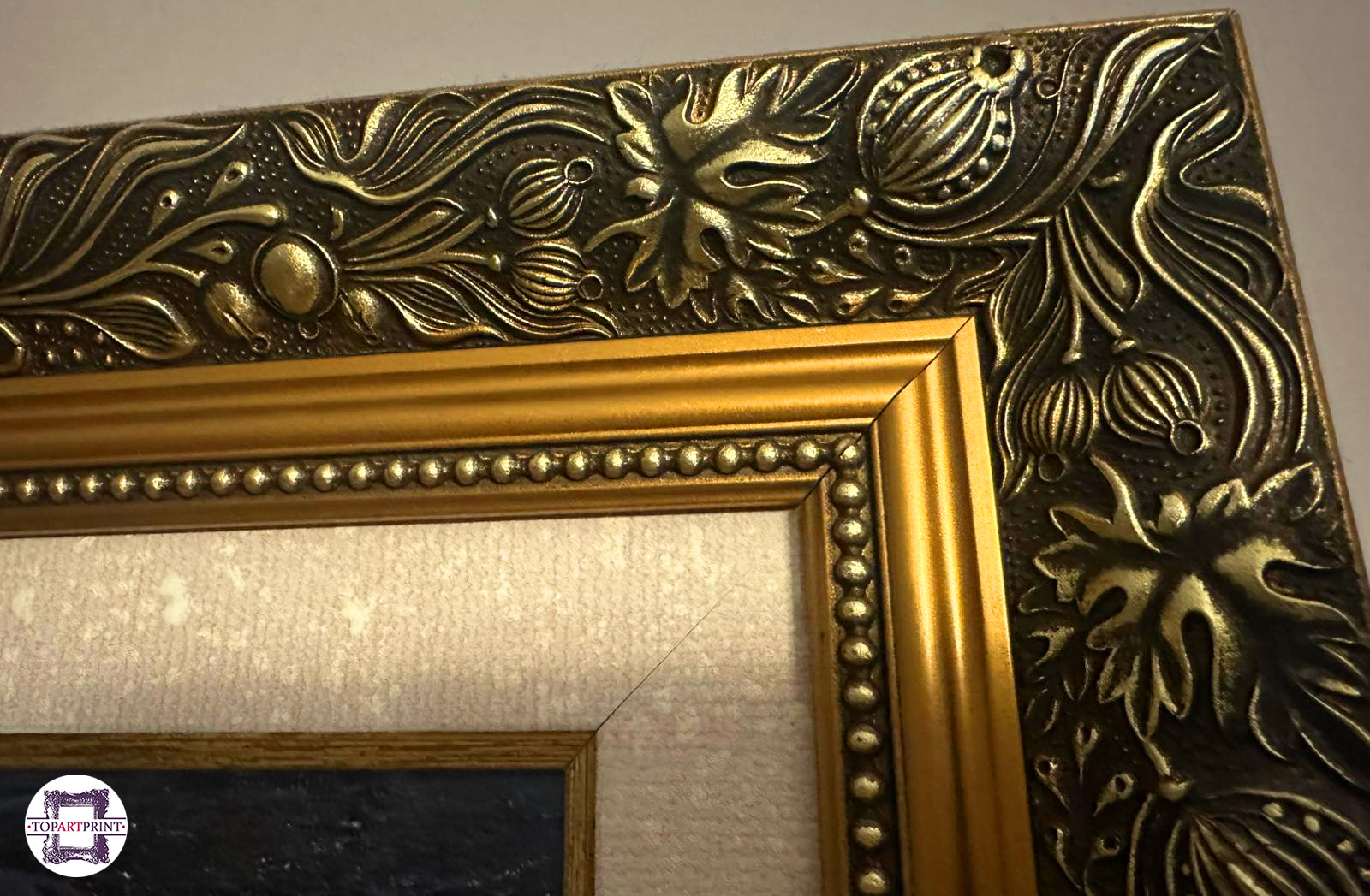
You already have the frame. Here's how to get the right print inside it.
It happens more often than you might think. A print has faded - the colours dimmed, the surface yellowed, the image ghostly compared to what it once was - but the frame around it is beautiful, and you're not ready to let it go. Or you've come across a magnificent old frame at an antique dealer, heavy in the hand, with the kind of carved moulding that no one makes economically anymore, and you're wondering: can I put a new print in this? Perhaps you've inherited a frame - Italian, gilded, slightly battered at the corners - and you want to give it a purpose again with a different artwork altogether.
The answer, in every case, is yes. And it's a rather satisfying way to display art: a museum-quality giclée reproduction, printed to your specifications, presented in a frame you already love. The marriage of new image and existing frame has a long and perfectly respectable history - frames have always outlived the works they held, and have been repurposed for centuries.
But there are things you need to get right. The measurements must be precise. The relationship between canvas and glass must be understood. And the proportions of the artwork and the frame must be compatible. None of this is complicated, but all of it matters.
The Anatomy of a Framed Work
It helps to understand what you're actually assembling. A framed piece of art — whether hanging in the Uffizi or above your sofa — is an ensemble of two principal components: the picture frame itself, which is the decorative outer structure, and the stretcher, which is the rigid inner support that carries the artwork. The stretcher sits inside the frame's rebate — the recessed ledge running along the inner edge — and that joint is where the two parts meet.
For a canvas print, the stretcher is a wooden construction, typically four slats joined at 45-degree mitred corners, over which the canvas is pulled taut and stapled on the reverse. The whole assembly then drops into the picture frame and is secured from behind.
For a print on paper — a reproduction of a Degas pastel, say, or a Dürer engraving — the principle is the same. The paper is mounted onto a rigid backing: thick pressed cardboard or a wooden panel that serves precisely the same structural role as a canvas stretcher. It sits in the rebate in exactly the same way. The only material difference is that paper requires protection — a sheet of glass or plexiglass placed between the frame and the artwork surface. Canvas does not.
So whether you're working with canvas or paper, the underlying architecture is identical: a rigid support that fits inside a decorative frame. And the measuring process is the same for both.
Why Canvas and Glass Don't Belong Together
This is the single most common misunderstanding we encounter, so let's be clear about it.
If your frame currently holds glass and you're ordering a canvas print, the glass comes out. Canvas is meant to be seen uncovered. This isn't a shortcut or an economy — it is the correct way to present artwork on canvas, and it has been the standard in galleries and museums for as long as canvas has been used as a painting surface. The weave of the fabric, the subtle texture of the printed or painted surface, the way light interacts with the material without the interference of a reflective barrier — these are qualities that glass destroys.
Paper is a different matter entirely. A reproduction of a watercolour, a pastel, a drawing, or an etching needs that protective layer. Dust, moisture, an accidental touch — paper is vulnerable in ways that canvas is not.
So: glass out for canvas, glass in for paper. If you're removing glass from a frame to accommodate a canvas print, store it carefully. You may want it again someday for a work on paper.
How to Measure Your Frame
This is where most mistakes happen, and where a little care saves a great deal of frustration.
The stretcher — whether for canvas or a mounted paper print — must fit snugly into the frame's rebate. Too large by a millimetre and it won't go in. Too small and it shifts, rattles, and eventually damages the frame or the print. Precision matters here in a way that it rarely does in domestic life.
Here is what you need to do:
Turn the frame face-down. You are measuring from the back — not the visible image area from the front, and not the outer dimensions of the frame. What you need is the inner dimensions of the rebate: the rectangular opening into which the stretcher will sit.
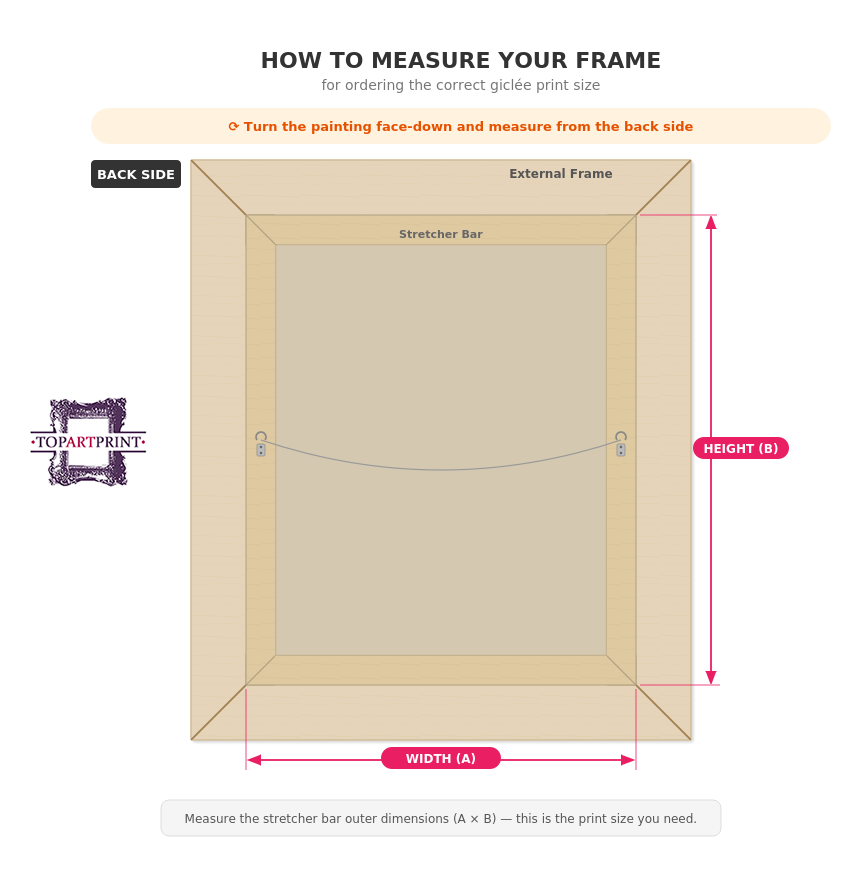
Measure width and height each in two places — top and bottom, left and right — to check whether the frame is true. Old frames, especially wooden ones, can warp subtly over decades. If you find a discrepancy, use the smaller measurement.
Use a rigid tool: a metal ruler or a taut tape measure. Be precise to the nearest millimetre. This is one of those situations where "roughly 76 centimetres" is not good enough.
A Word About Proportions
Here is something that catches people off guard: your frame's opening must have roughly the same proportions as the painting you want to reproduce.
Every painting has a specific aspect ratio — the relationship between its width and height. Rembrandt's The Night Watch is nearly square. Monet's Water Lilies murals are emphatically horizontal. El Greco's saints are tall and narrow. These proportions are not incidental to the composition — they are part of it. A horizontally composed landscape cannot be forced into a vertical frame without cropping away large portions of the image, and cropping is never as innocent as it sounds. It doesn't merely trim a strip of sky or a margin of foreground. It can shift the balance of the entire composition, alter the relationship between figures, remove elements the artist placed deliberately, and in severe cases produce something that barely resembles the original.
Before you order, compare the proportions of your frame opening with those of the artwork. They don't need to be identical — small adjustments are usually imperceptible — but they should be in the same neighbourhood. A 76 × 61 cm frame (a 5:4 ratio) pairs comfortably with paintings of similar proportions, but not with one that is nearly square or dramatically elongated.
If you're uncertain, write to us with your frame dimensions and the artwork you have in mind. We'll tell you whether the fit works — and if cropping would be required, we can prepare a side-by-side visual comparison: the original composition next to the cropped version, so you can judge the difference with your own eyes before committing. You approve what you'll receive. No surprises.
Ordering the Right Size
One practical detail that needs explaining: the resize tool on our website scales artwork proportionally. It preserves the original aspect ratio of the painting, which means you cannot enter arbitrary width and height values that diverge from the painting's own proportions. This is deliberate — non-proportional scaling would distort the image.
In practice, this means that if your frame's proportions differ slightly from those of the original painting, the print you order will end up a bit larger than your stretcher in one direction. This is not a problem. It is, in fact, exactly the right approach.
Think of it this way. Suppose your stretcher opening is 46 × 55 cm, and the painting you've chosen is slightly more elongated. When you resize on our website, the rule is simple: neither dimension should be smaller than your stretcher. If setting the height to 55 cm gives you a width of only 43 cm, that's too narrow — your stretcher would have exposed, unpainted canvas on the sides. Instead, set the width to 46 cm (matching your stretcher), which might produce a height of 59 cm. Now both dimensions meet or exceed what you need.
Two Ways to Order
Order the print rolled, and have it stretched locally. Following the sizing logic above, order the nearest proportional size where no dimension falls short of your stretcher. We print the canvas, apply a UV-protective varnish, and ship it rolled in a sturdy tube. Your local framing shop stretches it onto a stretcher bar cut to your exact dimensions and mounts it into your frame. This tends to be the best route for larger prints, or if you have a framer you trust.
Contact us for a custom order, stretched and ready to mount. Because our website's resize tool works only proportionally, it can't always produce the exact dimensions your stretcher requires. In this case, write to us with your stretcher measurements and the artwork you'd like. We'll create a custom ordering link built for your specific requirements — precise dimensions, correct stretcher, ready to drop into your frame when it arrives. No framing shop needed.
Either way, the outcome is the same: a museum-quality giclée print, stretched on a solid wooden stretcher, sitting exactly where it belongs — inside the frame you already love.
Before You Order: A Summary
Measure from the back of the frame — the inner rebate dimensions, not the front opening or the outer frame size. Measure twice, in two places for each direction, to catch any warping. Remove the glass for a canvas print and store it; keep it for paper. Check that your frame's proportions are compatible with the painting you want — and if in doubt, ask us for a visual comparison. Choose whether you'd like the print rolled or pre-stretched, and place your order accordingly.
And if anything is unclear — the dimensions, the proportions, the right option for your situation — contact us. We've been doing this for over thirty years, and we'd rather spend five minutes answering your questions than have you receive something that doesn't fit.