Jacques-Louis David Didn’t Start Roman — He Became Roman
 TopArtPrint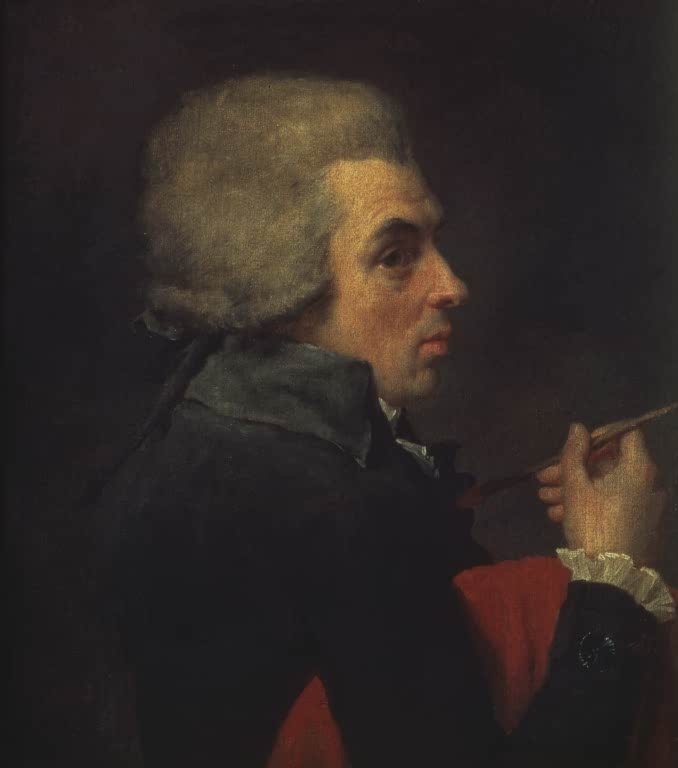
We’re used to the statue-still Jacques-Louis David: togas, straight spines, gestures you could set a metronome to. Actually, no – that’s not where he begins. His early work moves in the language of the 18th century, polished and elegant. Antiochus and Stratonice proves the point and wins him the Rome scholarship in 1774. Not destiny. Opportunity.
Italy does the rewiring. Long days with ancient marbles, the freshly uncovered cities (Pompeii and Herculaneum), the shock of stone turning back into people. The drawing tightens; the forms harden into sculpture. For a spell Caravaggio gets under his skin – stronger light, simpler means, a tougher edge. Five years on he returns to Paris with the same hand and a different backbone.
Stagecraft turned statecraft
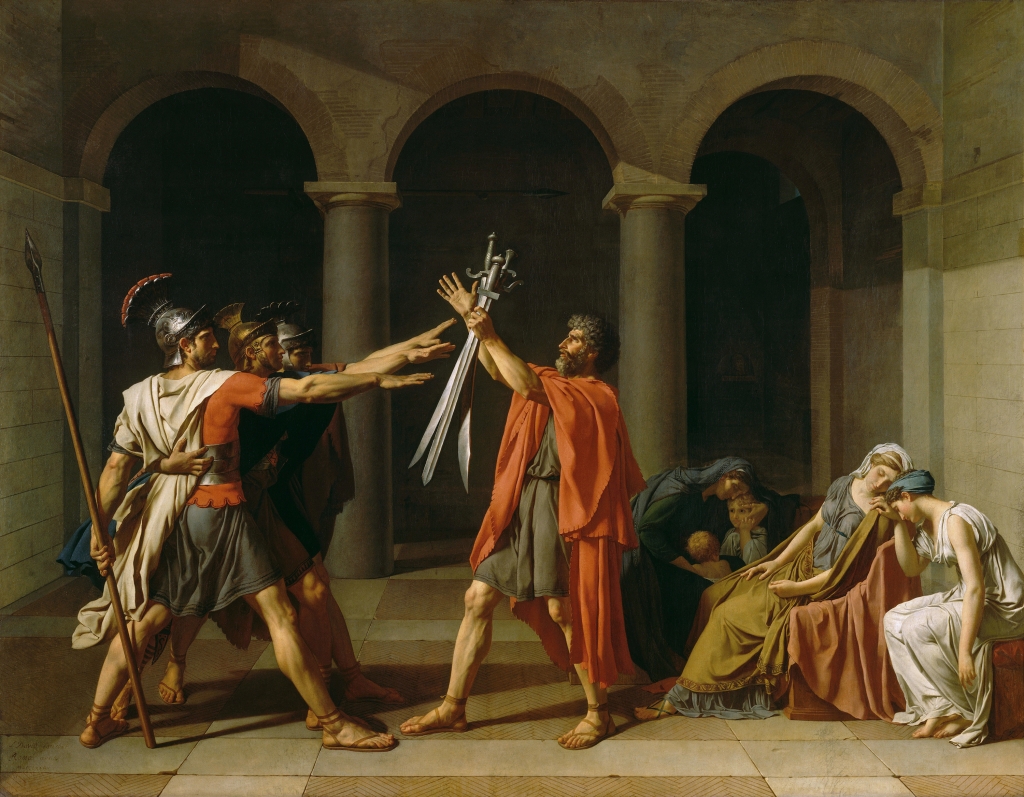
In a Paris theater he watches Corneille’s Horace – Roman duty over blood – and aims past the stage to the source: the oath itself. He heads back to Rome to steep in the real thing and finishes the canvas in 1784, showing it in Paris in 1785. The response isn’t just praise; it’s recognition. People read politics in the paint – discipline, sacrifice, civic virtue – the world they wanted to build, not merely admire.
The Oath of the Horatii behaves like a public monument: beneath dark arches the father raises three swords; the sons advance in profile with raised arms; at the right the women fold into grief. Every neoclassical marker clicks into place – clear, balanced structure; sharp drawing; figures modeled like stone; restrained, sober color; a frankly theatrical setup. It’s big too: 330 × 425 cm, Louvre. The picture doesn’t whisper. It declares.
One line worth keeping: posture is politics here.
Antique stories with present-tense consequences
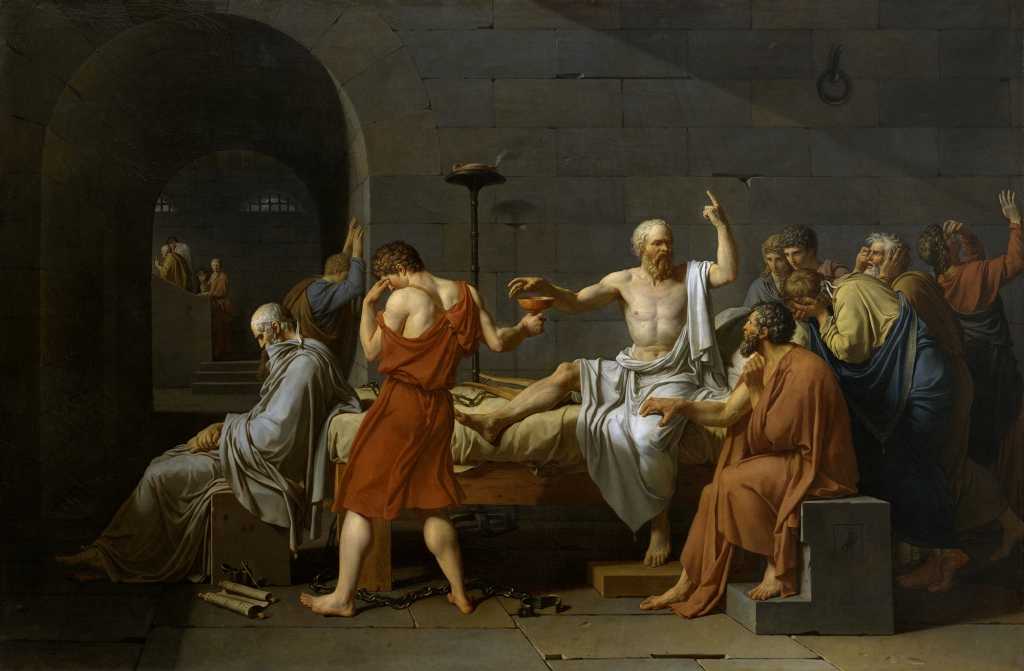
David keeps choosing Rome to speak to Paris. The Death of Socrates (1787, 127.5 × 193 cm, The Metropolitan Museum of Art, New York) stages philosophy as action – in the dim cell the cup is offered, Socrates’ lifted hand pulls our eye to what happens next. He even argues in color, setting the red garment of the man with the cup against Socrates’ white toga. Someone at the time called it “perfect.” Don’t know why. Everyone just does.
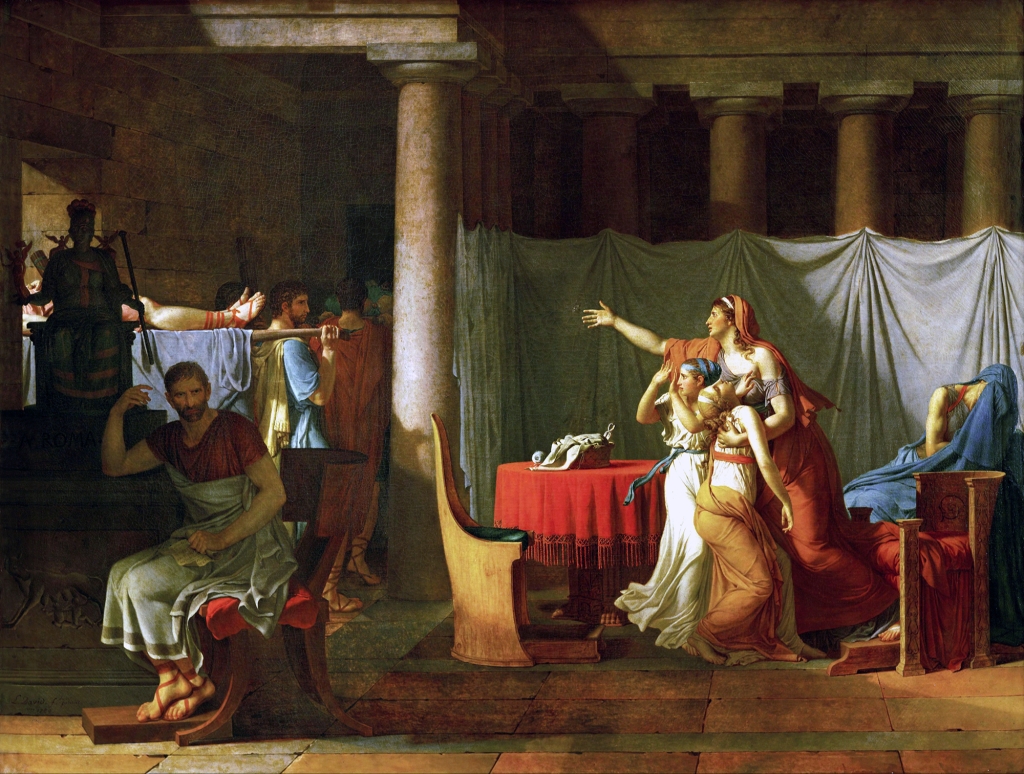
Then the year turns – 1789 – and The Lictors Bring to Brutus the Bodies of His Sons appears. The choice is merciless: Republic over family. In front of a carefully painted gray-blue curtain the women’s grief takes the center; Brutus sits to the side, eyes covered; the lictors carry the bodies in. David gets the Roman household right – furnishings, dress, hair – and oddly nudges revolutionary fashion in Paris. Classicism wasn’t just a look; it became a posture people wore on the street.
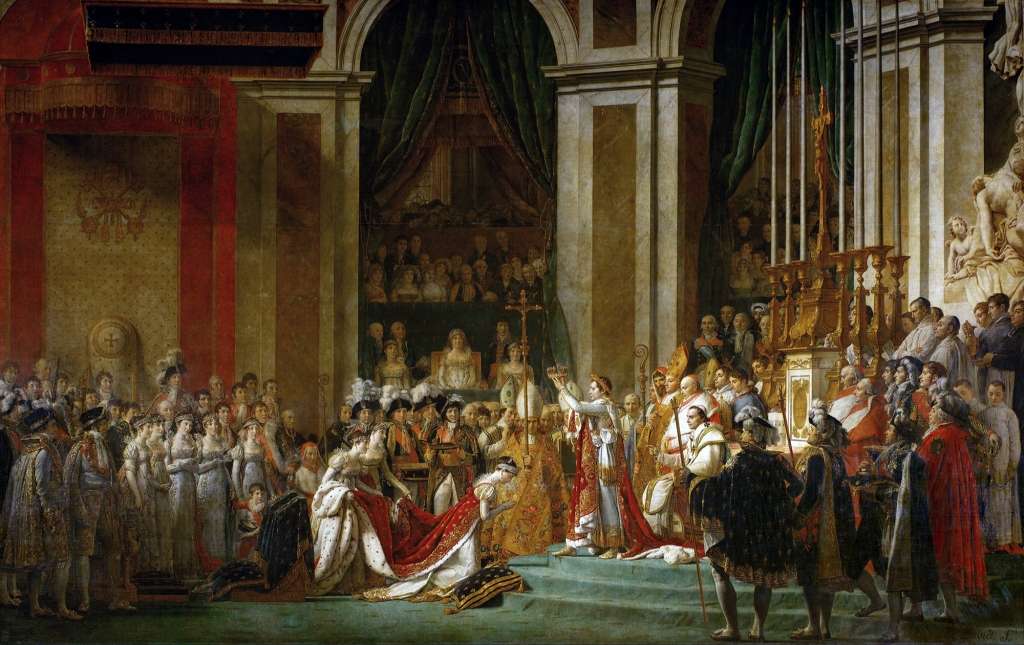
He doesn’t stay a spectator. David joins the Convention, sides with the Jacobins, lands in prison twice, and narrowly avoids the blade. Later he aligns with Napoleon and scales up. Ceremony replaces austerity; small ensembles give way to crowds. The Coronation of Napoleon (1805–1807) gathers the entire imperial court – theater, yes, but deliberately so.
The realist under the marble
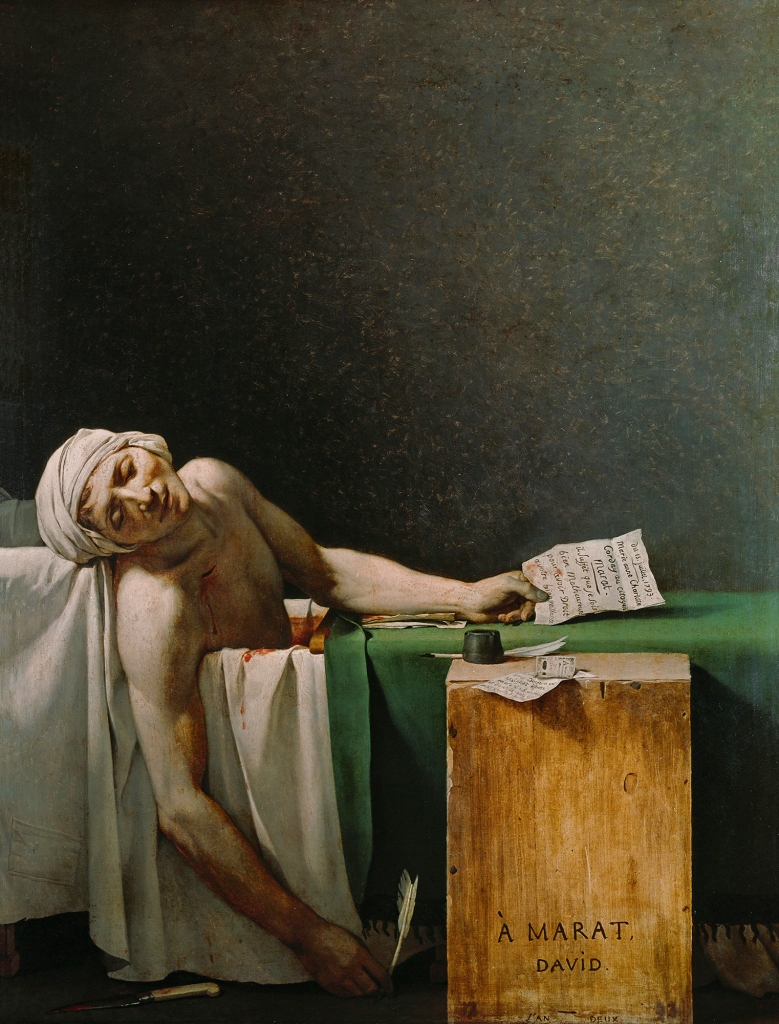
If you only know the togas, you miss the pulse. The Death of Marat (1793, 162 × 125 cm, Royal Museums of Fine Arts of Belgium, Brussels) isn’t a crime tableau so much as a fact made present. David paints Marat as he’d seen him the day before – writing in a bath, a wooden box as desk. The slack body in hard light, blood still visible, and that plain inscription on the box: “À Marat — David.” The means are reduced and strong. It feels startlingly modern.
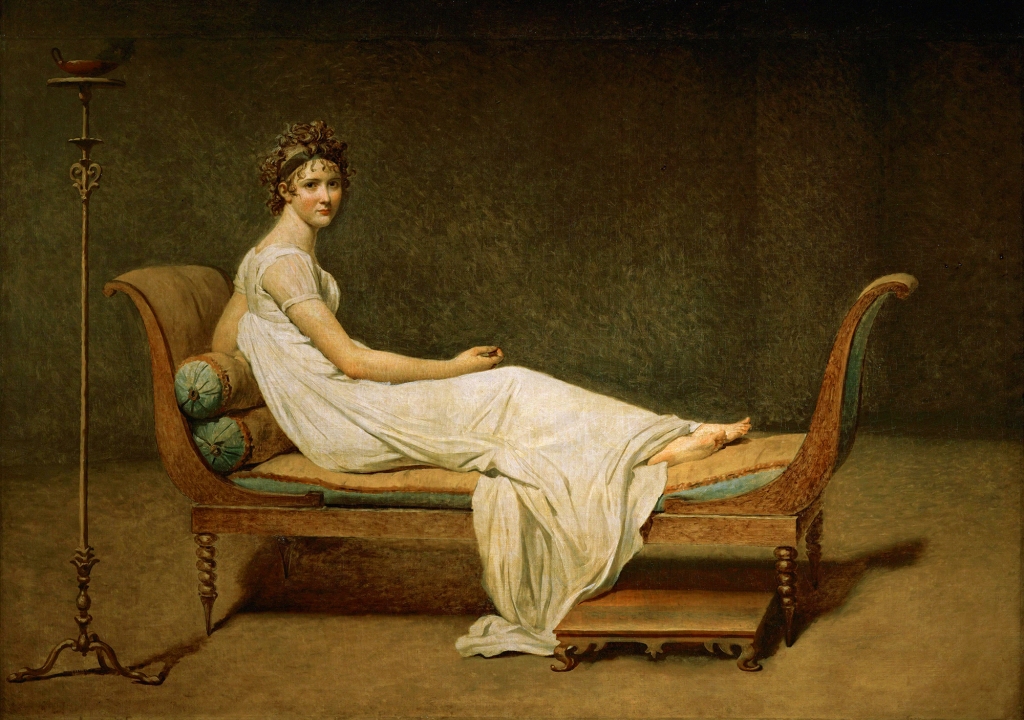
There’s a small Male Portrait (42 × 35 cm, Royal Museum of Fine Arts, Antwerp) that shows another register altogether: a green-brown tonality, broad strokes with air between them, the inner life of an older man caught without ceremony. Nothing like the court portraits. And Madame Récamier (1800, 173 × 243 cm, Louvre) – yes, famously unfinished – sets the celebrated hostess reclining in a loose, light gown, head tilted with casual grace. The yellows, browns, grays, blues, and whites melt into a calm, lucid surface. Different music, same composer.
Here’s the contradiction we respect: David codifies a style and then steps past it when life asks. The realist was always there; the antique frame made him legible.
Why it still lands
These pictures crystallize choices. Oath or family. Principle or comfort. Ceremony or conviction. Even the handling of paint behaves like character – hard contours in The Oath of the Horatii read as discipline; the broad, quiet planes in The Death of Marat read as grief; the red-and-white opposition in The Death of Socrates reads as argument.
Actually – one more thing. People sometimes wonder how a “cold,” carefully planned art shook an audience. Scale and staging matter, but timing matters more. In 1785 The Oath of the Horatii didn’t only look Roman; it modeled the virtues Parisians hoped to rehearse. Viewers saw themselves, sharpened.
The harder question: virtue with a blade attached
We like David for the clean lines and the Roman resolve. But the life behind those edges is messy. He didn’t just paint the Revolution; he served it. He voted for the king’s death, sat with the Jacobins, and took a seat on the Committee of General Security — the body that sorted dossiers, reviewed lists of “suspects,” and decided who would be sent to the Revolutionary Tribunal. In practice that meant choosing who might live and who might meet the machine. Posture, again, as politics — only this time off the canvas.
Actually — hold that thought. Before the Terror hardens, David is also the master of pageantry. He designs the Republic’s vast civic spectacles: the pantheonization of Voltaire, the Festival of the One and Indivisible Republic, and finally the Festival of the Supreme Being. A man-made mountain goes up on the Champ de Mars; choreography, choirs, costumes — he draws the blueprint and Paris marches through it. It’s theatre as statecraft, the same precision we admire in The Oath of the Horatii turned outward into real time.
Here’s the uncomfortable symmetry we can’t unsee after decades of looking: the severe clarity of his pictures — duty raised like a sword in The Oath of the Horatii, law over blood in Brutus — presses into his civic life. He helps shape the new moral grammar, then helps enforce it. When he paints The Death of Marat, it isn’t just grief; it’s canon-making. The Convention needed martyrs, and David could mint them in oil (the painting was requested as part of building a revolutionary pantheon of heroes). He knew exactly what a halo looked like and how to make one without paint that said “halo.”
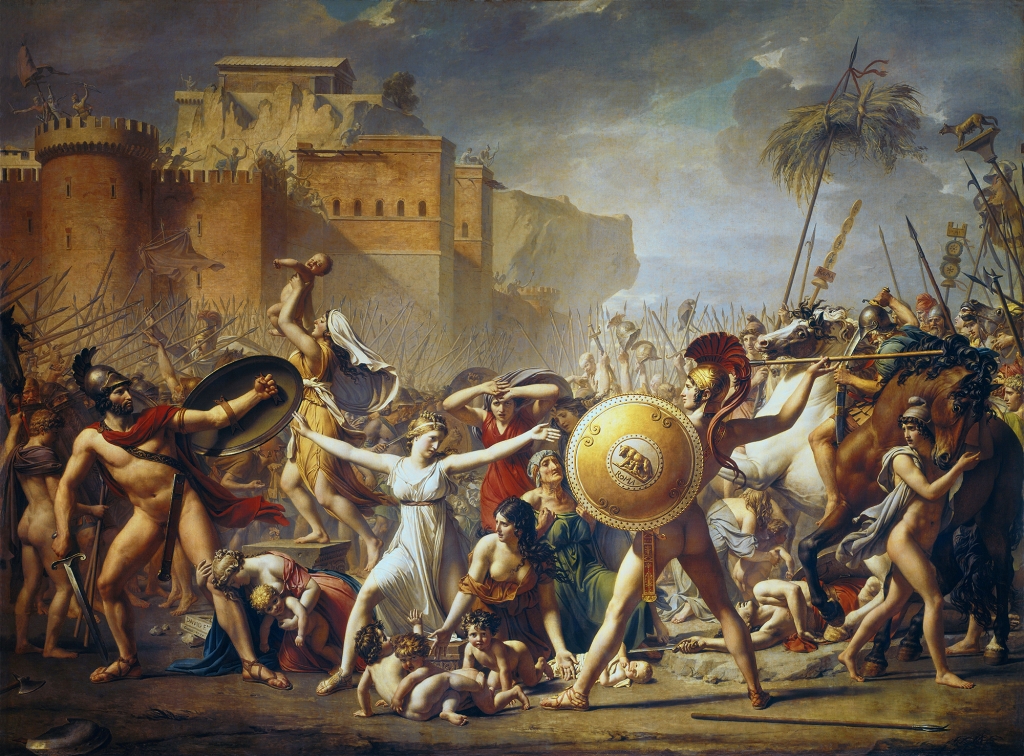
A few facts scrape against the marble shine and make him more human. The face we know from self-portraits — set jaw, tense mouth — was shaped by a violent injury from a fencing accident that left a lasting facial defect and a speech impediment. The voice that helped carry orations at the Convention had to work around that scar. Strength and severity weren’t just poses; they were adaptations.
So where does that leave us with the ethics? With friction, not absolution. David’s art argues for virtue disciplined into form; his career shows how quickly “virtue” can become administrative — minutes, warrants, names on paper moving toward a blade. He organized festivals that sacralized the Republic even as the committees he served empowered a justice that became mechanized. If the paintings still feel charged today, it’s because they aren’t merely about Rome or Paris. They’re about the ease with which beauty arranges itself around conviction — and how conviction, once arranged, asks for consequences.
We keep coming back to the same sentence: posture is politics. In David, the line between the studio and the state is a hair’s breadth. And that’s the philosophical rub — his greatest pictures don’t free us from the moral tangle of his life; they make us look at it, steadily, with the lights up.